
A county sled-dog relay board treats Cosmos consistency as only “strong or eventual.” Which order lists the five official Cosmos DB consistency levels from strongest to weakest?
Select an answer to reveal the explanation.
Short Explanation
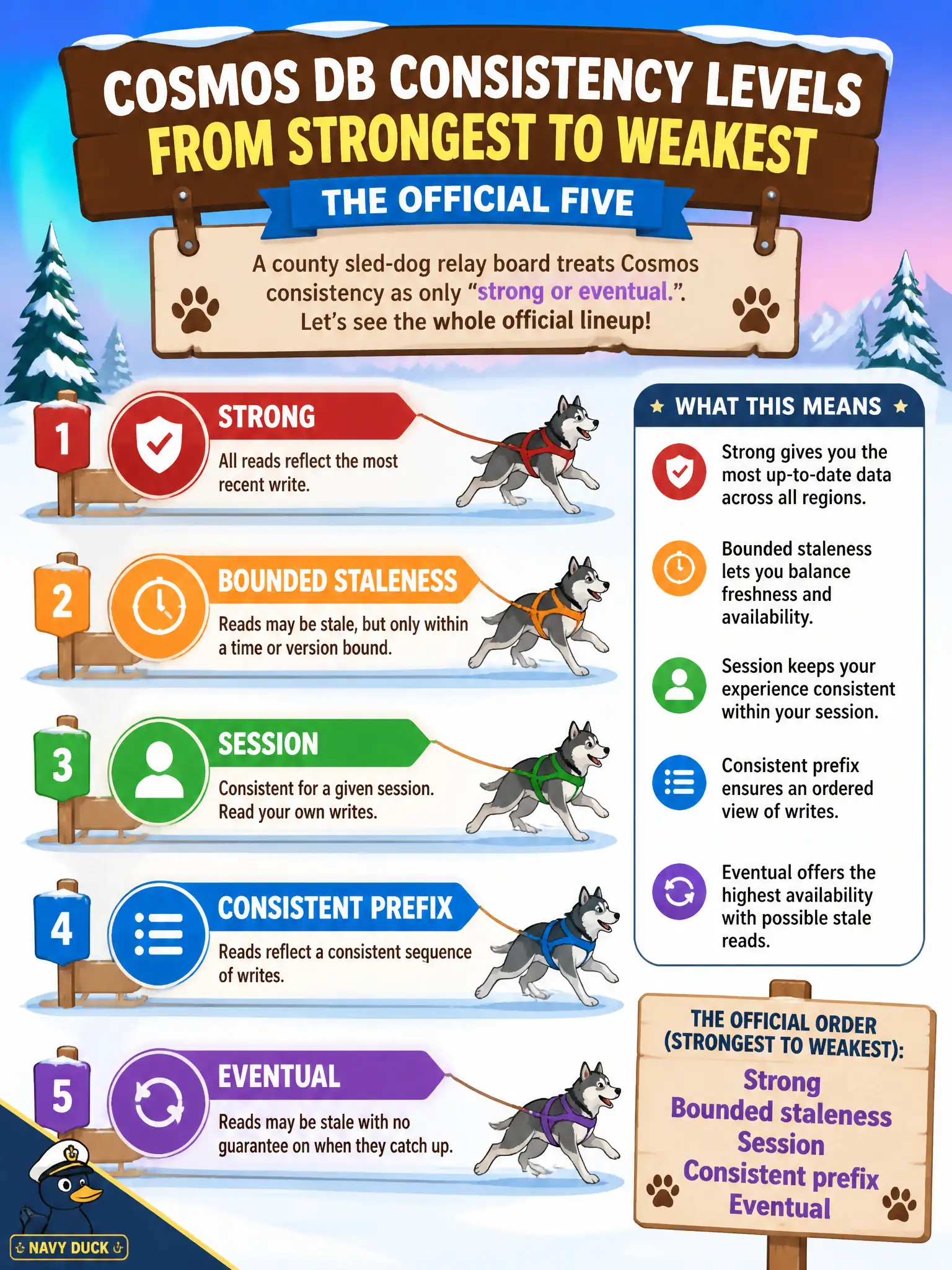
Cosmos does not give you a two-speed bike—it gives you a five-gear ladder. From the top down: Strong, Bounded staleness, Session, Consistent prefix, Eventual. Memorize that stack, not CAP trivia.
Full Explanation
Azure Cosmos DB defines five official consistency levels. From strongest to weakest they are Strong, Bounded staleness, Session, Consistent prefix, and Eventual. Strong offers linearizability for the configured read path. Bounded staleness allows controlled lag limited by K versions or T time. Session provides read-your-writes and write-follows-reads within a client session and is the common interactive default. Consistent prefix preserves order so readers never see later writes without earlier ones from the same transactional batch. Eventual is the weakest guarantee when lag and reordering are acceptable.
Ordering that starts at Eventual and climbs to Strong reverses the official ladder and will fail any recall question that asks strongest-to-weakest. Placing Session ahead of Bounded staleness, or Consistent prefix ahead of Bounded staleness and Session, mixes the middle tiers and no longer matches Microsoft’s documented stack. Candidates often remember Strong and Eventual but scramble the three middle levels; the exam expects the precise middle order.
Exam caveat: Session is frequently the account default for user-facing apps, but “default” is not the same as “strongest.” Memorize the five-level order independently of which level an account happens to use.
Operational check: in the Azure portal or ARM/Bicep, open the Cosmos account’s default consistency setting and confirm the listed level names match Strong → Bounded staleness → Session → Consistent prefix → Eventual so training materials and production config use the same vocabulary.