
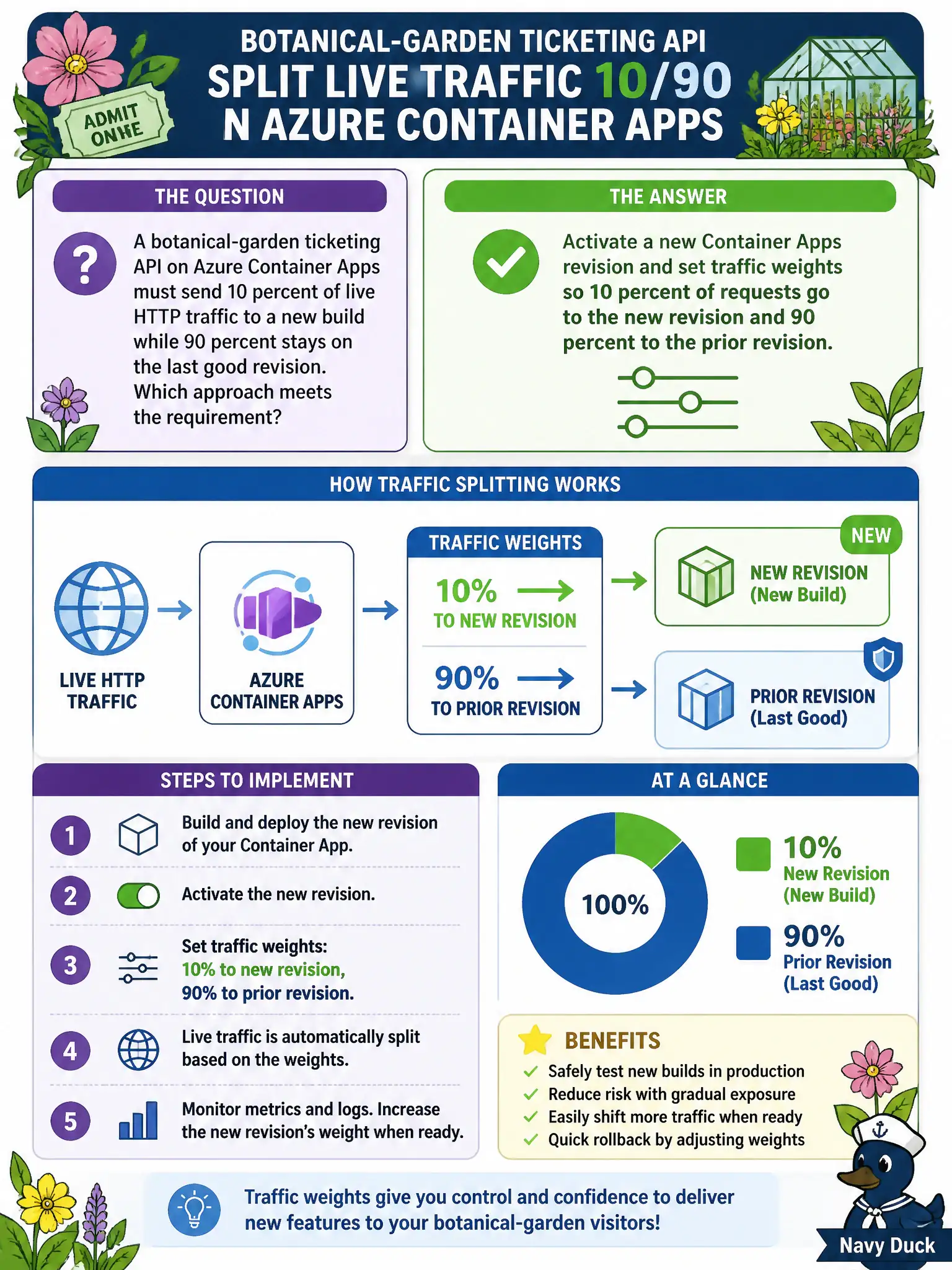
A botanical-garden ticketing API on Azure Container Apps must send 10 percent of live HTTP traffic to a new build while 90 percent stays on the last good revision. Which approach meets the requirement?
Select an answer to reveal the explanation.
Short Explanation
Revisions are like labeled batches of tickets at the garden gate—you can let a few visitors try the new batch while most still use the proven one. Traffic weights on Container Apps revisions give you that split. ACI restarts and App Service slots are different hosts with different knobs.
Full Explanation
Azure Container Apps creates a revision for each versioned deployment snapshot. Multiple revisions can stay active, and you assign HTTP traffic weights across them for canary or blue/green rollouts. For the botanical-garden ticketing API, activating the new revision and setting weights so ten percent of requests hit the new build while ninety percent stay on the last good revision is exactly that control—like sending a few visitors through a trial gate while most still use the proven turnstile.
Restarting a single Azure Container Instance replaces the whole container for every caller; it has no percentage traffic split and is not Container Apps revision routing. Swapping an App Service staging slot is an App Service feature; Container Apps revisions are not “only an ACR tagging feature,” so that option confuses three different products. Deleting the previous revision after each push forces all traffic onto the newest image and removes the ability to keep ninety percent on the prior good revision.
Exam caveat: traffic splitting applies to HTTP ingress traffic across active revisions. Confirm the prior revision remains active and that weights sum to one hundred percent; inactive or deleted revisions cannot receive the ninety-percent share.
Operational check: after activating the new revision, inspect revision traffic percentages in the portal or CLI, send a sample of authenticated requests, and confirm roughly one in ten lands on the new revision label while the rest stay on the previous revision.