
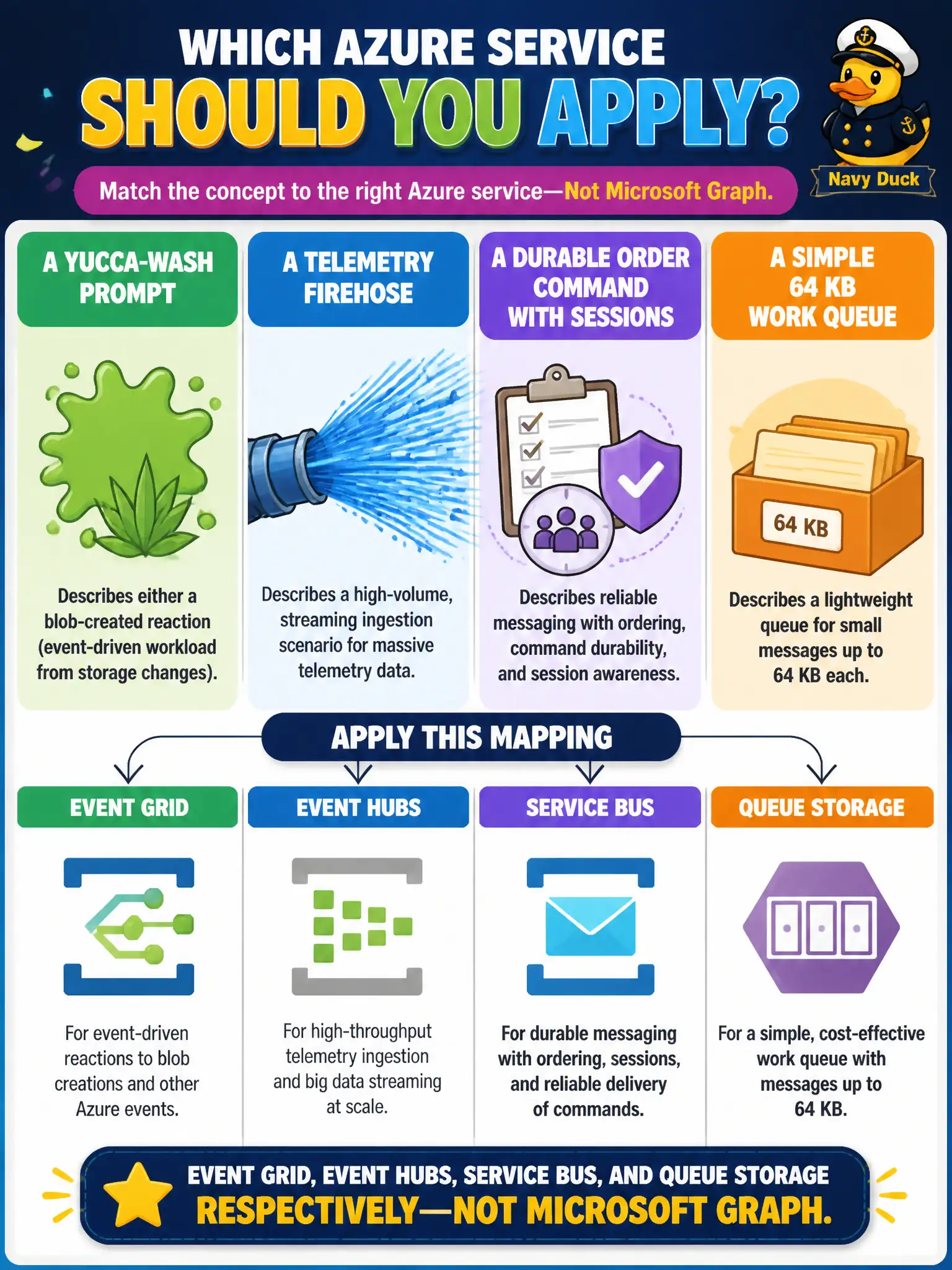
A yucca-wash prompt describes either a blob-created reaction, a telemetry firehose, a durable order command with sessions, or a simple 64 KB work queue. Which mapping should the developer apply?
Select an answer to reveal the explanation.
Short Explanation
Match the story to the bus: blob reaction → Event Grid, firehose → Event Hubs, durable sessioned command → Service Bus, simple small job → Queue Storage. Graph is not in that lineup.
Full Explanation
Yucca-wash scenario mapping for Domain 5 is deliberate: a blob-created or resource reaction maps to Event Grid; a telemetry firehose maps to Event Hubs; a durable order command that needs sessions or a DLQ maps to Service Bus; a simple small work item within queue size limits maps to Queue Storage. Microsoft Graph is not in that messaging quartet—it belongs to Domain 3 collaboration and API scenarios. Correct selection starts from the problem shape, not from habit.
Using Microsoft Graph for all four prompts because messaging is Domain 3 fails because messaging services are Domain 5 and Graph does not replace those brokers. Defaulting to Logic Apps, Notification Hubs, Relay, and Web PubSub as the quartet fails conceptually for this exam framing: those products solve orchestration, push notifications, hybrid connectivity, and websockets—not the four core Domain 5 messaging archetypes tested here. Treating AKS, VMs, Redis, and CDN as interchangeable messaging backplanes fails because compute, cache, and content delivery are not the first-class Event Grid / Event Hubs / Service Bus / Queue Storage answers.
Exam caveat: real systems often compose services (Event Grid trigger → Function → Service Bus command); composition is fine when each hop still matches its lane. Operational check: rewrite each prompt as "event reaction," "stream," "durable command," or "simple queue," pick the matching service, and validate with a one-message smoke test on that service alone.