
A violet-dell processor cannot keep up on a single ordered log in Event Hubs. Why do partitions exist for that workload?
Select an answer to reveal the explanation.
Short Explanation
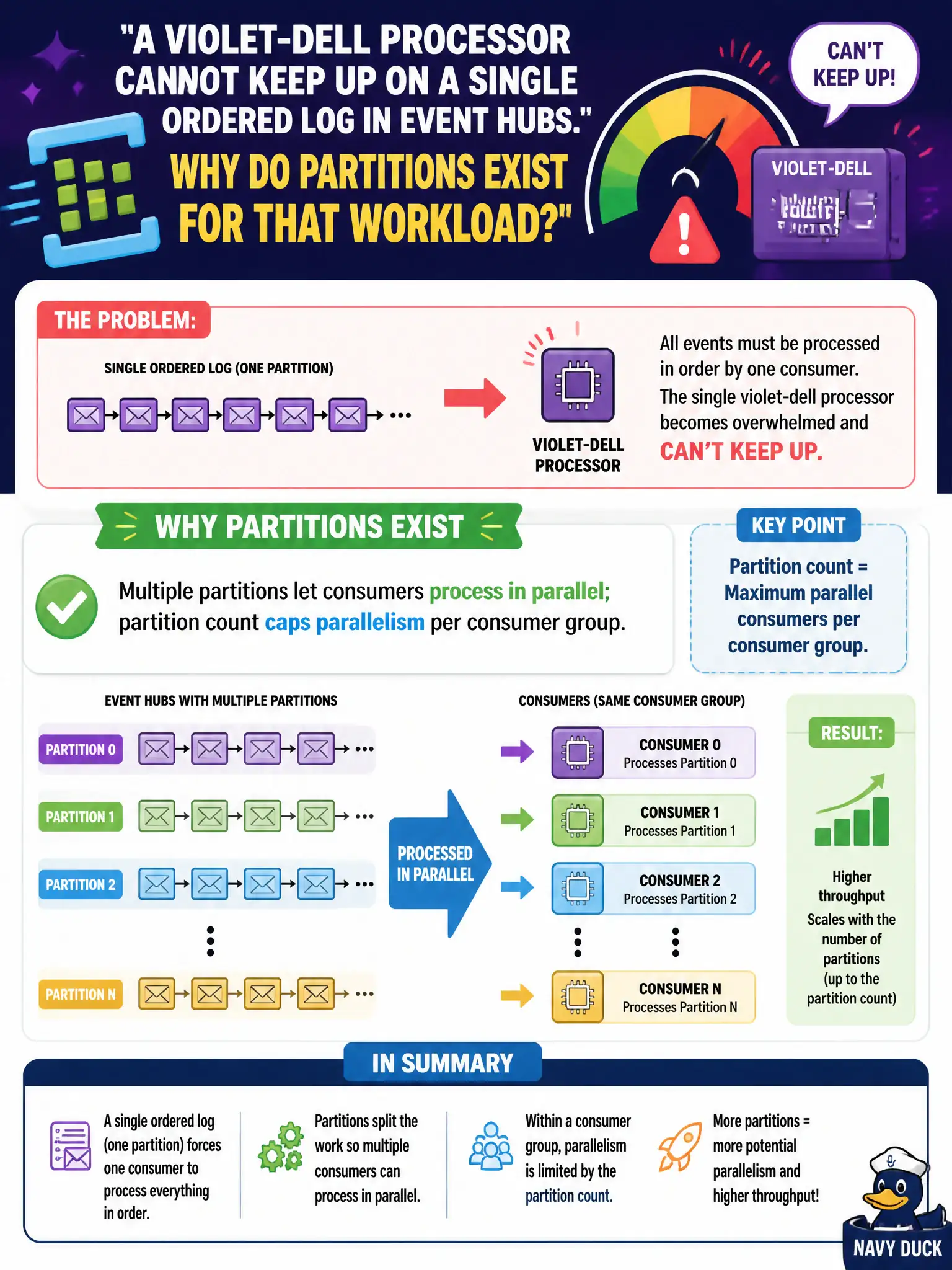
One partition, one ordered pipe. Add partitions so consumers can fan out—your parallelism ceiling per consumer group is that partition count.
Full Explanation
Partitions split an Event Hubs stream into ordered logs that consumers can process in parallel. For a violet-dell processor stuck on a single ordered log, adding partitions raises the parallelism ceiling: within a consumer group, the number of partitions caps how many concurrent readers can each own a slice of the stream.
Partitions only storing ARM templates and never affecting consumers fails factually—partitions are the unit of parallelism and ordering for event data, not an ARM template store.
Claiming more partitions are always free performance with no trade-offs (and citing an AZ-305 capacity exam) fails: partition count is a design trade-off (throughput, ordering granularity, rebalancing), and this is an AZ-204 Event Hubs consumption concept, not “free scale.”
Partitions deleting older events immediately so scale is unnecessary fails because retention—not partition count—controls how long events remain; partitions do not replace retention by instant deletion.
Exam caveat: you generally cannot decrease partition count later on a hub the way you casually scale an App Service plan—choose counts with growth in mind. Operational check: compare throughput with one partition versus several under load, and confirm consumer-group parallelism tracks the partition count.