
A quail-hedge Event Grid webhook is down for an hour. What delivery reliability behavior should the developer expect for push subscriptions?
Select an answer to reveal the explanation.
Short Explanation
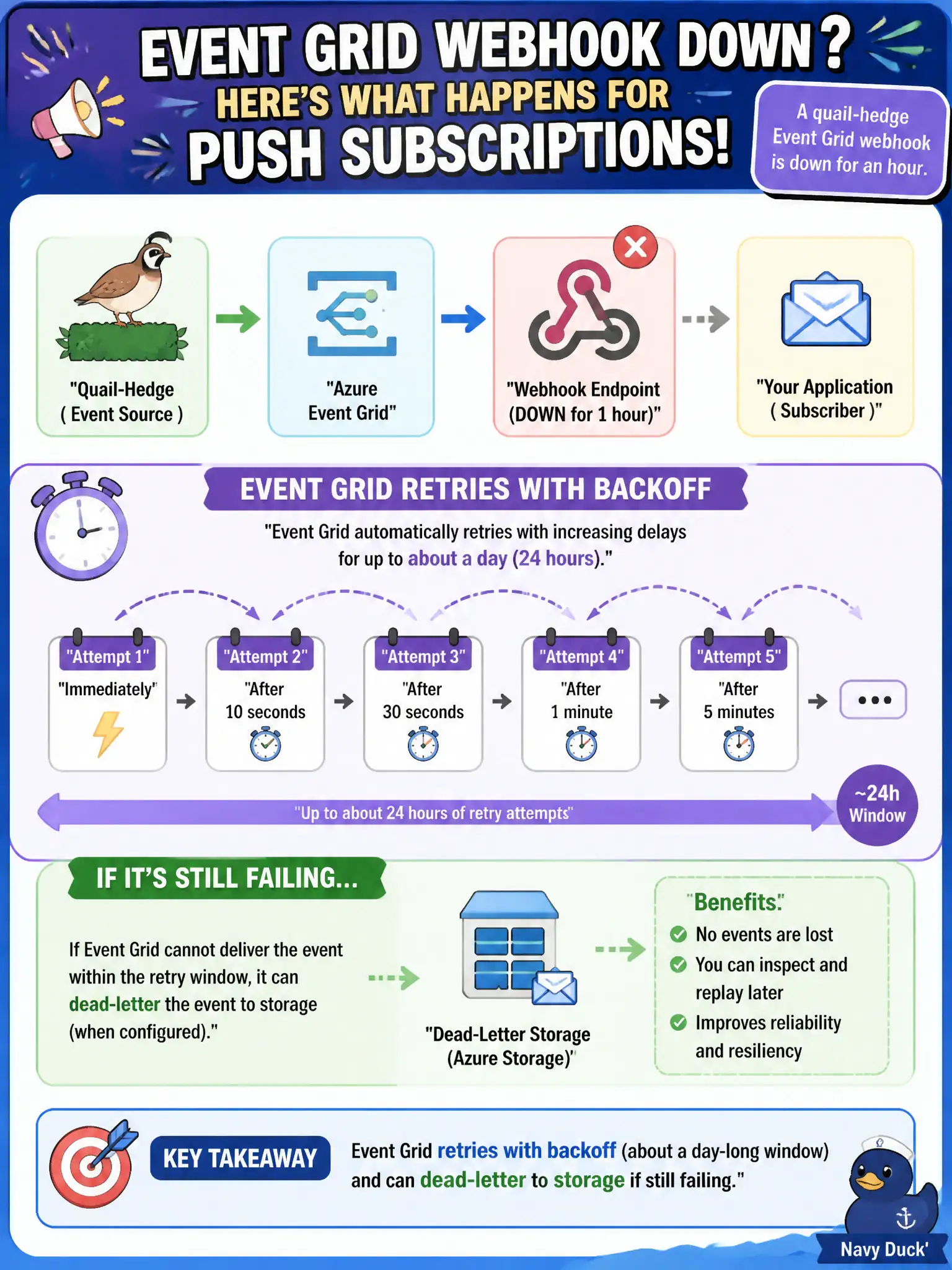
Push isn’t fire-and-forget. Event Grid backs off and retries (roughly a day), and you can send stubborn failures to a dead-letter storage destination.
Full Explanation
For push subscriptions, Event Grid is not fire-and-forget. When a quail-hedge webhook is down for an hour, the service retries with exponential backoff across an extended window (documented on the order of about 24 hours) and can dead-letter undeliverable events to a configured storage destination if delivery still fails. That is the reliability behavior developers should plan for.
Claiming events are dropped instantly with no retry because webhooks are best-effort only fails the documented retry model.
Treating Service Bus dead-letter queues as the Event Grid answer for every failed push fails the product boundary: Event Grid dead-letters to a storage destination you configure on the subscription; Service Bus DLQ is a different messaging service’s failure path.
Retries that happen only if a developer writes a custom AKS sidecar fail because retry/backoff is built into Event Grid push delivery—no sidecar required for the platform behavior.
Exam caveat: after the retry window, events are not held forever unless dead-lettering is configured—omit dead-letter and you can lose terminal failures. Operational check: point a subscription at a webhook that returns 500, observe retries in delivery metrics, enable dead-letter storage, and confirm failed events land there after exhaustion.