
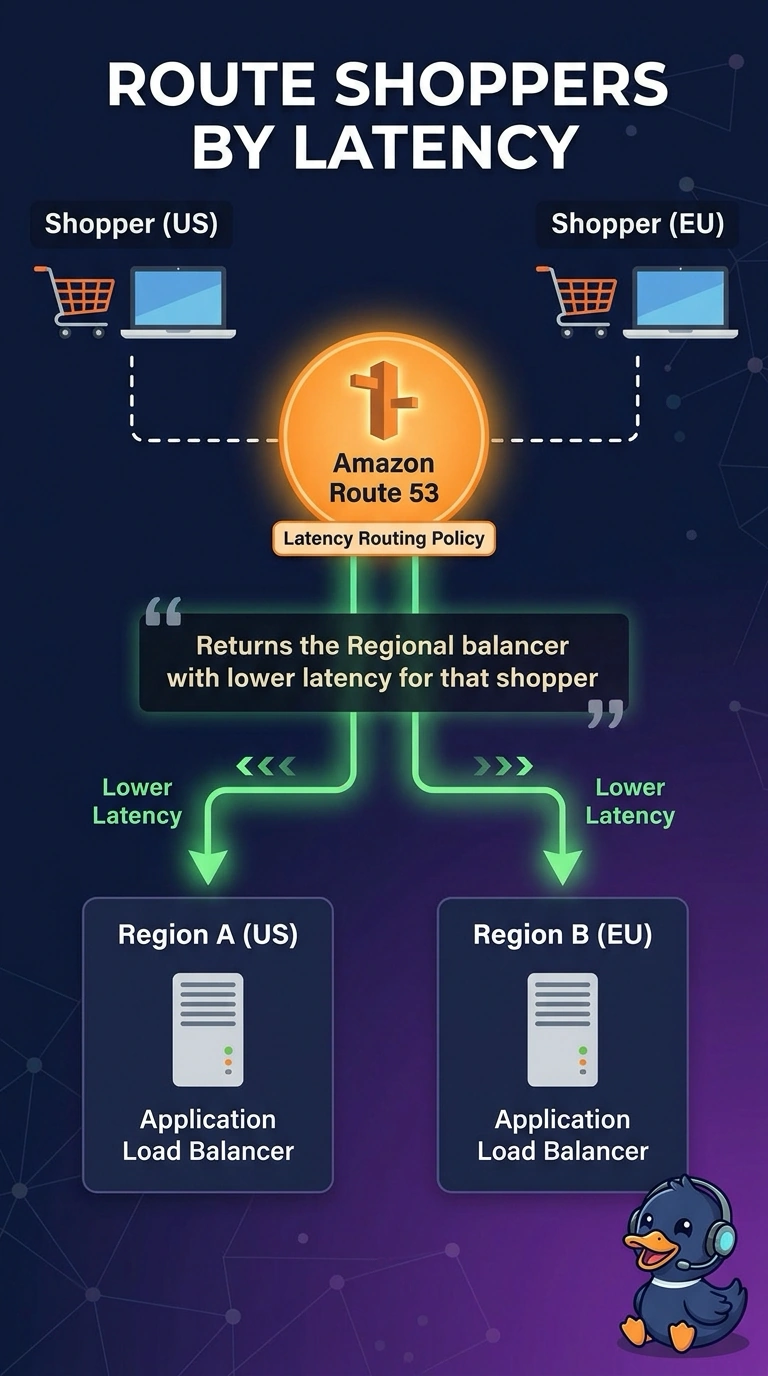
Shoppers in two Regions use a retail checkout site, and each Region has its own Application Load Balancer. Each shopper should reach the balancer with lower latency. A failover record with one primary Region was proposed. Which Route 53 policy fits?
Select an answer to reveal the explanation.
Short Explanation
You pick the closer checkout lane, not the one painted primary. Latency routing sends each shopper toward the Region with lower latency, while failover keeps everyone on one primary until it breaks. The trap is treating a two-Region speed choice as an active-passive pair.
Full Explanation
Latency routing returns the record for the AWS Region that Route 53 associates with lower latency for that client network. Each Regional Application Load Balancer stays in service, and a shopper in either Region is steered toward the faster one rather than toward a designated primary. A failover policy is active-passive: queries stay on the primary while it is healthy, even when the other Region would answer faster. A geolocation policy selects the record configured for a location, which is a place you assigned, not a latency measurement. A multivalue policy can return more than one address and leaves the choice to the client, so it does not pick the lower-latency balancer. Latency routing follows the DNS resolver's network, which can differ from the shopper when a distant resolver is in use. Query the name from each Region and confirm each location receives the balancer that belongs to the lower-latency Region. Attach health checks if a Regional balancer should be skipped when it is unhealthy, or latency routing can still prefer a Region that is fast but failing.