
A Lambda alias was moved entirely onto a new published version, and errors spiked. The previous version is still published. How should a small share of traffic reach the new version while the rest stays on the known-good version?
Select an answer to reveal the explanation.
Short Explanation
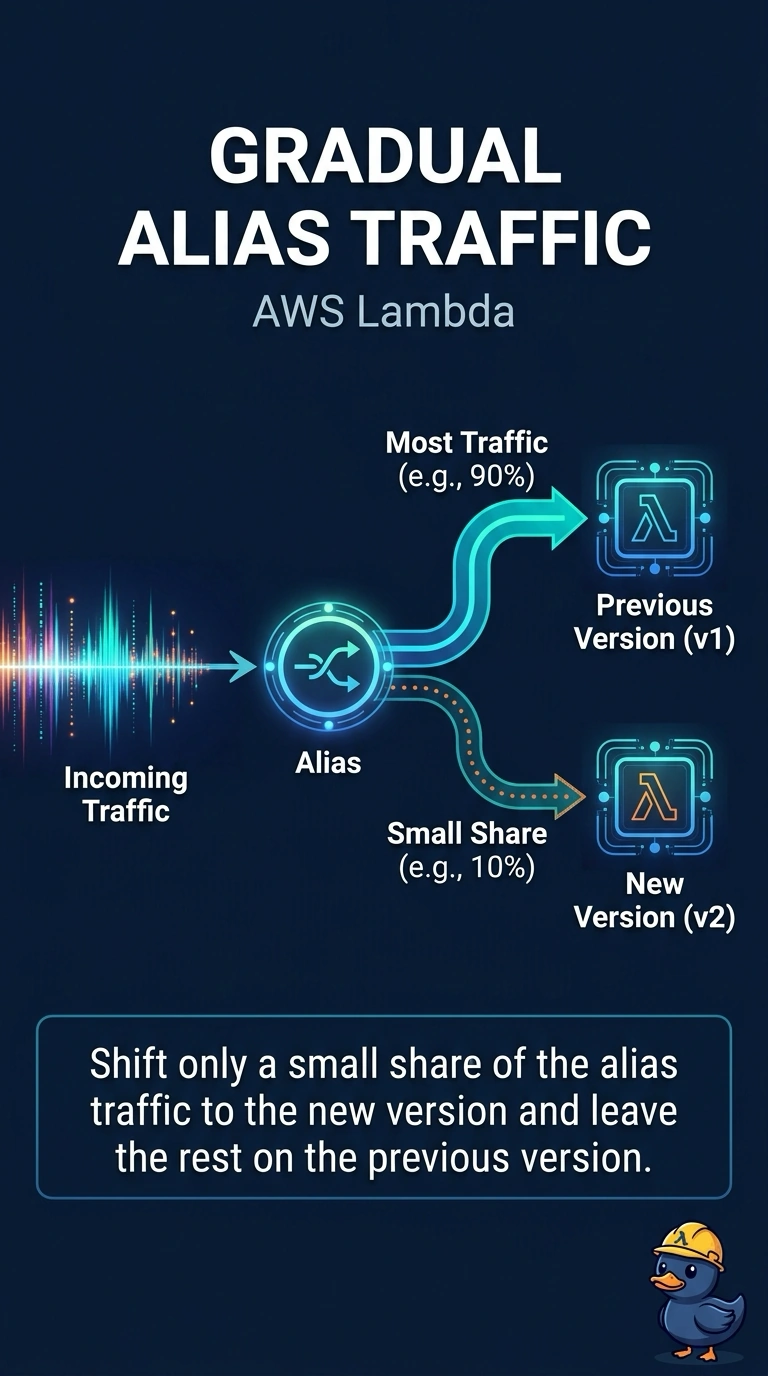
You do not move the whole town onto a new bridge the same afternoon a plank snaps. After a full cutover failed, send only a small share of the alias traffic to the new version. Pointing the alias entirely at that version again is the cutover you just reversed.
Full Explanation
A Lambda alias can point at one version and send the remaining share of invokes to a second version through the alias routing configuration. After a full cutover, point the alias back at the known-good version and place only a small share on the new version so most callers stay on the code that was working. Moving the alias entirely onto the new version repeats the cutover, and a longer timeout does not fix a version that is already throwing. An unqualified function name invokes the unpublished latest code, which is not a controlled split between two published versions. Reserved concurrency of zero throttles the function so invocations are stopped, not shifted. Caveat: the alias can weight only two versions, and callers must invoke the alias qualifier. A client pinned to a version ARN ignores the alias weights. Operational check: call the alias, confirm most log lines show the previous version and a small share show the new one, and watch the error count before you increase that share.