
A SaaS platform must run one CloudFormation template as the same stack in three Regions and stop those copies from being edited separately. What should they use?
Select an answer to reveal the explanation.
Short Explanation
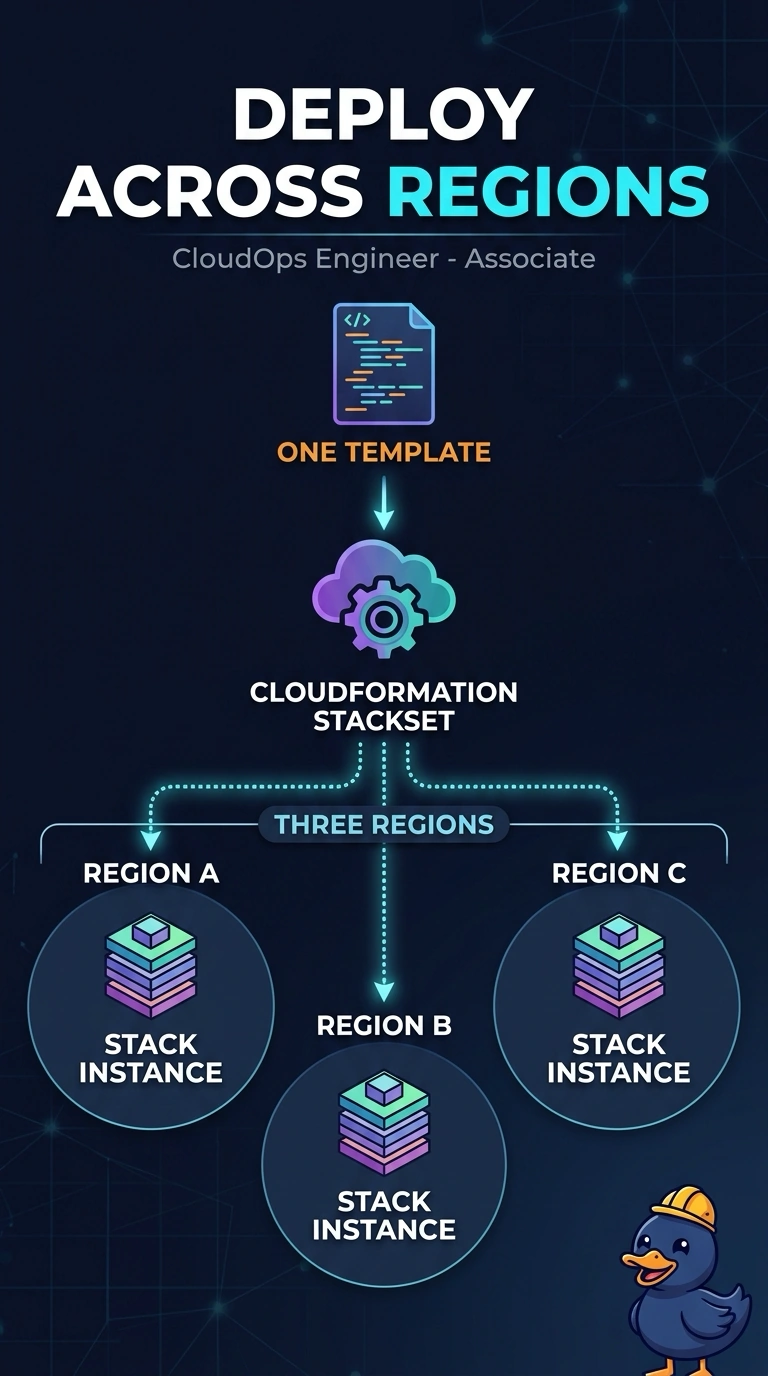
Three hand-copied maps drift the first time someone pencils a road onto only one of them. You need the same stack in three Regions, and a StackSet deploys one template as a stack instance in each Region. Separate stacks, or an SCP, will not keep those copies aligned.
Full Explanation
A CloudFormation StackSet keeps one template and deploys it as a stack instance in each Region you select. Updating the StackSet is how all three Regions receive the same change, instead of three files that diverge when someone edits only one. Each stack instance is that Regional copy, so a difference shows up on the instance rather than inside a hand-edited file. Hand-maintained stacks have no shared operation, so a resource added in one Region is easy to miss in the others. A stack is regional, and replicas of a database do not create the rest of that stack in the other Regions. A service control policy can deny an API, and it does not instantiate a template or update a stack. Caveat: a StackSet update can still fail in one Region because of a local limit or permission, so success in the first Region is not proof the other two have finished. Operational check: after the operation, list the stack instances and confirm each of the three Regions shows a current status for this template.