
A healthcare organization with 80 accounts must continuously check CIS Benchmark drift, centralize compliance scores, and auto-remediate noncompliant S3 encryption and disabled logging. Which assessment and remediation automation meets continuous compliance needs?
Select an answer to reveal the explanation.
Short Explanation
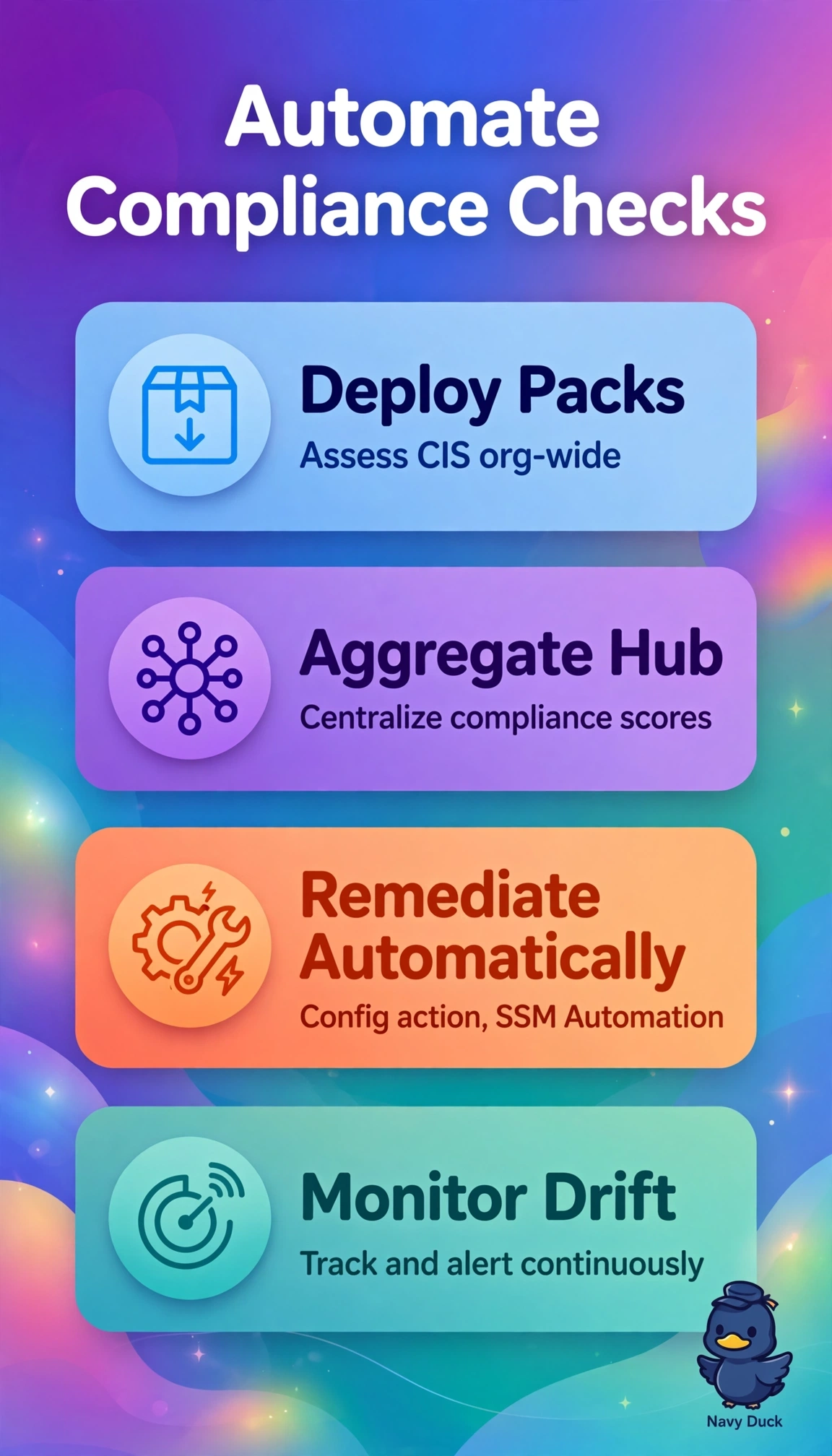
You're moving from spot checks to always-on assurance. Packs plus Hub plus automation keep your posture measured centrally and fixed without ticket churn.
Full Explanation
The correct design satisfies all three mandates together because Config conformance packs encode CIS Benchmark controls as managed Config rules deployed via Organizations for continuous drift detection across all 80 accounts, Security Hub with a delegated administrator centralizes those findings as normalized compliance scores and dashboards for auditability, and Config auto-remediation actions run SSM Automation runbooks to automatically enable S3 encryption and restore disabled S3 logging on noncompliant resources without human delay. The SNS notification design preserves detection and central scoring but fails enforcement by substituting manual owner remediation for automation, which cannot meet continuous auto-remediation and leaves encryption and logging exposed between tickets. The design without central aggregation preserves detection and auto-remediation but fails centralization because per-account enforcement without Security Hub aggregation prevents unified scoring, trending, and oversight required across 80 accounts. The management-account-only design preserves central scoring and automation but fails scale because scoping packs and automations to one account leaves workload accounts unevaluated and unremediated, defeating organization-wide CIS control. Exam caveat is to separate detection from aggregation from enforcement and not assume Config detection alone remediates or that notification equals automation. Practical check is to verify Security Hub shows all members under the CIS standard, conformance packs report success in every OU, and a test noncompliant bucket is automatically remediated by the Config remediation action that runs the SSM Automation runbook.