
A gaming company with ALB, CloudTrail, VPC Flow Logs, and EKS must retain 7 years of audit logs for regulators, enable SQL analysis of security events, and keep hot investigation data queryable for 90 days cost-effectively. Which log ingestion and storage design meets these requirements?
Select an answer to reveal the explanation.
Short Explanation
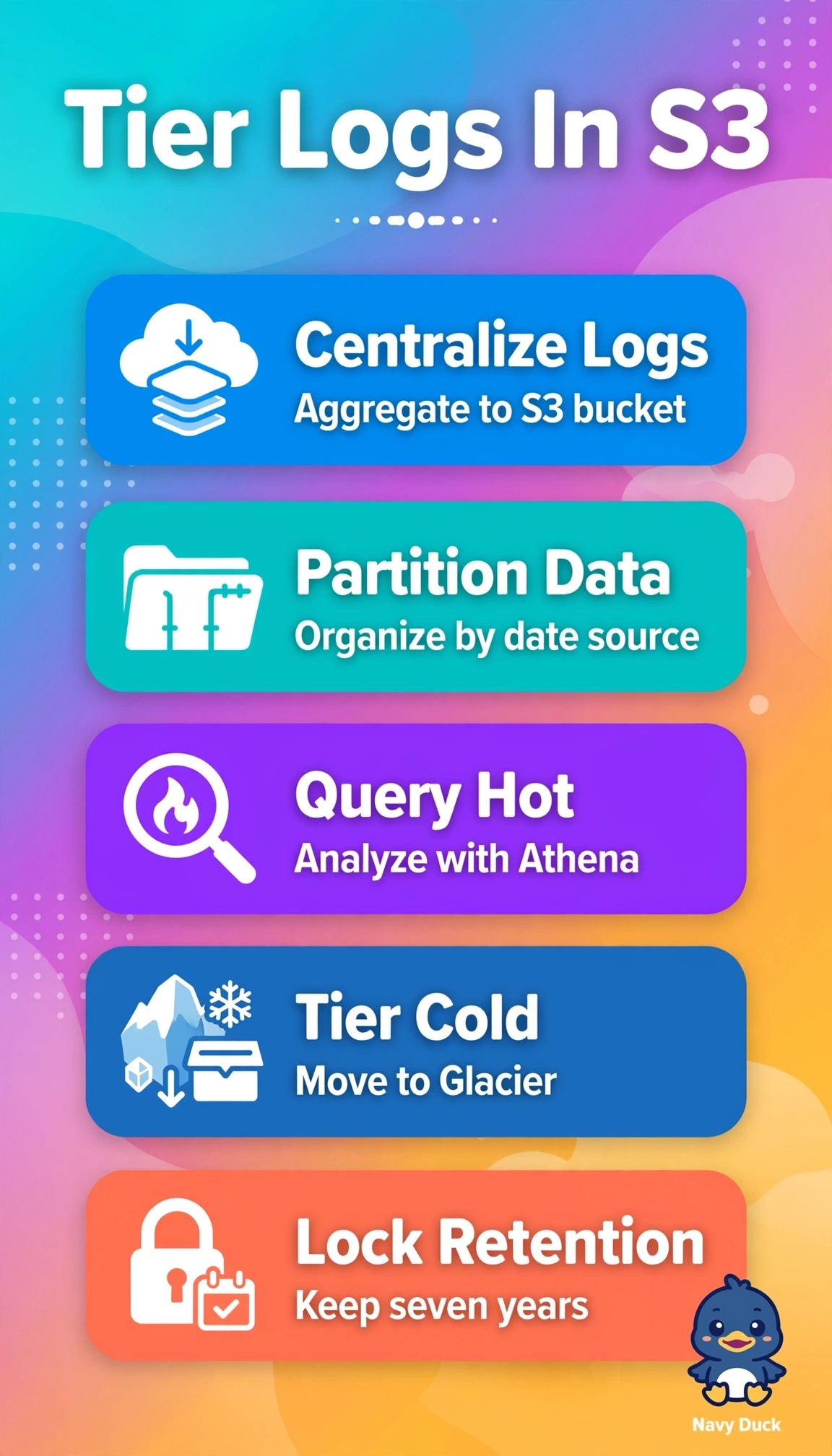
You've got to keep seven years of logs without blowing your budget, like tidying your closet for every season. You'll stash everything in S3 with lifecycle rules so your recent 90 days stay ready for Athena SQL searches while older logs settle cheaply into Glacier.
Full Explanation
S3 provides durable, low-cost object storage with lifecycle policies to transition from Standard to Infrequent Access and Glacier for seven-year retention, while Athena enables serverless SQL over partitioned ALB, CloudTrail, VPC, and EKS logs and S3 Intelligent-Tiering plus Athena workgroups keep 90-day hot queries cost-effective. CloudWatch Logs indefinite retention for seven years across high-volume VPC and ALB logs becomes prohibitively expensive and Logs Insights is not suited for multi-year SQL analytics at that scale. EBS volumes are ephemeral block storage tied to instances, lacking durability, lifecycle management, and centralized query for organization audit. DynamoDB is a key-value store for transactional workloads, not for large immutable log objects, and SQS is a message queue, not archival storage. For the exam match S3 plus Athena to long-term audit and analytics, and in practice enforce Object Lock, partition by date, and replicate to a central log archive account.