
A bank rehearses ransomware containment quarterly but has never tested backup restores or network isolation under load. Regulators demand evidence that the IR plan actually works during realistic failures. Which testing procedure validates the effectiveness of the incident response plan under controlled disruption?
Select an answer to reveal the explanation.
Short Explanation
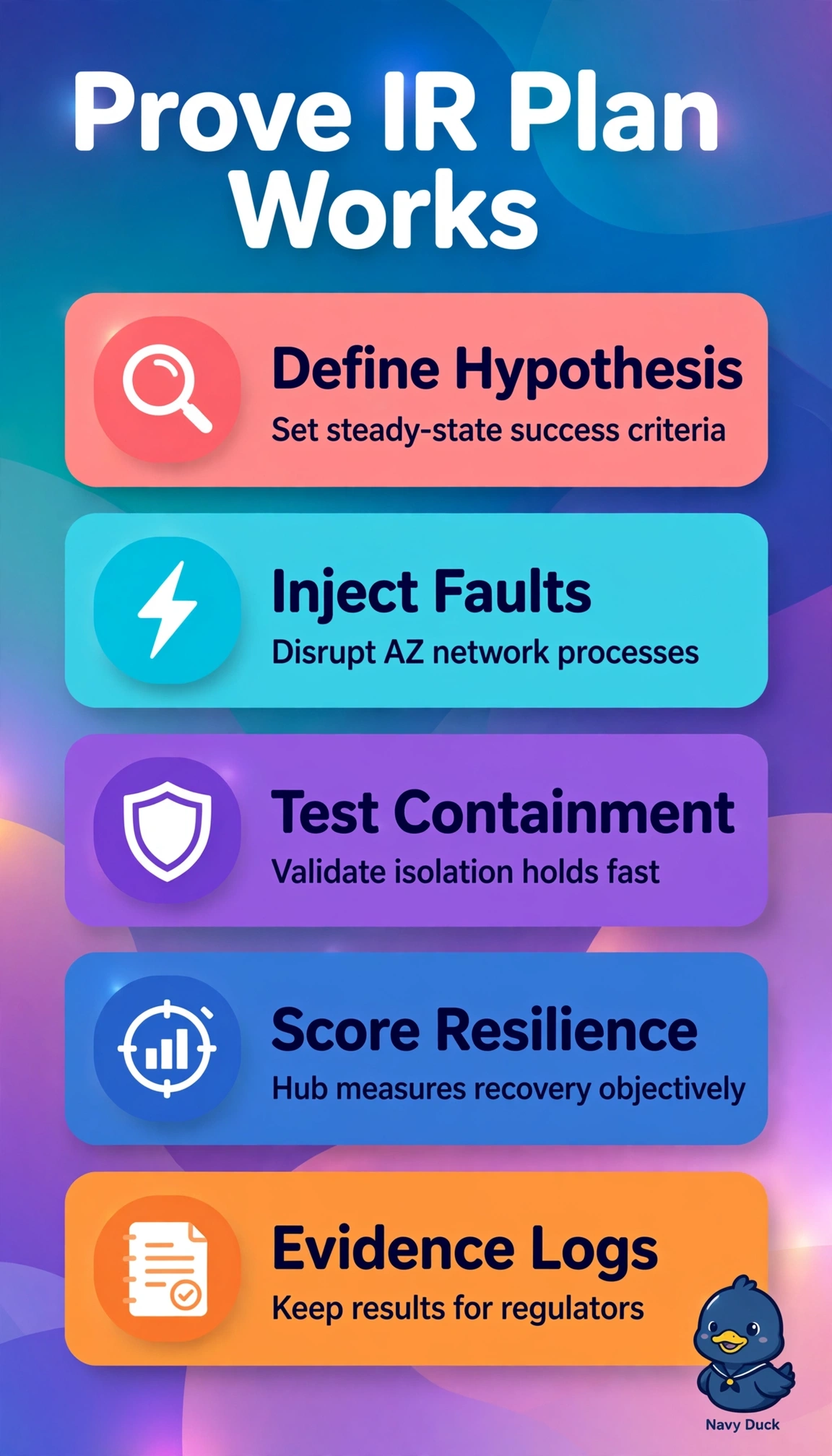
Paper plans crumble under real pressure. Fault Injection with Resilience Hub lets you break things safely and prove recovery works.
Full Explanation
The correct procedure succeeds because AWS Fault Injection Service creates controlled realistic disruption such as dependency failure and network partition while Resilience Hub measures the workload against resilience policies and RTO/RPO targets, generating evidence that containment and restoration work together under stress. The facilitated tabletop approach is inadequate conceptually because it tests people and process through discussion of roles and communications without exercising infrastructure, so it cannot demonstrate that isolation or recovery controls operate under load. The automated backup restore validation is inadequate conceptually because it proves data integrity and recovery time in isolation but does not exercise network isolation or coordinated IR execution, leaving half the stated gap unaddressed. The controlled network load test is inadequate conceptually because it measures throughput and scalability under stress rather than security orchestration, so it yields performance data but no validation of containment and recovery. An exam caveat is to prioritize integrated disruption testing when the scenario stresses realistic failures and untested recovery paths over reviews or single-control tests. A practical check is to verify FIS guardrails and rollback are set and that Resilience Hub reports document isolation and restore success for audit traceability.