
A global video streaming company runs stateless transcoders on ECS Fargate behind a Network Load Balancer in two Regions. Viewers reported buffering during an AZ impairment that target health stayed green through. They need synthetic transactions, per-AZ visibility, and paging on failure. Which workload health-check design gives earliest warning of endpoint impairment?
Select an answer to reveal the explanation.
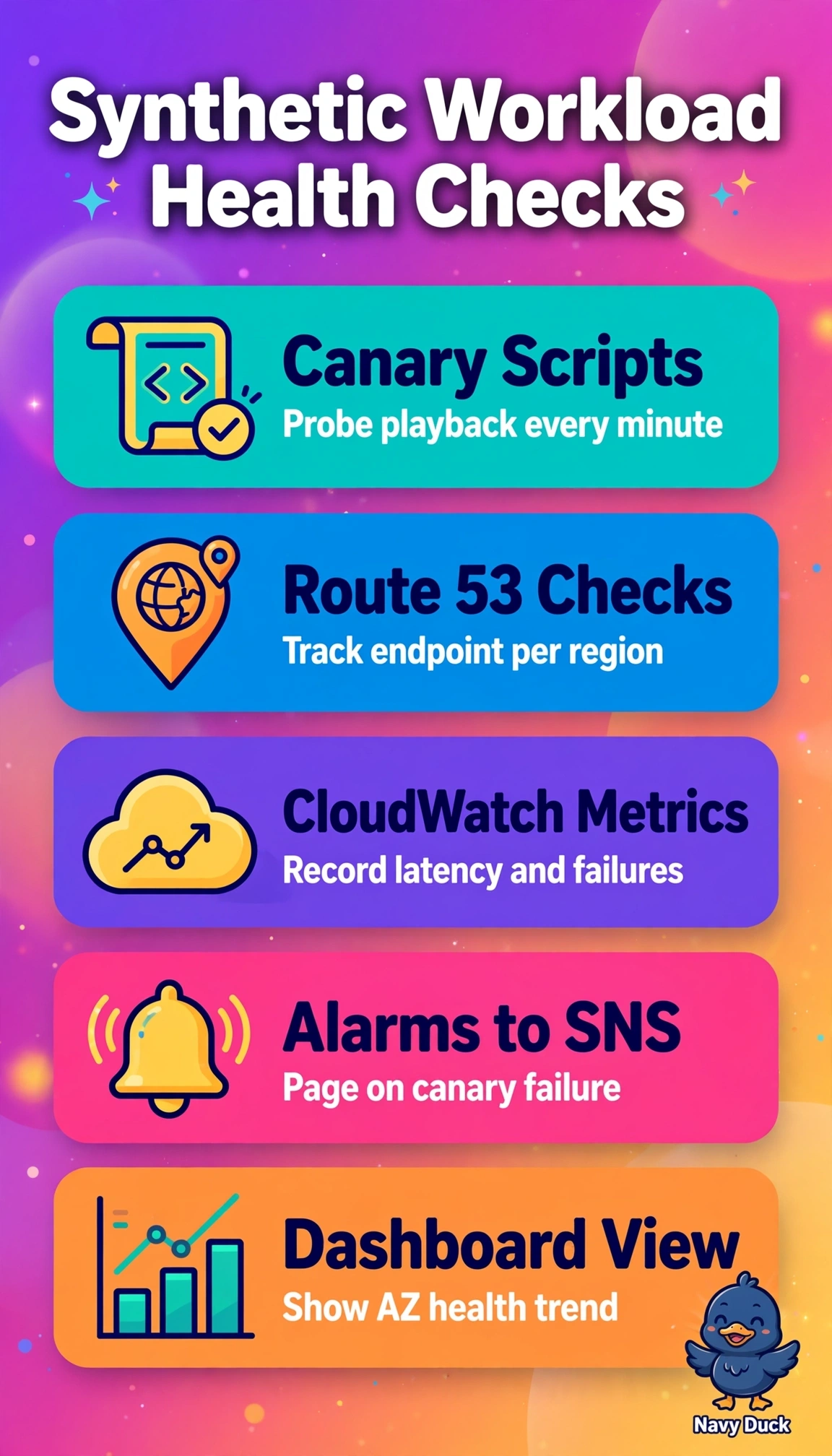
Short Explanation
You’ll catch silent outages before viewers tweet about them. Synthetics act as tireless robot viewers probing playback every minute from outside. Route 53 health checks add per-endpoint proof when a zone stumbles.
Full Explanation
The correct design is right because active playback canaries continuously exercise the full viewer path through the NLB to Fargate transcoders in both Regions, while Route 53 health checks aimed at the NLB's per-AZ endpoints expose zonal impairment even when NLB target health remains green because default target health checks only confirm that a port or path answers, not that segmented playback works, and CloudWatch alarms provide immediate paging for earliest warning rather than delayed human review. The NLB target-group health-check design with per-AZ metrics and paging fails by concept because passive infrastructure health checks only confirm port open and task reachable, so an AZ impairment that breaks segmented playback but leaves TCP succeeds is invisible and reproduces the reported false-green gap. The aggregated regional canary design fails by concept on observability granularity because rolling per-AZ results into a single regional alarm dilutes a single-AZ failure below threshold and delays isolation, violating the explicit per-AZ visibility requirement for fast failover or traffic shift. The dashboard-only per-AZ canary design fails by concept on response because visualization without alarm-driven paging relies on operators noticing graphs, which cannot meet earliest-warning paging on failure for a real-time streaming workload. Exam caveat: distinguish synthetic probing from logs, metrics, or target health, as only synthetics prove user-impacting availability when infrastructure signals are green. Practical check: verify canaries run in each AZ behind each regional NLB with separate alarms, test paging integration, and confirm Route 53 health check failure triggers traffic policy change during a simulated AZ playback fault.