
A fintech SaaS has 200 startups on shared services but five banks demand isolated compute, data, and keys with tenant-aware auth. It must balance cost efficiency with strong isolation. Which multi-tenant control satisfies both isolation tiers for this platform?
Select an answer to reveal the explanation.
Short Explanation
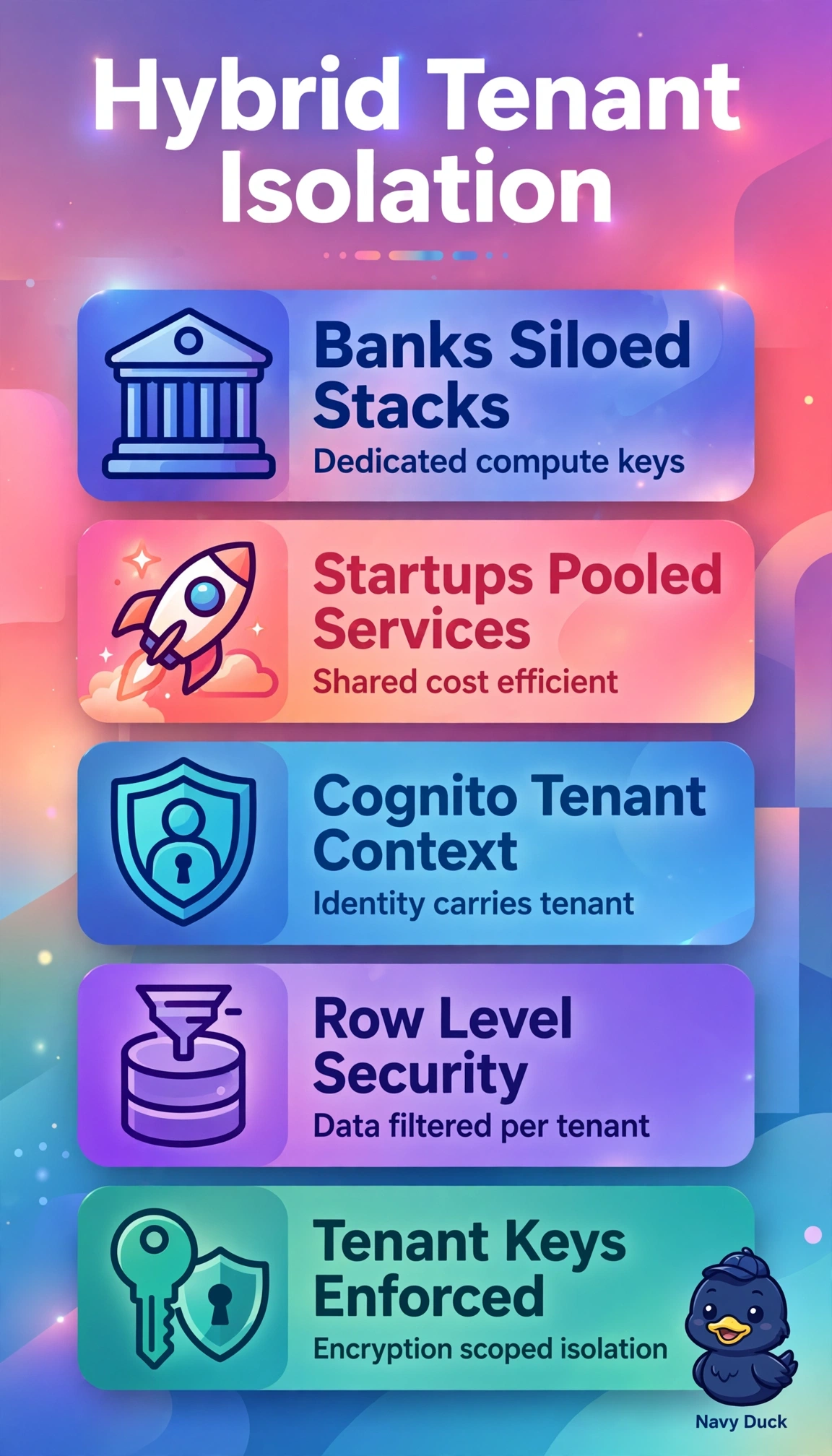
You'll keep costs down when your startups share apartments while your banks get their own private houses with hybrid tenancy. You're giving siloed stacks where it's demanded and efficient row-level pooling everywhere else.
Full Explanation
Hybrid multi-tenancy places regulated bank tenants in siloed compute, storage, and KMS keys while running startups on pooled services enforced by Amazon Cognito tenant context, row-level security, and tenant-specific encryption, balancing isolation and cost. Fully siloed stacks for all 200 startups multiplies VPC, database, and operational costs without business justification and fails cost efficiency. Fully pooled services with one shared database and no tenant context cannot demonstrate data isolation, key separation, or auditable tenant identity for banks. Anonymous shared credentials eliminate authentication and authorization entirely, violating isolation, compliance, and traceability. Exam caveat: choose silo for regulated or noisy-neighbor-sensitive tenants and pooled with RLS plus Cognito context for scale. Practical check: verify tenant ID enforcement in IAM, RLS policies, and per-tenant KMS grants.