
A B2B analytics platform runs its API on EC2 Auto Scaling behind an ALB. Traffic jumps sharply at 8 a.m. on weekdays, baseline demand grows 5% monthly, and leaders want capacity provisioned before the spike while keeping average CPU near 50% all day. Which auto scaling policy combination provides proactive scaling with stable utilization for this workload?
Select an answer to reveal the explanation.
Short Explanation
You're juggling a clockwork spike, steady growth, and flat CPU — you need both a forecast and a thermostat. Pairing prediction with continuous adjustment is like preheating the oven and then holding temp, guided by predictive scaling.
Full Explanation
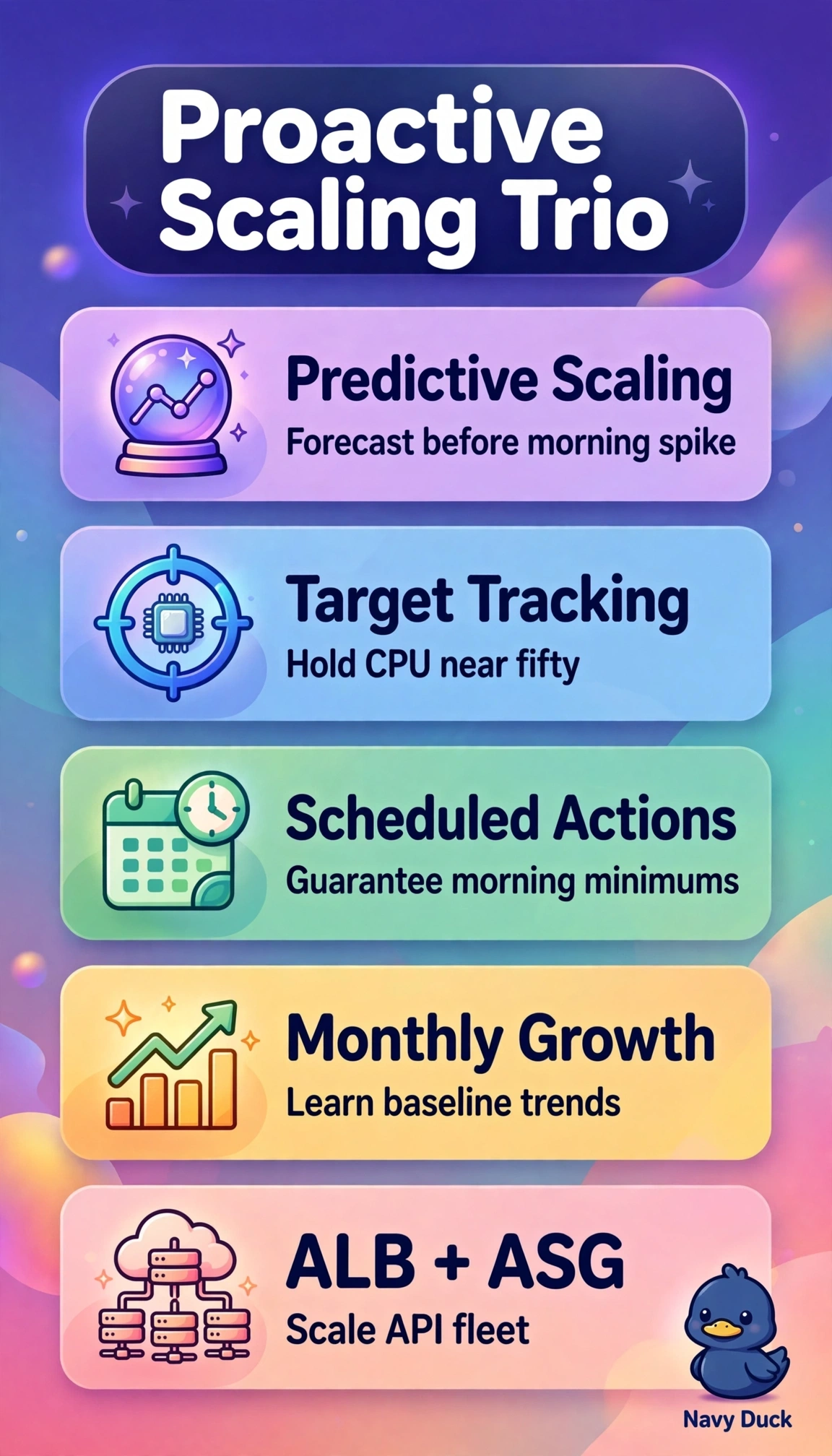
Predictive scaling uses machine learning on history to provision capacity ahead of the 8 a.m. weekday pattern and adapt to 5% monthly baseline growth, target tracking maintains average CPU near 50% through continuous adjustments, and scheduled actions guarantee minimum capacity for the known calendar event, together covering proactive, steady-state and calendar-aware needs. Target tracking only with lifecycle hooks fails the proactive concept because it still reacts after CPU rises and cannot pre-provision before the sharp jump. Scheduled actions with step scaling fails the stability concept because step thresholds require manual tuning and oscillate around spikes rather than holding a utilization target plus forecasting growth. Simple scaling on memory with long cooldowns fails the metrics concept because memory is the wrong signal for request-driven API CPU pressure and simple policies with cooldowns respond too slowly. Exam caveat: predictive scaling only anticipates recurring patterns, so pair it with target tracking to absorb unforecast load and with scheduled actions for known events. Practical check: confirm 24 hours of history for forecasts, set predictive mode to Forecast and Scale, and validate CPU target and scheduled cron in the console.