
A retailer runs 40 ECS microservices across three VPCs needing fine-grained L7 routing, identity-aware access, and unified tracing without managing sidecar proxies. Which service mesh design for microservice communication best reduces operational overhead?
Select an answer to reveal the explanation.
Short Explanation
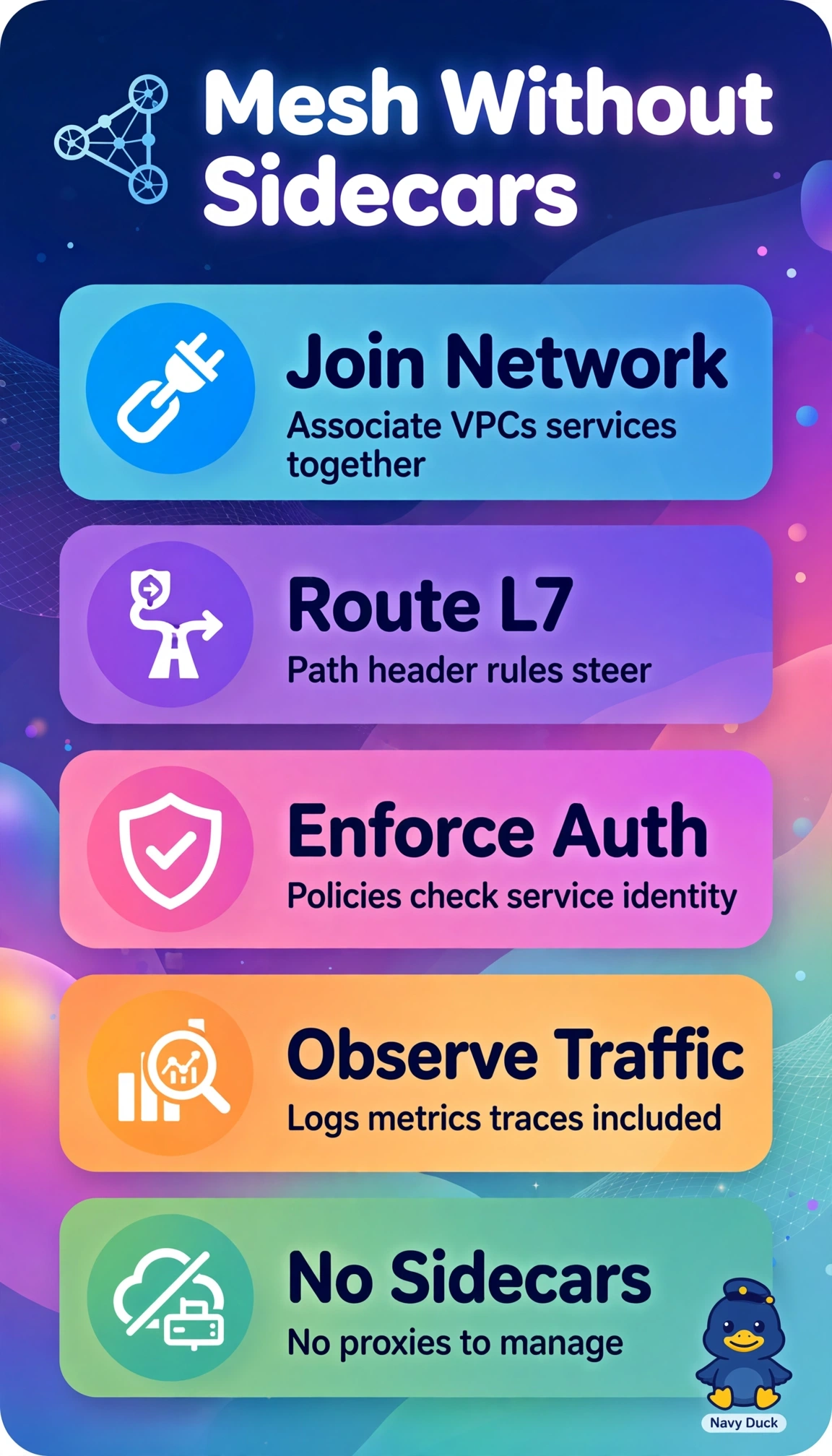
Sidecars everywhere feel like paperwork for every conversation. VPC Lattice handles discovery and policy outside your containers. It's like a hotel concierge routing guests for you.
Full Explanation
The correct architecture uses Amazon VPC Lattice service networks spanning VPCs and accounts to provide L7 routing, auth policies and access logs plus CloudWatch metrics without injecting sidecars into your containers, which meets cross-VPC discovery, identity-aware control and low overhead. ECS Service Connect provides service discovery and traffic control within ECS clusters but does not natively span multiple VPCs without additional networking, so it satisfies single-cluster mesh but misses the three-VPC requirement. Istio on EKS delivers rich mesh features but requires Kubernetes, Envoy sidecar lifecycle, control plane operations and cross-VPC gateways, violating the no-sidecar and low-overhead facts. Per-service ALBs with Route 53 create dozens of load balancers, fragmented policies and higher cost without unified mesh observability or identity-aware service policies, failing operational efficiency. For the exam, choose Lattice for ECS and cross-VPC service networking without sidecars and Service Connect for ECS-internal simplicity, and in practice verify service network associations, auth policies and log delivery.