
A travel booking platform runs stateless services on Amazon EKS behind an ALB where a recent rolling update caused cascading 500s because faulty pods received live traffic immediately and rollback required redeploying old manifests. The team needs progressive traffic shifting, automatic health-based rollback, and zero code changes to manifests. Which deployment strategy provides safe rollback for this EKS workload?
Select an answer to reveal the explanation.
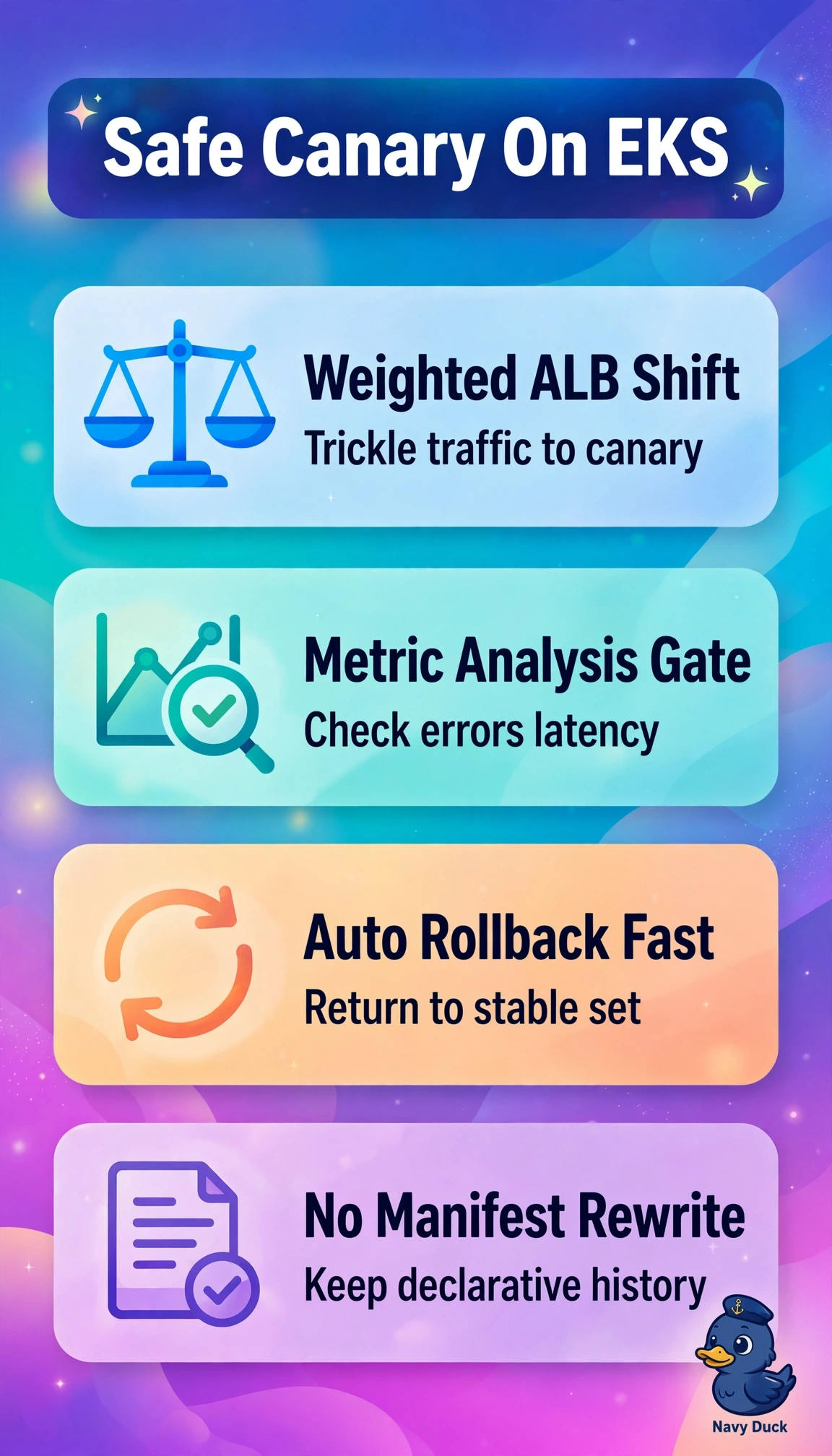
Short Explanation
You want a dimmer switch with an automatic cutoff, not yanking the main breaker. Canary analysis sends a trickle to new pods and snaps back instantly on errors.
Full Explanation
The correct strategy uses progressive canary with ALB weighted target groups and Argo Rollouts analysis templates that shift small traffic percentages, verify metrics like 5xx rate and latency, and automatically revert to the stable ReplicaSet without manifest redeploys, preserving fast rollback. Native integration with load balancer weighting provides fine-grained control and history. Standard rolling updates with maxSurge still send production traffic to new pods as they become ready and rollback via kubectl undo is slower and manual, lacking automated metric gates. Duplicating the cluster for blue/green with DNS switching is heavyweight, incurs duplicate control-plane and node cost, suffers DNS caching delays, and requires manual validation rather than automated progressive analysis. In-place DaemonSet image swaps bypass Deployment safety, offer no traffic shaping or ReplicaSet history, and rely on ad hoc ECR restores instead of declarative rollback. For the exam distinguish canary incremental shifting from blue/green full switch and rolling in-place replacement, and remember automated promotion requires metric analysis. In practice define SLO-based thresholds and retain previous ReplicaSets for instant recovery.