
A health startup adds a Bedrock RAG assistant that summarizes discharge notes. Clinicians report occasional hallucinations. Product needs repeatable quality scores, safety checks for toxicity, and clinician review before release. Release cycles are weekly. Which evaluation approach validates AI outputs with Bedrock Evaluations?
Select an answer to reveal the explanation.
Short Explanation
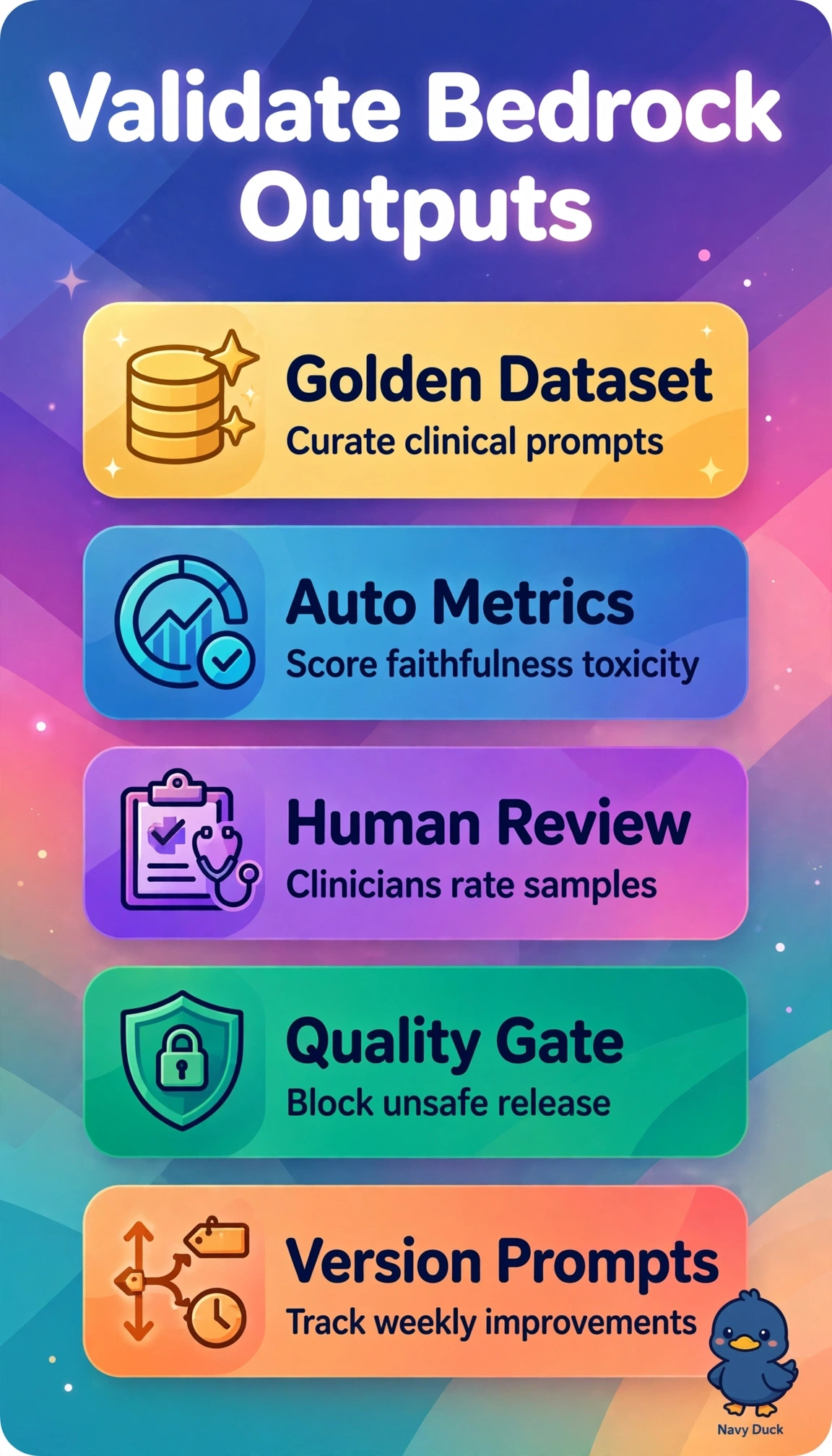
Gut feelings won't catch clinical hallucinations reliably. Combining automatic evaluations with expert review gives you defensible weekly quality gates.
Full Explanation
The correct approach is right because Bedrock Evaluations combines automatic metrics with human workflows, satisfying all stated needs for the discharge-note RAG assistant in a weekly cadence: curated datasets and model-graded scores give repeatable quality signals for hallucination and summarization fidelity, integrated harmfulness and toxicity detectors provide required safety checks, and clinician reviewers supply domain judgment before release. The weekly accuracy-focused workflow with clinician scoring fails on safety concept because it validates factual quality and expert oversight yet omits toxicity screening essential for patient-related summaries and compliance. The automated accuracy and toxicity scoring for each release fails on oversight concept because it is efficient and repeatable but excludes mandatory clinician review, and automatic scores alone often miss subtle clinical hallucinations or unsafe omissions. The one-time comprehensive assessment with metrics, safety checks, and clinician review fails on lifecycle concept because a single pre-launch study cannot regress weekly prompt, retrieval, or model changes. Exam caveat: when a scenario explicitly lists repeatable scores, safety, and expert review, eliminate any approach missing one pillar even if it correctly uses Bedrock and sounds operationally mature. Practical check: version de-identified discharge notes, reference summaries, toxicity policies, and clinician rubrics, then gate each weekly release on metric thresholds plus recorded human approval.