
A media firm with 12 business units tags all resources by CostCenter but cannot explain monthly variances or allocate shared data-transfer costs. Finance needs hourly, resource-level history queryable by SQL and visual dashboards by team. Which cost reporting design using detailed billing data meets these needs?
Select an answer to reveal the explanation.
Short Explanation
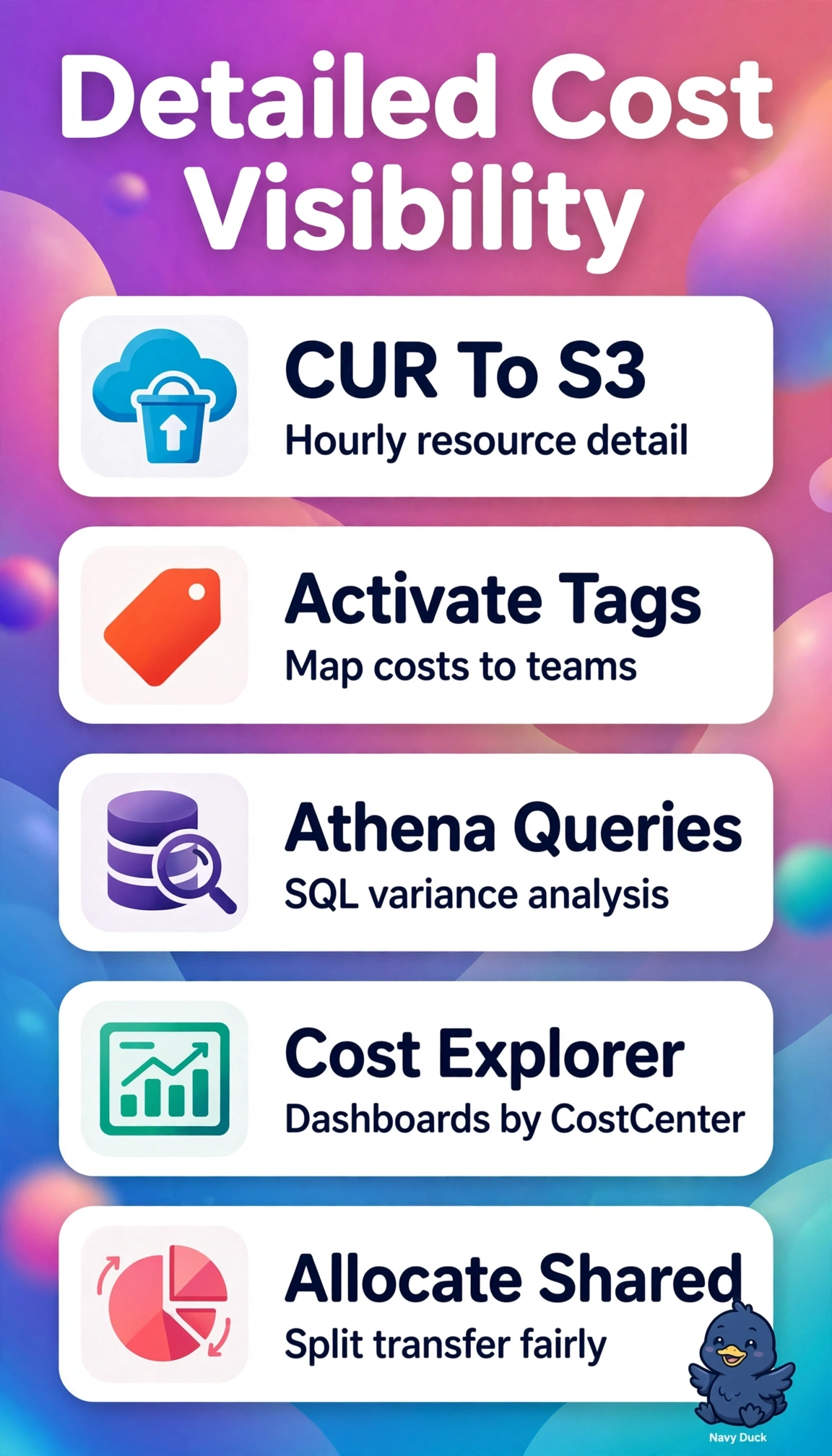
You can give Finance resource-level history by hour and use SQL to investigate variances with hourly Cost and Usage Reports in S3 and Athena. Activating CostCenter tags and splitting shared charges through Cost Categories also helps you see costs by team in dashboards.
Full Explanation
Hourly Cost and Usage Reports (CUR) in S3 preserve detailed billing history, including hourly timestamps, resource IDs, usage types, and tags; Athena lets you query that history with SQL. Activating CostCenter as a cost allocation tag and using a Cost Categories split charge rule attributes shared data-transfer costs across business units, supporting team-level dashboard views. Daily-granularity CUR loses intraday detail, so you cannot explain hourly variances or recover the missing resolution later. Hourly CUR with allocation tags and Cost Explorer dashboards does not meet the SQL requirement: visualizations and APIs do not provide ad-hoc SQL over raw line items for custom joins, window functions, or resource-level history queries. Hourly CUR in S3 with Athena but no allocation of shared transfer costs leaves those charges in a common pool, so team chargeback and variance explanations remain incomplete. Exam caveat: consolidated billing, Budgets, or Cost Explorer alone do not create hourly, SQL-queryable history; use CUR in S3 with Athena, and activate tags before they appear in reports. In practice, verify hourly granularity and resource IDs are enabled, confirm the S3 files are available as an Athena table, activate CostCenter in billing preferences, and check that a sample shared transfer charge is split correctly in Cost Explorer.