
An enterprise builds agentic AI support assistants that call CRM and billing APIs on behalf of users, requiring per-user scoping, short-lived credentials, and audit trails of agent actions. Which access control design best secures these agentic AI tool invocations?
Select an answer to reveal the explanation.
Short Explanation
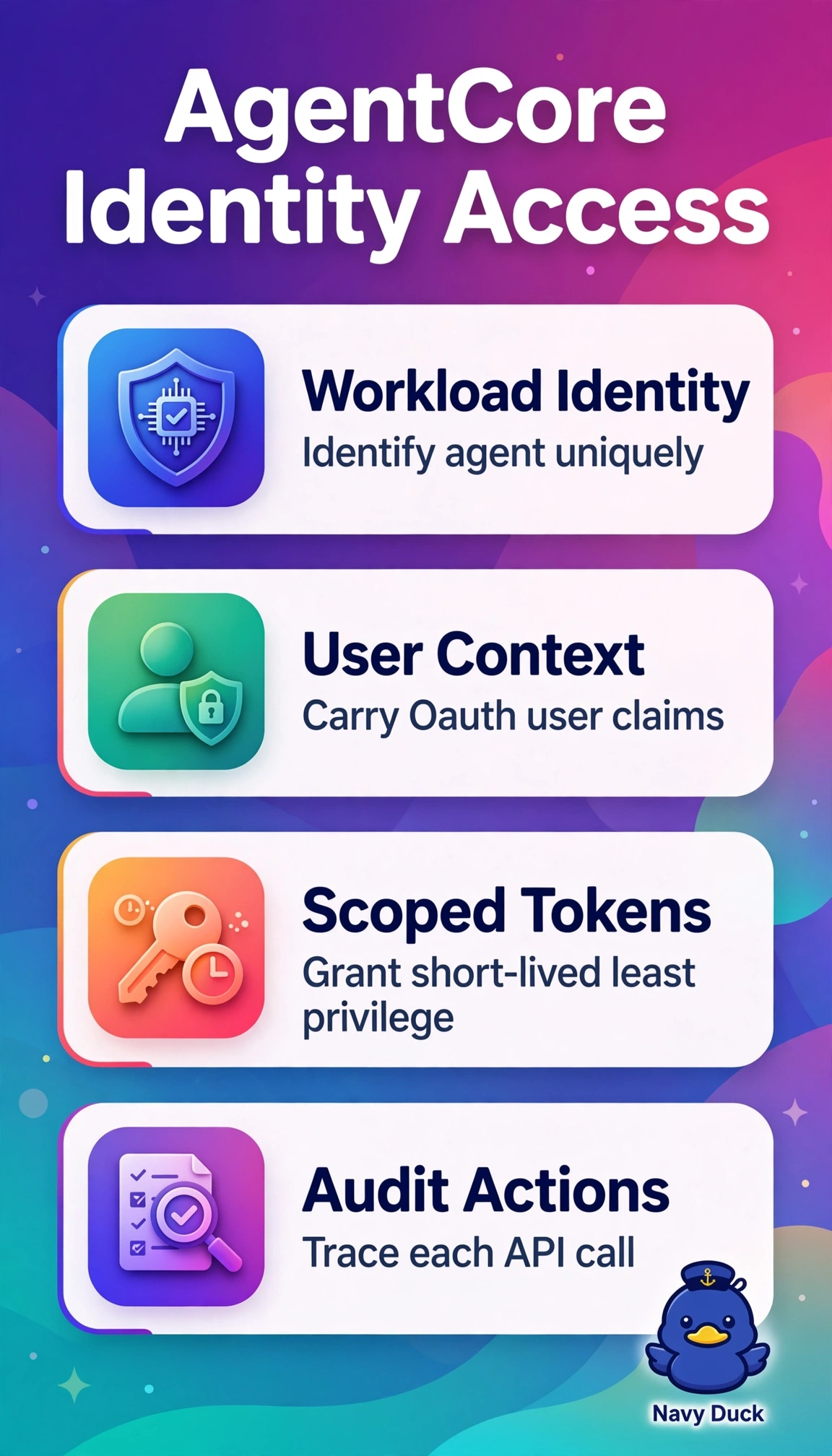
You wouldn't hand your assistant your whole wallet, just enough cash for one errand. With AgentCore Identity, your agent gets a tiny, short-lived pass tied to you that's easy to trace.
Full Explanation
Bedrock AgentCore Identity provides workload identity for agents with inbound user context via OAuth and outbound credential vending that issues downscoped, short-lived tokens per tool call, enabling least privilege and per-action auditability across CRM and billing APIs. Secrets Manager with long-lived keys fails by concept because shared static credentials lack per-user scoping, expiry, and attribution for autonomous actions. A single broad IAM role fails by concept because it grants excessive standing privilege to all users and cannot constrain actions to individual user context. Cognito login alone fails by concept because authentication proves user identity but does not vend least-privilege workload credentials or enforce tool-level scopes for agent invocations. Exam caveat: distinguish user authentication from agent workload identity and credential vending. Practical check: verify token scopes, lifetimes, and CloudTrail entries mapping each API call to user and agent.