
A global streaming platform is exhausting IPv4 addresses, faces higher NAT costs, and must support IPv6 clients while keeping IPv4 compatibility for legacy encoders. Which IPv6 adoption and dual-stack migration strategy enables end-to-end coexistence?
Select an answer to reveal the explanation.
Short Explanation
You're adding a second language while everyone still speaks the first. Dual-stack lets resources speak IPv4 and IPv6 side by side, so you can support new clients without breaking legacy gear.
Full Explanation
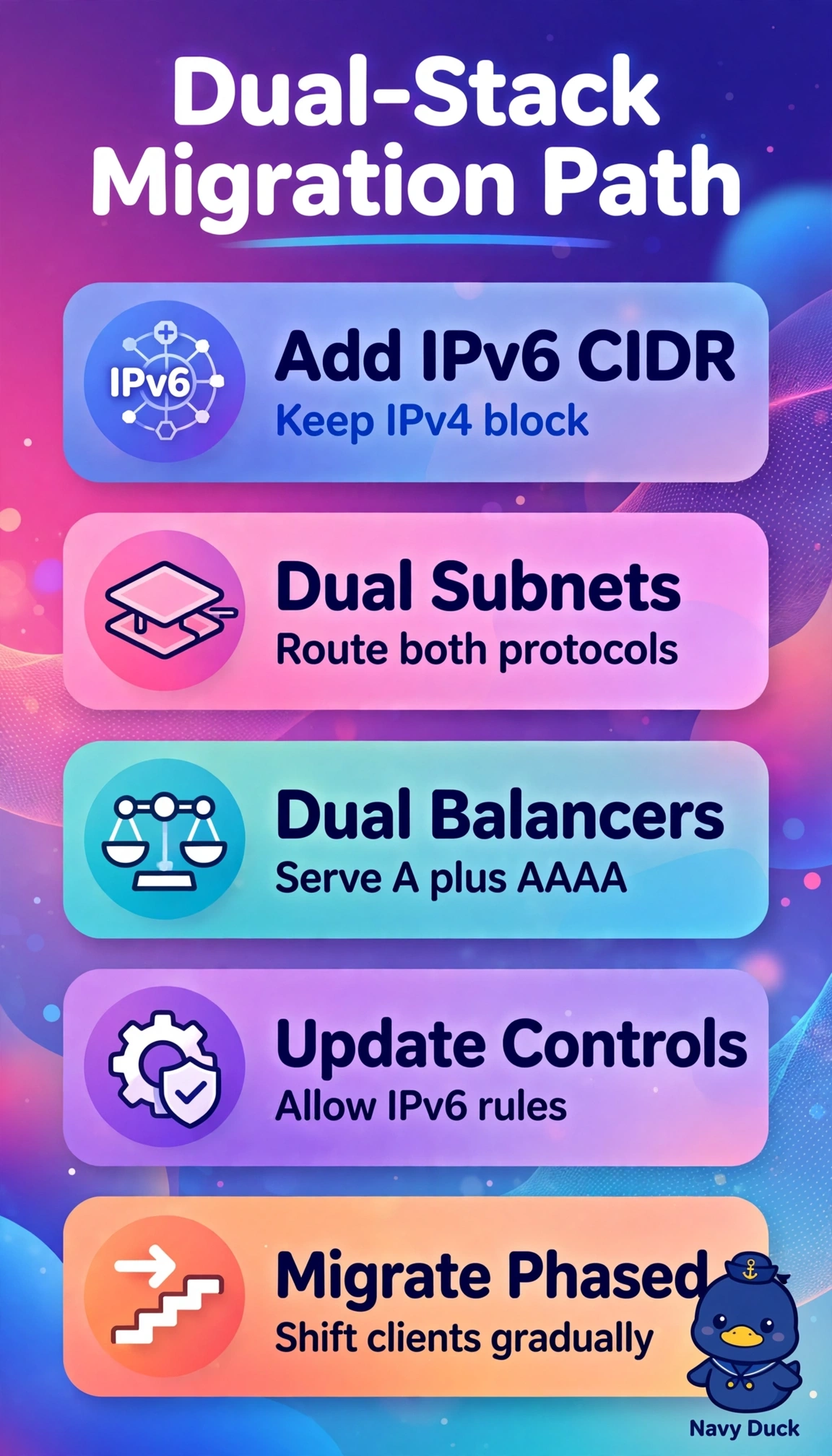
Enabling VPC dual-stack with an IPv6 CIDR, dual-stack subnets and load balancers, and phased security group updates provides native paths for both protocols. New IPv6 viewers can connect without relying on large-scale NAT for inbound access, while legacy IPv4 encoders keep using their existing paths; phased security group changes help avoid outages. The design using egress-only gateways and NAT64/DNS64 can scale outbound-initiated traffic, but IPv4-only public load balancers leave IPv6 clients without a native inbound listener. The design with dual-stack subnets and IPv6 internal routing supports internal IPv6 traffic, but IPv4-only CloudFront leaves global edge traffic on IPv4 and does not meet the need to serve IPv6 clients there. Centralized NAT64 can connect IPv6 clients to IPv4 encoders, but it relies on translation rather than native dual-stack paths and retains translation-state and gateway costs. An exam caveat: these approaches can be useful migration aids, but outbound translation or internal-only IPv6 does not provide end-to-end coexistence. As a practical check, validate AAAA records, dual-stack load balancer settings, subnet IPv6 routes, and IPv6 ingress rules in staging with both an IPv6-only client and a legacy IPv4 encoder before cutover.