
An e-commerce company runs nightly 5-hour inventory reconciliation on x86 instances and processes order events through orchestrated workflows with millions of sub-second checks plus occasional multi-hour exception handling flows. Compute dominates the bill and transitions are charged per state change. Which pricing-model architecture minimizes cost for this workload mix?
Select an answer to reveal the explanation.
Short Explanation
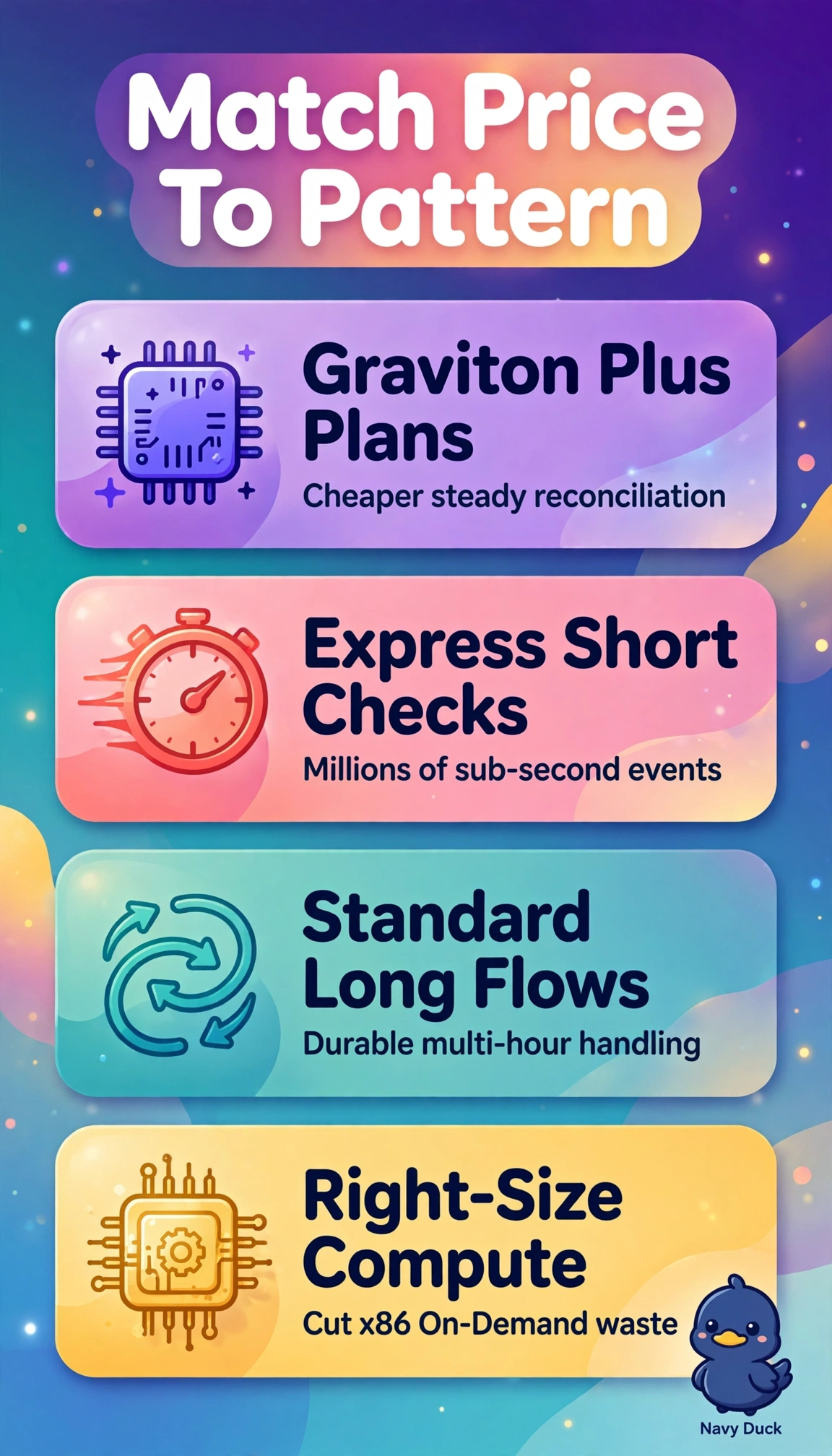
You're paying limo rates for pizza delivery and scooter rates for moving day. Workflow splitting matches Express to high-volume sprints and Standard to marathons while Graviton trims compute.
Full Explanation
The correct architecture minimizes both cost drivers by combining Graviton with Compute Savings Plans for reconciliation and splitting workflows by billing model: Graviton provides up to 40% price-performance improvement for compatible workloads and Savings Plans discount predictable recurring compute versus On-Demand, critical when compute dominates the nightly 5-hour job, while Standard per-transition pricing fits infrequent long-running exception flows with full history and exactly-once semantics and Express duration-plus-invocations billing is dramatically cheaper for millions of sub-second checks. The Standard-only workflow design fails on workflow economics by forcing high-volume short checks onto per-transition pricing, inflating cost by orders of magnitude where Express would aggregate work. The Graviton On-Demand split-workflow design fails on commitment economics by omitting Savings Plans for a fixed nightly job, leaving a guaranteed discount uncaptured for no architectural benefit. The Express-only workflow design fails on service limits because Express synchronous and asynchronous executions cap at 5 minutes and cannot support occasional multi-hour flows requiring Standard up to one year. Exam caveat: do not default to consistency or a single workflow type when the stem explicitly contrasts millions of short executions versus few long executions and calls out per-transition charges, as that contrast signals a hybrid Express plus Standard split. Practical check: verify Graviton compatibility and enable Compute Optimizer plus Cost Explorer, then tag Standard versus Express executions and compare transition versus duration charges before committing Savings Plans coverage to the steady-state baseline.