
A retailer runs checkout on Amazon EKS in us-east-1, needs survival of Regional failure with under 5-minute failover and consistent container images in both sites. Which multi-cluster container strategy provides high availability and disaster recovery?
Select an answer to reveal the explanation.
Short Explanation
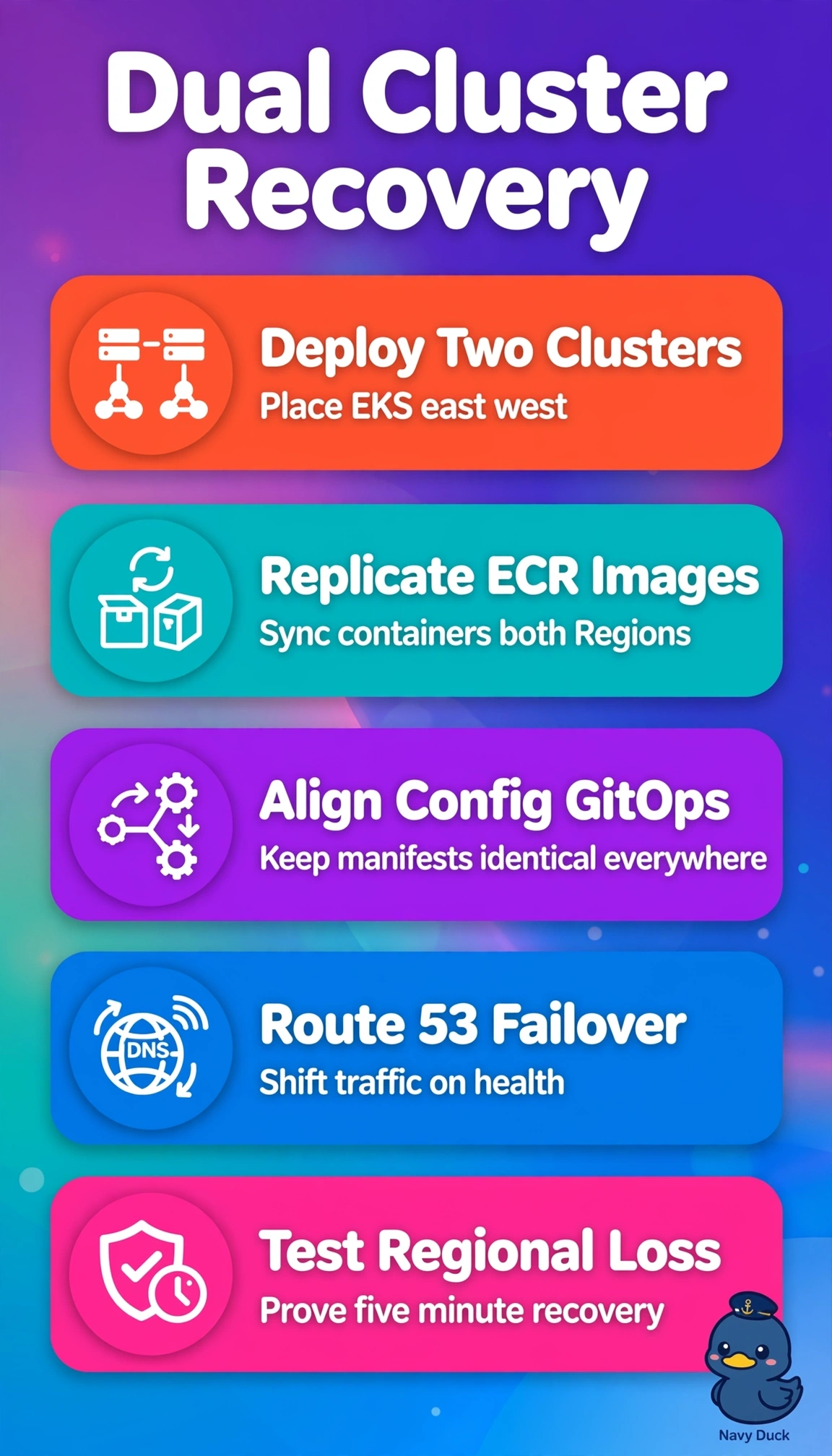
You’ll keep checkout ready across a Regional outage with a warm standby and Route 53 steering shoppers to it quickly. Replicated images help both sites serve the same checkout experience.
Full Explanation
A warm active-passive footprint in two distinct Regions removes the blast radius of a full Regional outage, and Route 53 health-checked failover automates the traffic shift within the five-minute objective. Cross-Region image replication also ensures both clusters pull identical digests for consistent checkout behavior. Building images independently in each Region supports availability and fast routing, but breaks consistency: tag drift, patch timing, and build differences can create divergent containers and checkout errors after failover. Manual DNS failover preserves the two-Region topology and image parity, but human validation and propagation make recovery an unpredictable operational procedure that may exceed five minutes. A scaled-to-zero standby preserves the topology, routing, and image parity on paper, but node scale-out, pod scheduling, image pulls, and warm-up cannot reliably complete and serve production load within five minutes. Exam caveat: multi-AZ protects against AZ failure only, while backup-restore without warm capacity implies higher recovery time; for Regional survival with tight recovery and image parity, look for warm standby and automated health-based routing. As a practical check, confirm replication status and matching image digests, validate Route 53 health checks and failover policy with synthetic transactions, maintain sufficient warm nodes and replicas in the passive Region, and rehearse failover to measure time to healthy serving.