
A travel booking site gets complaints of slow checkout but backend metrics look healthy, spanning desktop and mobile users across continents. Product needs proactive alerts plus real failure diagnostics. Which user experience monitoring strategy using synthetic transactions and real user monitoring reveals true checkout friction?
Select an answer to reveal the explanation.
Short Explanation
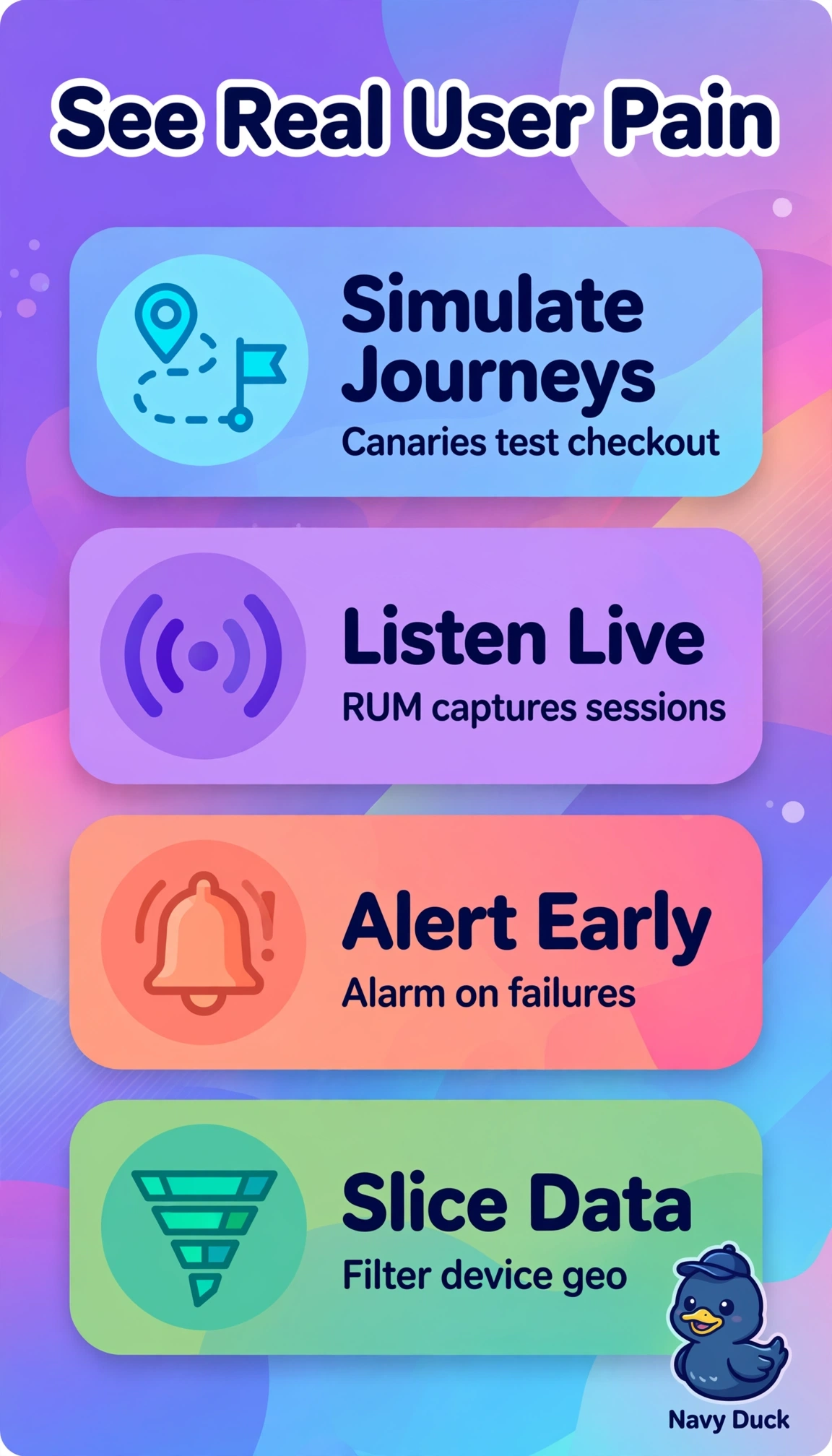
You get both a controlled checkout test and a view of real travelers’ experience: canaries exercise the flow, while RUM captures actual latency. That empathy for what users experience can reveal friction healthy backend metrics miss.
Full Explanation
The effective strategy combines CloudWatch Synthetics canaries that exercise complete checkout flows with CloudWatch RUM on checkout pages: canaries provide proactive, controlled checks, while RUM captures actual user latency and session diagnostics across desktop and mobile users and continents. This reveals frontend, network, and third-party friction that healthy backend metrics can miss. Canaries limited to checkout API endpoints validate backend availability, which already appears healthy, and cannot reproduce browser rendering delays, JavaScript errors, or payment-widget latency. Canaries restricted to one region cannot represent intercontinental routing, CDN edge performance, or localized failures; global RUM provides real-user evidence but not the controlled synthetic baseline needed for proactive alerting. Canaries run only on deploys offer point-in-time validation, not continuous monitoring for drift, regional outages, or third-party degradation between releases. Exam caveat: distinguish continuous scheduled canaries with CloudWatch alarms from manual or event-triggered runs, and browser transaction monitoring from API monitoring when user experience is poor despite healthy services. Practical check: verify scripts proceed from add-to-cart through payment confirmation and capture screenshots and timings; confirm RUM is deployed on checkout pages with device and geography segmentation; then verify alarm actions notify product teams and correlate synthetic failures with RUM load distributions.