
A video editing collective has 40 EC2 editors across two Availability Zones needing shared POSIX access to 20 TB of active projects with sub-millisecond latency and burst throughput for 4K renders. Cold footage must cost little. Which storage architecture matches access patterns and performance requirements?
Select an answer to reveal the explanation.
Short Explanation
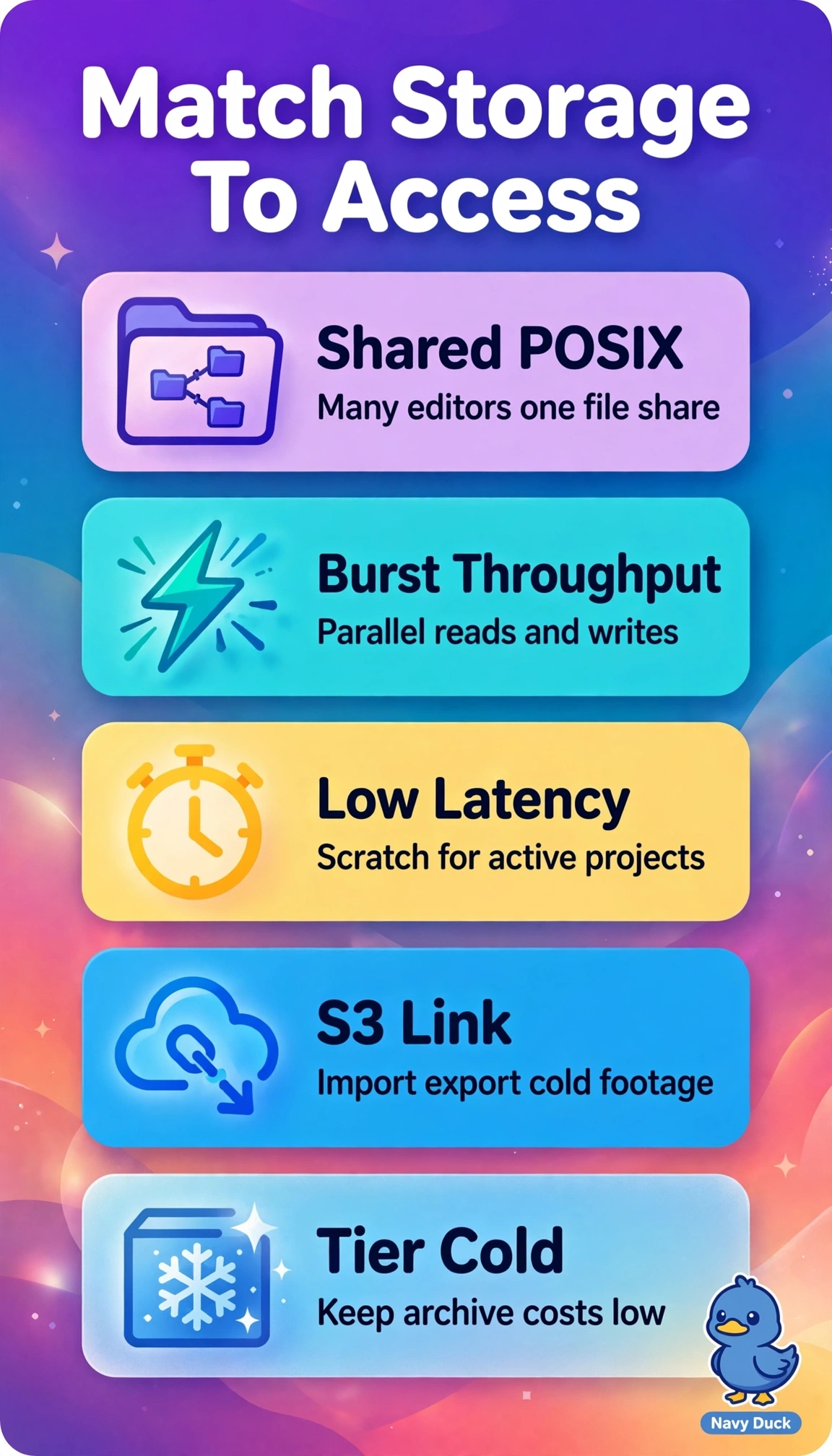
You need a shared scratch disk that screams, so FSx-Lustre fits like a turbocharged whiteboard. It bursts for renders while S3 keeps cold reels cheap.
Full Explanation
FSx for Lustre provides a shared POSIX parallel file system with high aggregate throughput and sub-millisecond latency (the file system lives in one Availability Zone, but clients in both zones can mount it), integrates natively with S3 for transparent data lake linkage, and suits burst-heavy render workloads across many clients, while S3 handles durable low-cost cold storage. EBS volumes are zonal block storage for one instance and even with NFS sharing create a single bottleneck and availability risk, failing the multi-AZ shared performance need. EFS offers elastic shared POSIX across zones but targets general-purpose latency and throughput profiles and cannot match Lustre burst throughput for 4K parallel renders. S3 provides durable object storage but lacks native POSIX semantics, file locking, and low-latency random writes needed for active editing. For the exam, map Lustre to HPC and media scratch, EFS to shared general files, and S3 to object and archive tiers. In practice size scratch capacity for throughput, validate client mounts, and lifecycle cold data to S3.