
A media company stores 800 TB of user-uploaded videos with unpredictable access patterns, some files become rarely accessed after 30 days, retrieval must remain in milliseconds when requested, and finance requires automatic cost reduction without application changes or retrieval fees. Which storage tiering design meets these access and cost requirements?
Select an answer to reveal the explanation.
Short Explanation
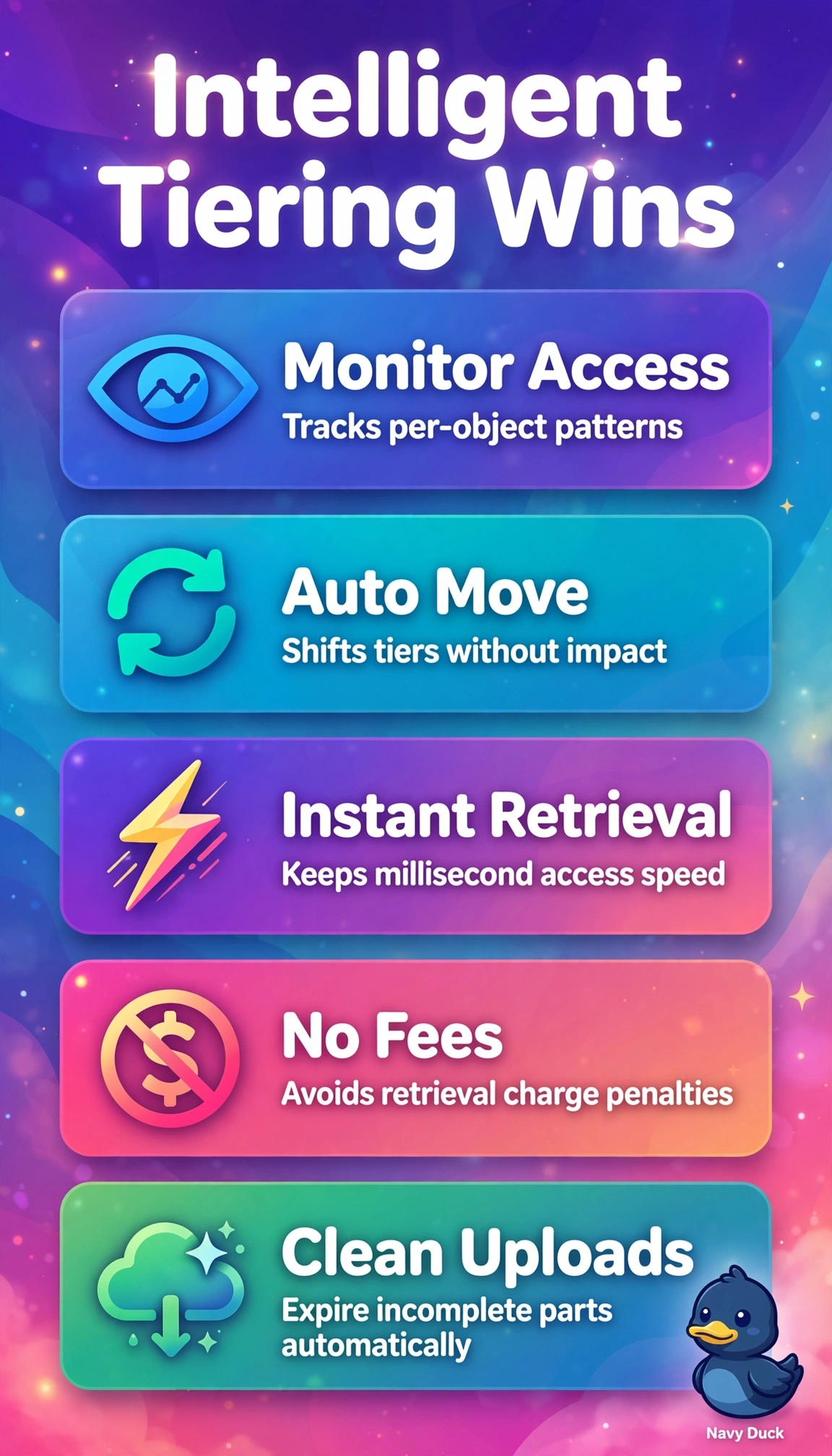
You're dealing with mystery access patterns that still need instant playback. Intelligent-Tiering watches each object and slides it to cheaper frequent or infrequent layers automatically.
Full Explanation
S3 Intelligent-Tiering monitors object-level access and moves data automatically between the Frequent, Infrequent, and Archive Instant Access tiers without performance impact or retrieval fees (the optional Archive Access and Deep Archive Access tiers are left disabled because they need minutes to hours to restore), preserving millisecond access for sudden re-requests while lowering cost without code changes, and lifecycle rules clean up incomplete multipart uploads. Transitioning to Glacier Flexible Retrieval after 30 days lowers storage cost but introduces hours-long restore times and retrieval fees that violate the millisecond retrieval requirement. Using Standard-IA with One Zone-IA assumes predictable infrequent access, charges retrieval fees, reduces durability to a single AZ, and misses automatic per-object optimization. Placing data in Express One Zone provides very low latency for high-performance workloads in a single AZ but carries higher storage cost, is not designed for 800 TB archival tiering, and CloudFront caching does not replace tiering. For the exam, remember Intelligent-Tiering suits unknown patterns with instant access, and confirm retrieval latency plus fee constraints before selecting Glacier.