
A regional retailer runs an Oracle workload on EC2 with 500 GB data in us-east-1. Business requires RPO under 1 hour, RTO under 4 hours for regional outage, with minimal standby cost and no rewrite. Which disaster recovery design meets the stated RTO, RPO, and cost constraints?
Select an answer to reveal the explanation.
Short Explanation
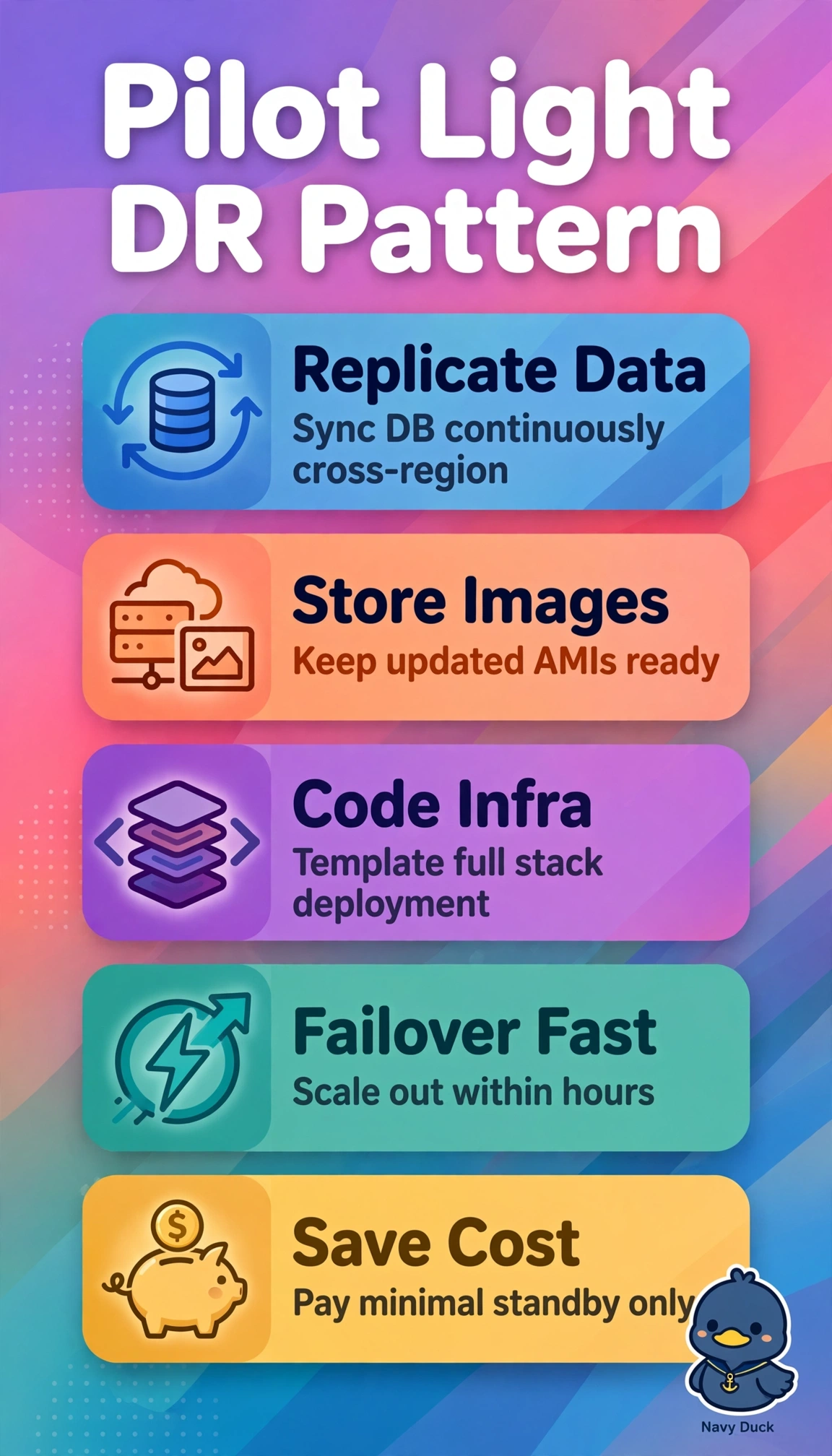
You're buying insurance you can afford but still pays out fast enough. Pilot light keeps critical data simmering so you can fire up full capacity only when disaster strikes.
Full Explanation
Pilot light maintains the minimum critical core in the recovery Region, typically continuous asynchronous database replication plus up-to-date AMIs and infrastructure as code, which holds RPO to minutes and allows RTO within a few hours by provisioning the remaining capacity on failover while avoiding always-on compute cost. Backup and restore with weekly AMIs and daily snapshot copies cannot reliably meet sub-hour RPO and adds lengthy restore and testing time that risks breaching the four-hour RTO. Warm standby with fully scaled duplicate infrastructure easily meets RTO and RPO but violates the minimal standby cost constraint with idle EC2 and database spend. Multi-site active-active with synchronous writes delivers near-zero RTO and RPO yet incurs the highest cost and Oracle licensing complexity and is excessive for the stated objectives. For the exam match RTO and RPO bands to backup, pilot, warm, and multi-site patterns, and in practice validate replication lag and run automated failover drills with timed CloudFormation launches.