
A pharmaceutical firm runs a regulated research assistant on Amazon Bedrock in two accounts, must retain every API action and every model prompt for 7 years immutably, and must prove no log tampering to auditors. Which audit trail design satisfies regulated AI logging requirements?
Select an answer to reveal the explanation.
Short Explanation
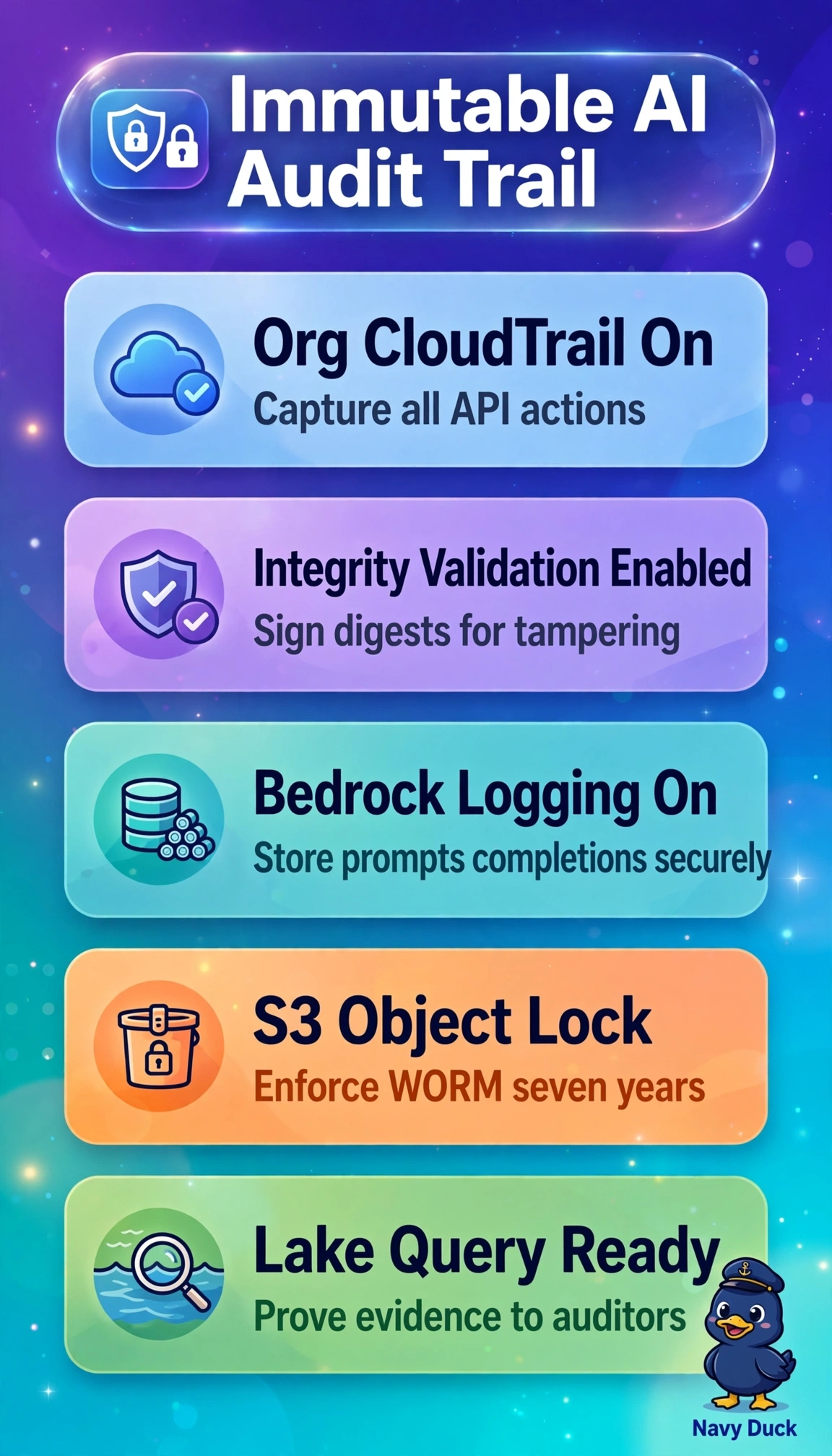
Auditors love receipts you can’t shred, and you’ve got them here. You’ll keep API history and AI prompts sealed with immutability, like evidence in a vault, while tamper checks and locked storage close the loop.
Full Explanation
Organization-wide CloudTrail with log file integrity validation creates a signed digest chain for API calls across both accounts. Storing the logs in a centralized S3 bucket with Object Lock in Compliance Mode and seven-year retention, together with Bedrock model invocation logging to that immutable store, captures control-plane actions and AI prompts and completions with user identity and time. This supports completeness, non-repudiation, and long-term retention for model governance. VPC Flow Logs with GuardDuty findings archival captures network telemetry and threat findings for review, but misses API identity and AI prompt content, so it cannot reconstruct who invoked which model. CloudWatch Logs Insights on Bedrock agents with Config history export supports operational searches and tracks configuration changes, but does not provide cryptographically verifiable integrity or immutable seven-year WORM retention. Security Hub aggregation with Athena queries on ALB logs centralizes security posture and load-balancer access data, but omits CloudTrail management events and Bedrock invocation payloads. Exam caveat: CloudTrail integrity validation proves log-file integrity, while Bedrock invocation logging is needed for AI accountability; neither alone supplies both records. In practice, verify digest validation, Object Lock retention settings, and the KMS key policy before audit season.