
A logistics firm plans to migrate 400 servers from two data centers with undocumented dependencies, tight cutover windows, and business-critical batch jobs that cannot move together. Leadership needs dependency mapping and phased waves. Which discovery design plans migration waves?
Select an answer to reveal the explanation.
Short Explanation
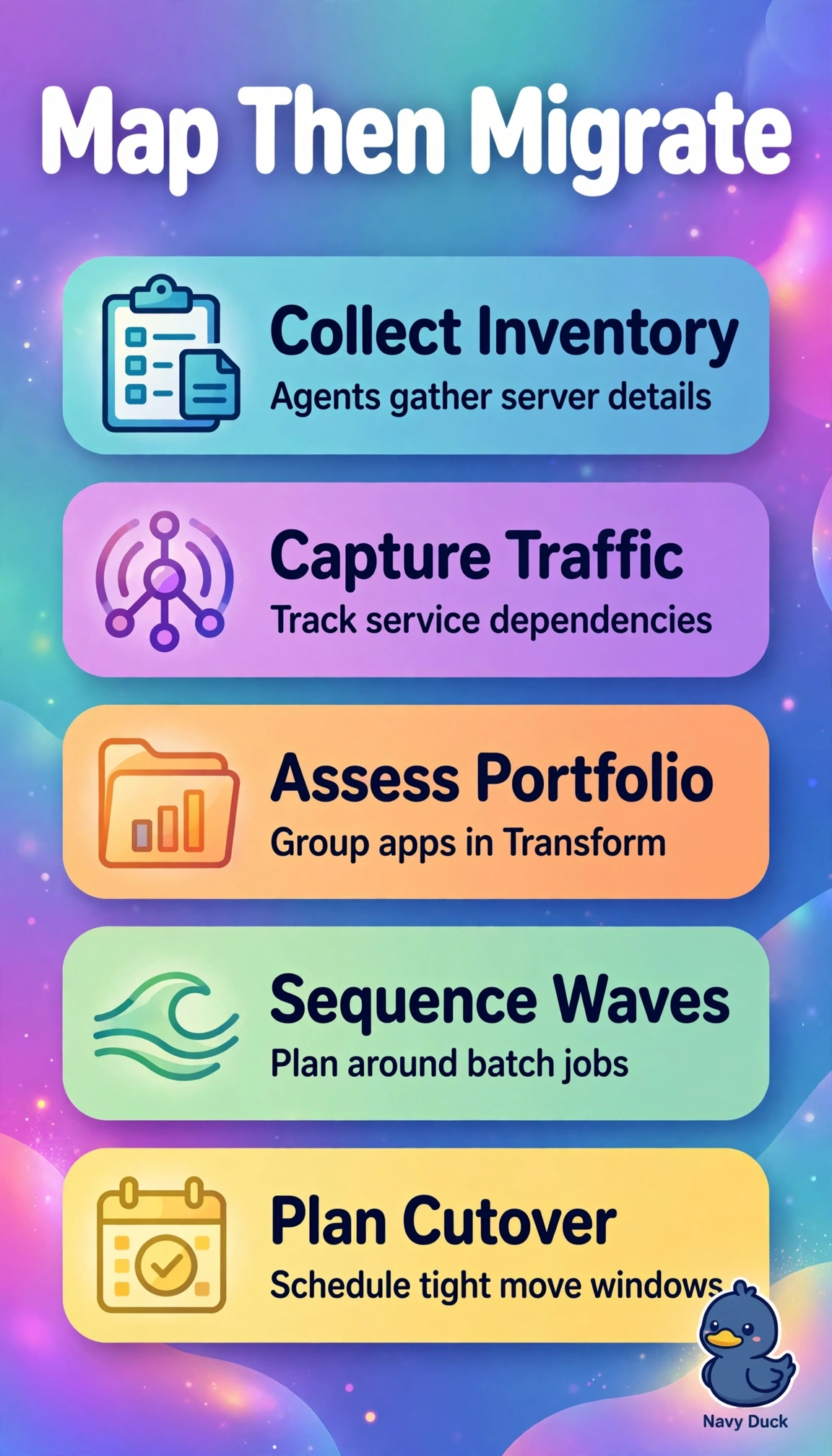
Solid waves start with seeing who talks to whom before anyone moves. Mapping chatter first gives you dependency mapping that keeps critical batch jobs happily together.
Full Explanation
The correct design is right because with 400 servers across two sites and no reliable documentation, agent-based discovery in AWS Transform collects process-level communication data, builds application dependency maps, and supports wave planning, which is what lets you separate business-critical batch jobs and fit tight cutover windows. AWS Transform is the current home of these capabilities: AWS Application Discovery Service and Migration Hub are closed to new customers (since November 7, 2025) and point new projects to AWS Transform. The vCenter inventory approach fails on discovery depth because host cluster affinity shows where virtual machines run, not how applications talk, so hidden dependencies remain and waves risk breaking transactions. The together-migration approach fails on constraint handling because placing tightly coupled systems in shared windows ignores the explicit rule that business-critical batch jobs cannot move together. The replication-first approach fails on sequencing because continuous replication and launch testing validate movability but do not establish move groups, so teams cannot order cutovers safely. Exam caveat is to distinguish discovery for wave planning from migration execution and choose dependency mapping whenever undocumented dependencies and separation constraints appear. Practical check is to confirm collector coverage across both data centers, review dependency graphs for batch schedulers, and align proposed waves with owners before freezing dates.