
An insurance firm processes claims in five steps across Lambda, human approvals, and partner APIs with retries, timeouts, and full audit of state. Executions must survive staff delays lasting days and resume safely after failures. Which design provides durable execution?
Select an answer to reveal the explanation.
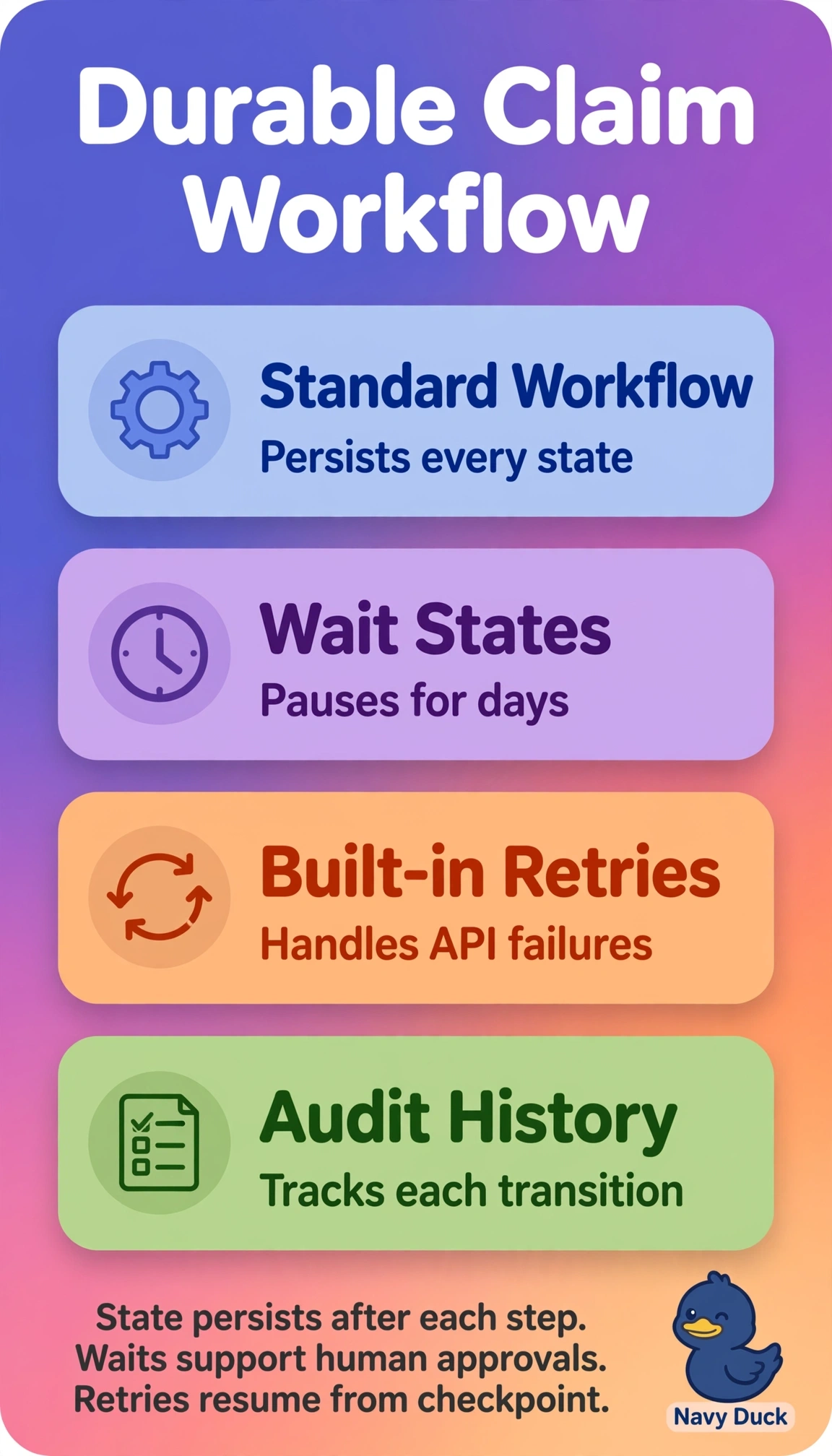
Short Explanation
Claims stuck for days awaiting signatures? You'll keep every step safe with durable state that pauses, retries, and resumes without losing place.
Full Explanation
Step Functions Standard is correct because it provides managed durable execution that persists state after every transition for up to one year, with built-in retries with backoff, per-state timeouts and heartbeats, integration for human approvals via task tokens, and immutable execution history that satisfies full audit and safe resume after failures even when staff delays last days. The SQS queue design with Lambda consumers, DLQs and idempotent handlers is widely used for decoupled retries and fault isolation, but as choreography it lacks a central execution record, so timeout enforcement, resume position and audit must be reconstructed manually. The Express workflow design is widely used for high-volume short-lived event processing with low latency, but maximum duration is five minutes with limited history retention, so it cannot span multi-day human waits. The DynamoDB table design driven by EventBridge rules and Lambda retries is a solid event-driven approach that persists progress, but ordering, deduplication, timeout escalation and compliant audit remain custom code without durable engine guarantees. Exam caveat is to choose by duration and history requirements rather than speed or cost when Standard and Express both appear. Practical check is to confirm longest human wait, required retention of state history, and task-token heartbeat handling with failure injection.