
A national logistics firm runs inventory on premises with JMS queues and SOAP XML services that cannot be rewritten. Partners need REST JSON APIs with burst buffering and per-key throttling during peak season. Which data-transformation integration pattern modernizes the legacy interface without rewriting the host?
Select an answer to reveal the explanation.
Short Explanation
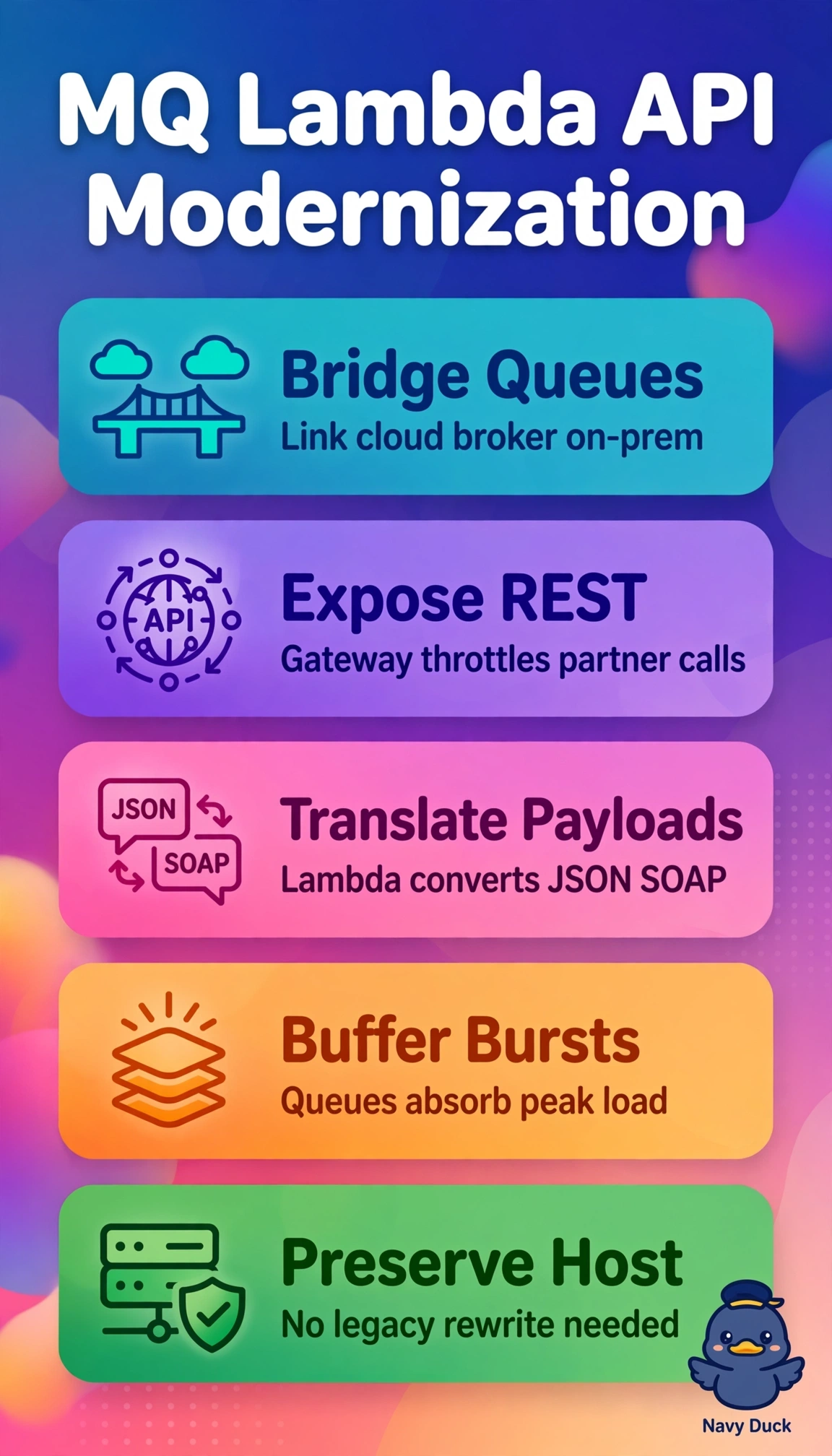
You've got an old language speaker meeting new visitors — you need a patient interpreter, not a megaphone. Your broker-bridge absorbs bursts in queues while Lambda quietly rewrites each message format.
Full Explanation
The correct pattern preserves the system of record while adding a cloud-native facade: Amazon MQ speaks native JMS and can federate or bridge to the on-premises broker so no host rewrite is needed, API Gateway provides REST, throttling, and auth for partners, and Lambda performs stateless JSON to SOAP XML translation per request, with queues absorbing bursts that direct synchronous calls would drop. Publishing SOAP directly behind API Gateway fails by concept because mapping templates handle payload shape but do not speak JMS nor provide durable buffering for back-pressure, leaving peak bursts to overwhelm the legacy service. Streaming through Amazon MSK fails by concept because it requires changing producers to publish to Kafka topics and rearchitecting reads around DynamoDB, violating the no-rewrite constraint and shifting consistency semantics. Replicating with AWS DMS to Aurora and exposing GraphQL fails by concept because it solves data-read modernization but breaks transactional queue semantics, ordering, and write-through inventory operations that must still flow to the legacy queues. For the exam, remember transformation plus protocol bridging points to Amazon MQ plus Lambda plus API Gateway, and in practice verify queue federation, idempotency in Lambda, and Gateway usage plans before peak load.