
A logistics firm runs 50 microservices across three VPCs and two accounts with polyglot protocols. Teams need identity-aware routing, fine-grained traffic shifting, and unified telemetry without running sidecar proxies or managing service discovery manually. Which service mesh design simplifies communication and observability?
Select an answer to reveal the explanation.
Short Explanation
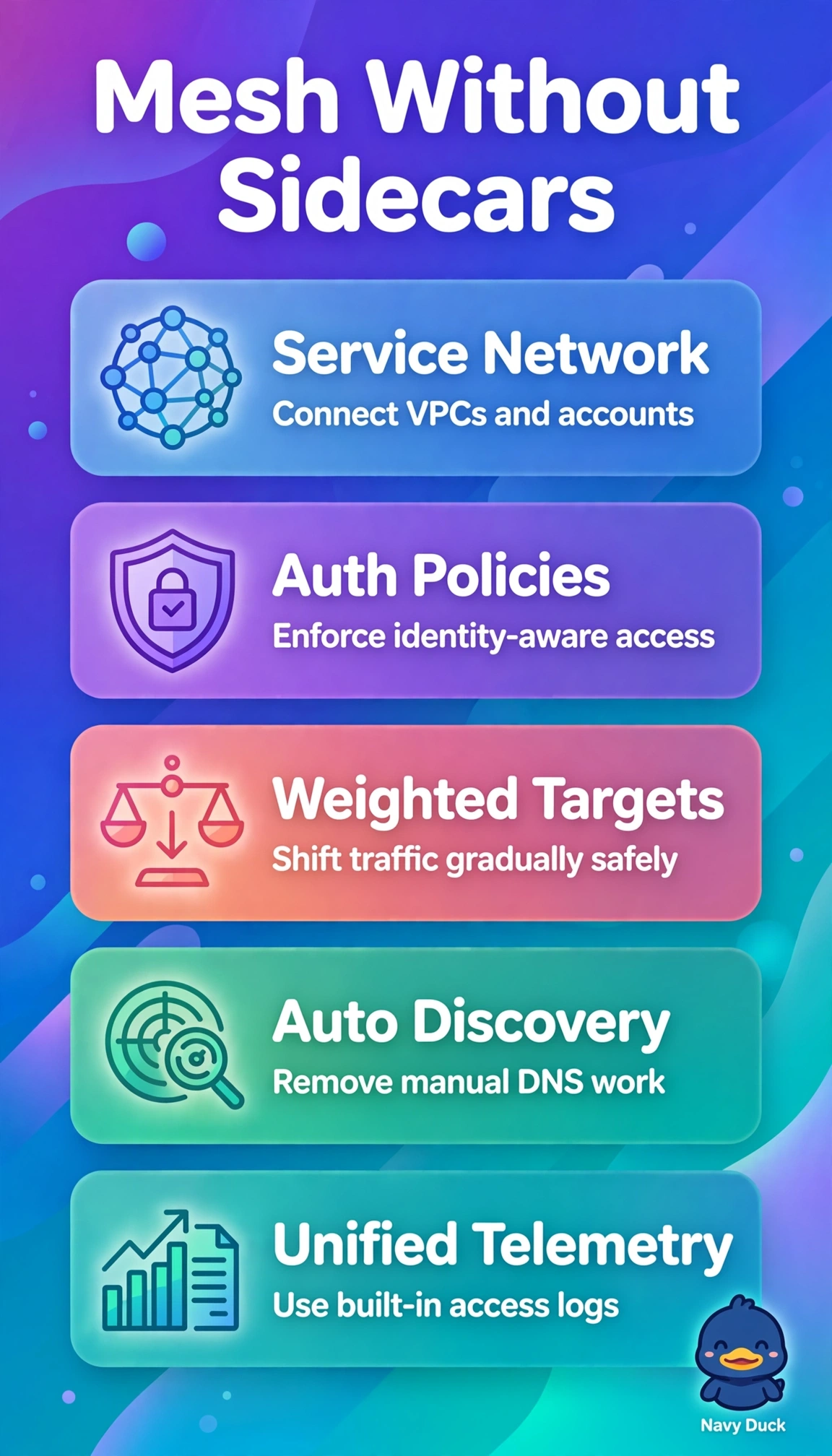
You're juggling dozens of services, and it's like trying to direct traffic at a busy intersection by hand. With VPC Lattice, you'll get discovery, auth, weighted shifting, and logs built right in, so you don't have to babysit sidecars.
Full Explanation
VPC Lattice is the intended sidecarless mesh for this estate because a service network natively spans multiple VPCs and accounts through associations, provides identity-aware routing via auth policies tied to IAM principals, supports fine-grained shifting via weighted target groups across services, and emits unified access logs and metrics without agents, which directly satisfies polyglot east-west communication with no proxy fleet and no manual discovery. AWS App Mesh fails the operational constraint by concept, and is also being discontinued (support ends September 30, 2026, with VPC Lattice as a documented migration path), because every workload must still inject, patch and scale an Envoy container for routing and telemetry, reintroducing the sidecar burden the stem explicitly rules out despite strong traffic and observability features. ECS Service Connect with Cloud Map fails the scope constraint by concept because it is an ECS-centric discovery and short-name routing construct whose namespaces and configuration do not transparently federate across three VPCs and two accounts as a single mesh, leaving cross-boundary discovery and policy fragmented. Private API Gateway with Lambda authorizers fails the topology constraint by concept because it is a north-south ingress front door for edge-to-service calls with stage canaries, not a transparent service-to-service fabric, so using it for 50 polyglot microservices forces centralized hops, protocol translation and per-API overhead. Exam caveat is to distinguish managed ingress and orchestrator-local discovery from true multi-account mesh when the stem stresses no sidecars and no manual discovery, and practical check is to confirm Lattice service network associations to all VPCs and accounts, attached auth policies, weighted target distributions, and centralized access-log delivery before migration.