
A travel company wants a conversational agent that can check live bookings via Lambda, answer policy questions from PDFs, maintain session memory, and trace each tool call for support audits. Developers prefer managed orchestration over custom LangChain code. Which AI agent architecture integrates tools with traceable managed orchestration?
Select an answer to reveal the explanation.
Short Explanation
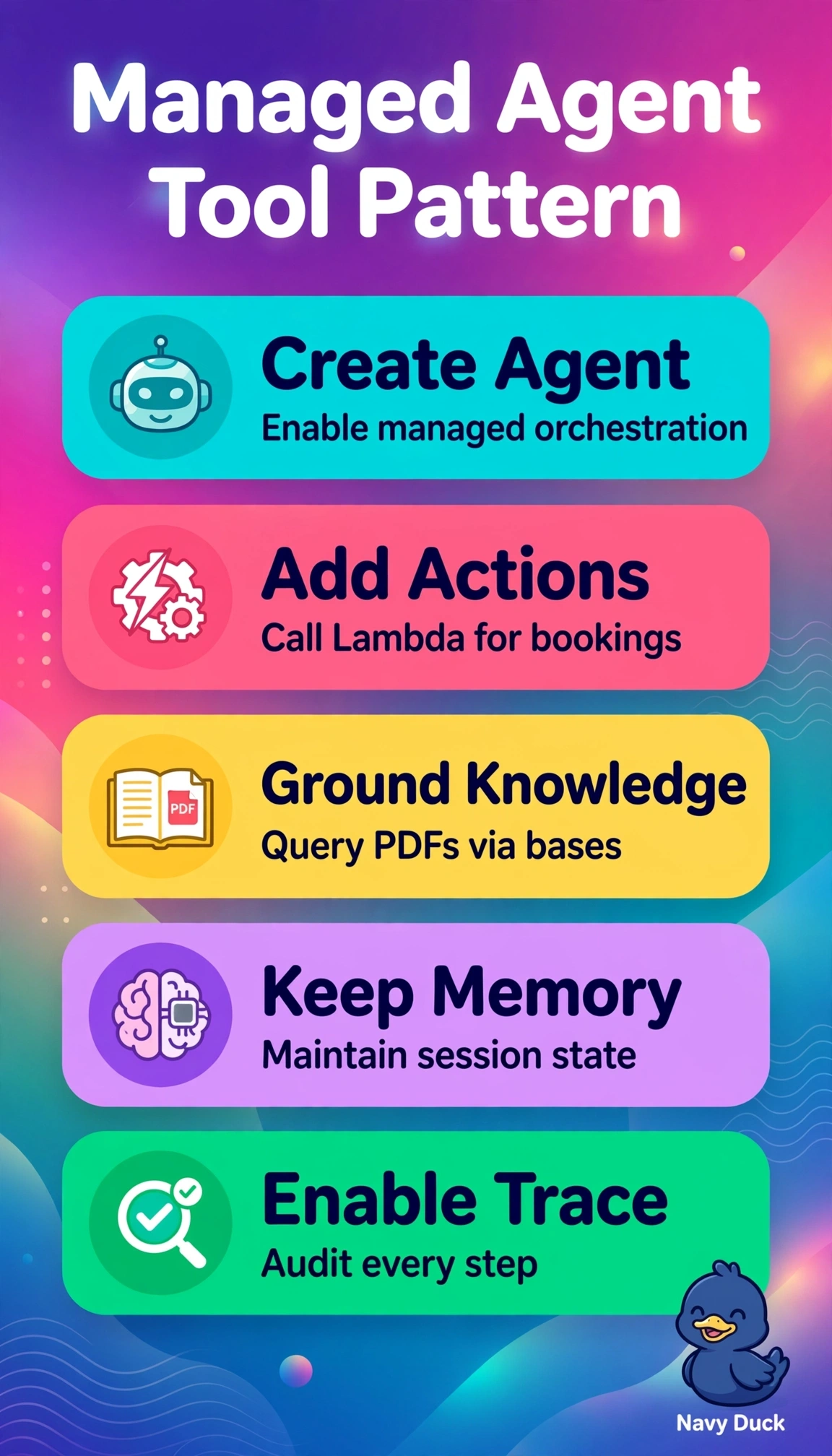
Great agents juggle live tools and docs without dropping context. Bedrock agents plus action groups give you managed orchestration with receipts for every call.
Full Explanation
The correct design is right because Bedrock Agents provides managed orchestration that plans multi-step tasks, invokes action groups backed by Lambda for live bookings, retrieves policy answers from PDFs via Knowledge Bases with managed chunking and embeddings, maintains session state across turns, and emits a unified agent trace showing reasoning, Knowledge Base lookups, and Lambda inputs and outputs for support audits. The Lex-based design fails by concept because Lex offers managed intent fulfillment with Lambda, Kendra retrieval, session attributes, and CloudWatch conversation logs, but its logging records utterances and slot fills rather than the detailed per-turn agent orchestration trace with tool invocations required here. The LangChain-based design fails by concept because LangChain orchestration of Bedrock models with Lambda tools, PDF retrieval, memory, and custom logging is powerful and widely used, yet it requires developer-managed code for planning, parsing, error handling, and observability, which directly violates the stated preference for managed orchestration over custom code. The Bedrock agent with inline prompt context design fails by concept because stuffing policy text into prompts cannot reliably scale to large evolving PDF corpora with semantic search, citations, and sync, unlike a Knowledge Base designed for grounded retrieval-augmented generation. Exam caveat: do not equate CloudWatch logs, model invocation logs, or prompt history with agent trace, as only the Bedrock agent trace exposes the orchestrator’s step-by-step decisions for audits. Practical check: verify the action group OpenAPI schema to Lambda is configured, the Knowledge Base PDF data source is synced, the same sessionId is reused for memory, and test invocations return trace events showing the full tool chain.