
A gaming company runs active-active APIs in us-east-1 and eu-west-1 needing sub-100ms joins, automatic failover on health failure, and static IPs for firewall allowlisting. Latency-based DNS alone causes inconsistent reconnects. Which global traffic routing design meets latency, failover, and static IP needs?
Select an answer to reveal the explanation.
Short Explanation
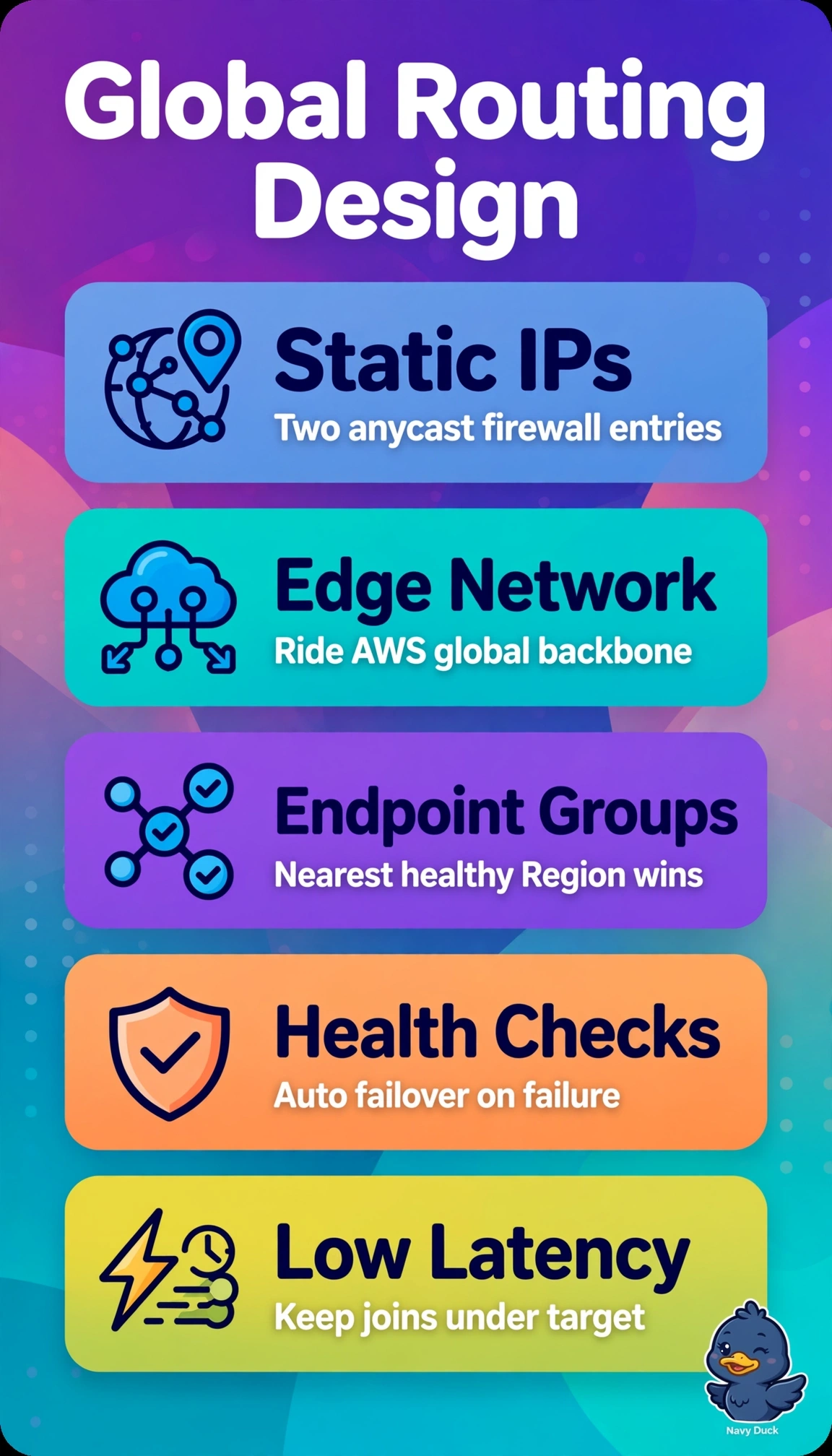
You'll keep your players in the game with fast, reliable joins that work like an express lane to the closest open checkout. Global Accelerator gives you two static anycast IPs for easy allowlisting while routing over AWS backbone to healthy endpoints with automatic failover.
Full Explanation
AWS Global Accelerator provides two static anycast IPs, routes TCP and UDP over the global edge network to the nearest healthy endpoint group, performs continuous health checks with automatic failover between Regions, and preserves client affinity better than DNS caching for real-time joins. Route 53 latency routing improves DNS answers but depends on client resolver caching and lacks static IPs and transport-level steering, causing inconsistent reconnects. Geolocation plus failover controls placement by user geography but still uses DNS with per-Region Elastic IPs requiring multiple firewall entries and slower failover. CloudFront optimizes HTTP caching and needs weighted DNS without static anycast IPs for non-HTTP game traffic and does not provide Regional endpoint-group failover. Exam caveat is Global Accelerator for static IPs and backbone performance versus Route 53 for DNS control, and practical check is to confirm accelerator listeners, endpoint weights, and firewall allowlists contain only the two accelerator IPs.