
A global media company streams product videos from an S3 bucket in us-east-1 to viewers in North America, Europe, and Asia. Origin fetch fees are spiking during launches, cache hit ratio is below 60%, and an origin outage must not cause playback failures. Which content delivery design best reduces data transfer and network costs while adding failover?
Select an answer to reveal the explanation.
Short Explanation
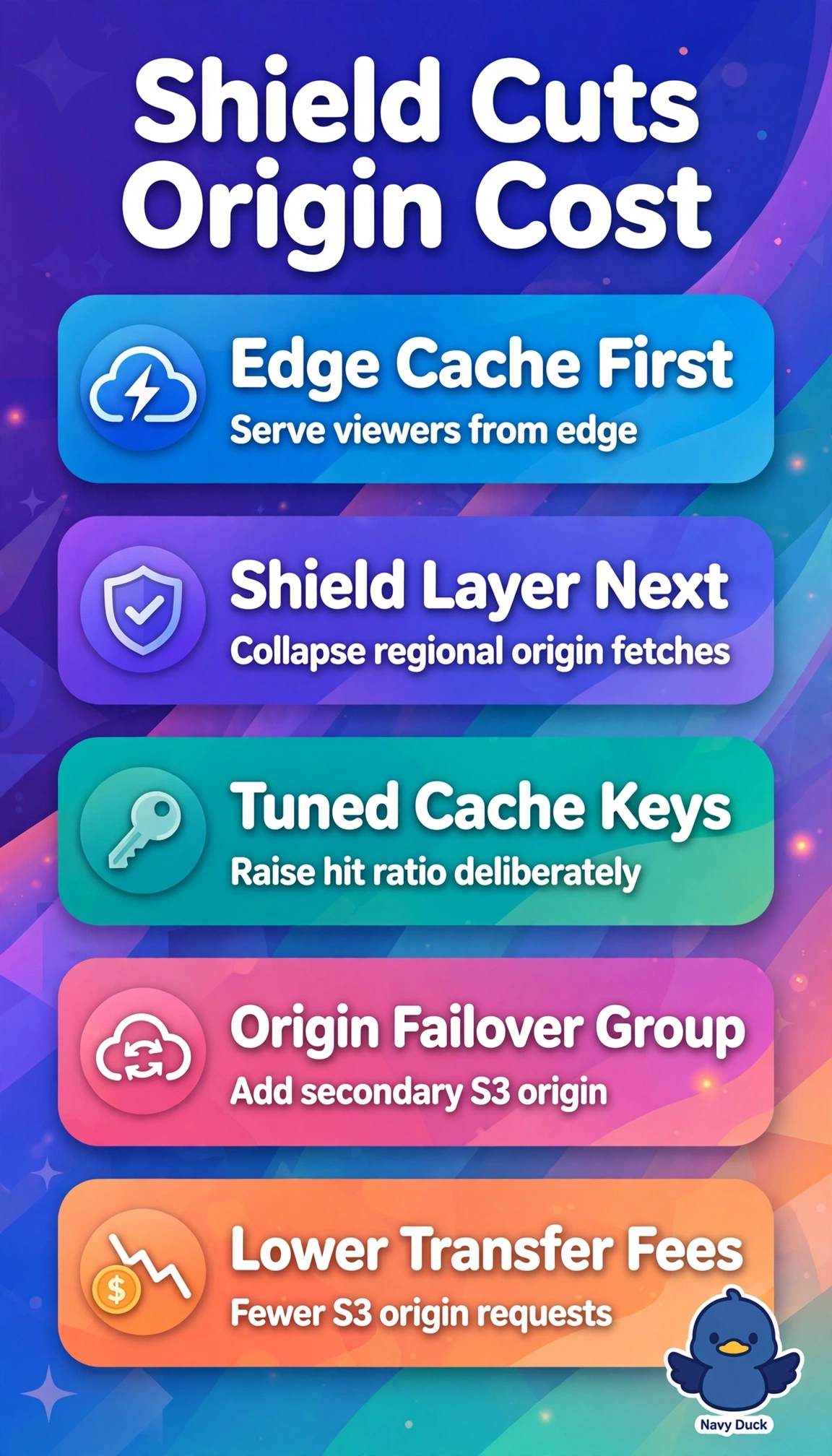
You cut repeat trips to the origin when Shield collapses requests into one regional fetch. Origin Shield boosts hit ratio, lowers egress, and paired with failover keeps playback resilient.
Full Explanation
CloudFront caches edge content and Origin Shield adds a regional mid-tier cache that collapses concurrent origin requests into a single fetch, sharply raising cache hit ratio and cutting S3 origin data transfer and request charges across continents while keeping distribution logic centralized. Tuned cache keys and TTLs extend reuse for launch spikes, and an origin group with a secondary S3 origin provides automatic failover without custom client logic. S3 Transfer Acceleration with presigned URLs still forces clients toward the origin over optimized paths but lacks edge caching and failover, so origin fees remain high. Global Accelerator improves network path performance to load balancers but does not provide HTTP caching or S3-aware origin shielding, leaving repeated fetches expensive. Direct Connect gateways optimize private connectivity rather than public delivery and replicating buckets per viewer region adds storage and replication transfer cost without edge caching intelligence. Exam caveat: choose Origin Shield when the scenario stresses origin fetch cost and hit ratio, not just latency. Practical check: monitor cache hit ratio and origin requests in CloudFront metrics after enabling Shield.