
A county needs subject-matter judgment on whether clerk-bot answers are factually correct. Which evaluation mechanism best supplies that signal?
Select an answer to reveal the explanation.
Short Explanation
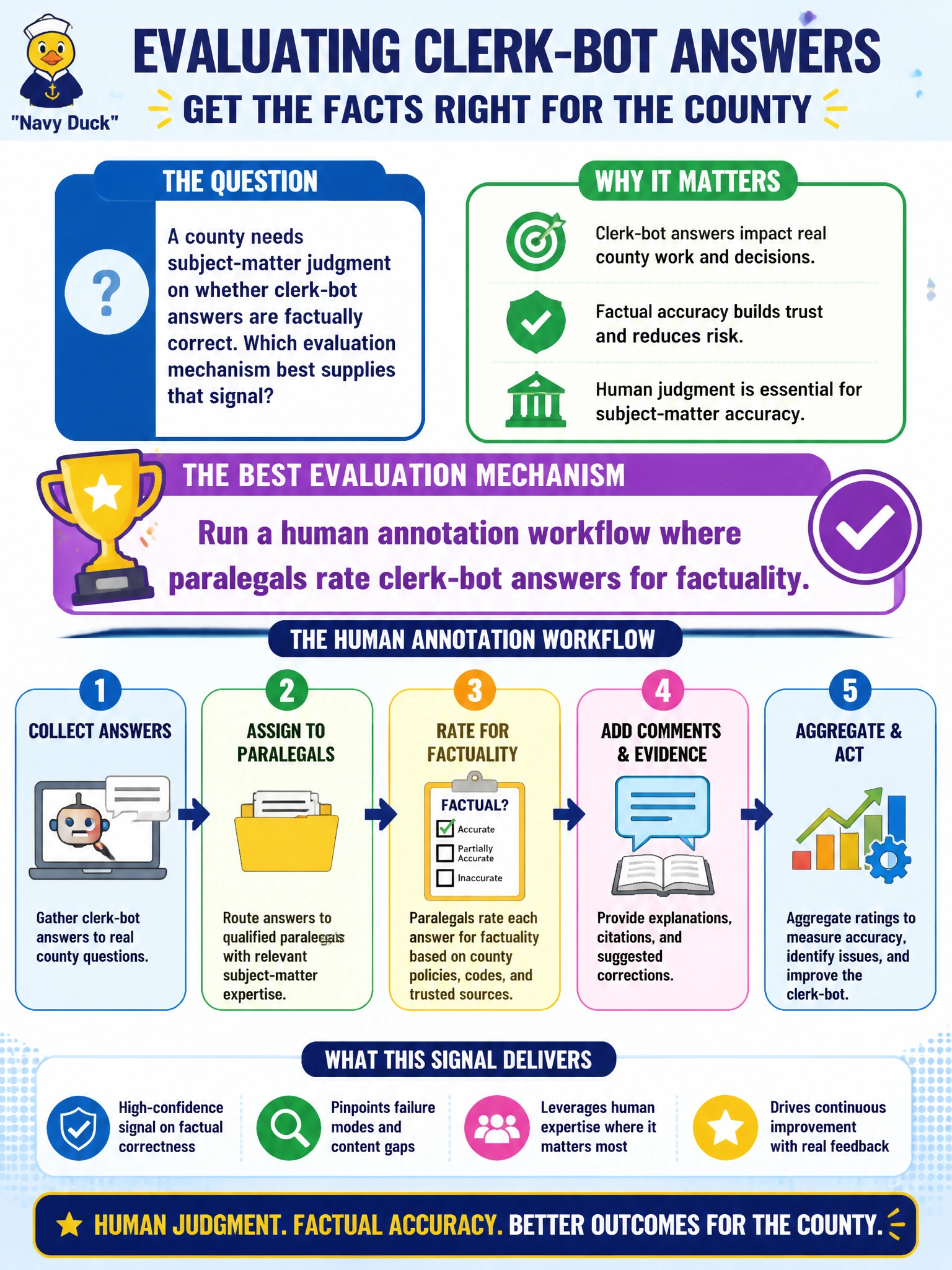
Paralegals know when a clerk-bot answer is quietly wrong. A human annotation queue is the red-pen review that machine speed alone cannot fake for factuality.
Full Explanation
Running a human annotation workflow where paralegals rate clerk-bot answers for factuality is the evaluation mechanism that best supplies subject-matter judgment on whether clerk-bot answers are factually correct. Factuality for clerk guidance often hinges on local procedure, fee rules, and filing nuances that automated proxies miss; trained paralegals provide grounded labels the county can use for scoring, error analysis, and model or retrieval fixes. Human annotation is the SME signal machine speed alone cannot invent. Automatically marking every answer correct if latency is under one second fails by concept: speed is not factual correctness. Using only synthetic random strings as the factuality ground truth fails by concept—random strings are not a valid factuality reference for clerk answers. Outsourcing factuality scoring to an unreviewed web scraper with no SME review fails by concept: unreviewed scrape noise is not subject-matter judgment. Exam caveat: factuality evaluation for civic assistants expects SME/human annotation rather than latency heuristics, random strings, or unreviewed scrapers. Operational check: define a factuality rubric, sample clerk-bot answers into a paralegal annotation queue, measure inter-annotator agreement, feed labels into evaluation dashboards and fine-tuning/retrieval backlogs, and re-annotate after major ordinance or prompt changes.