
A county must choose between two foundation models for ordinance Q&A using a structured, repeatable comparison. Which approach best supports that decision?
Select an answer to reveal the explanation.
Short Explanation
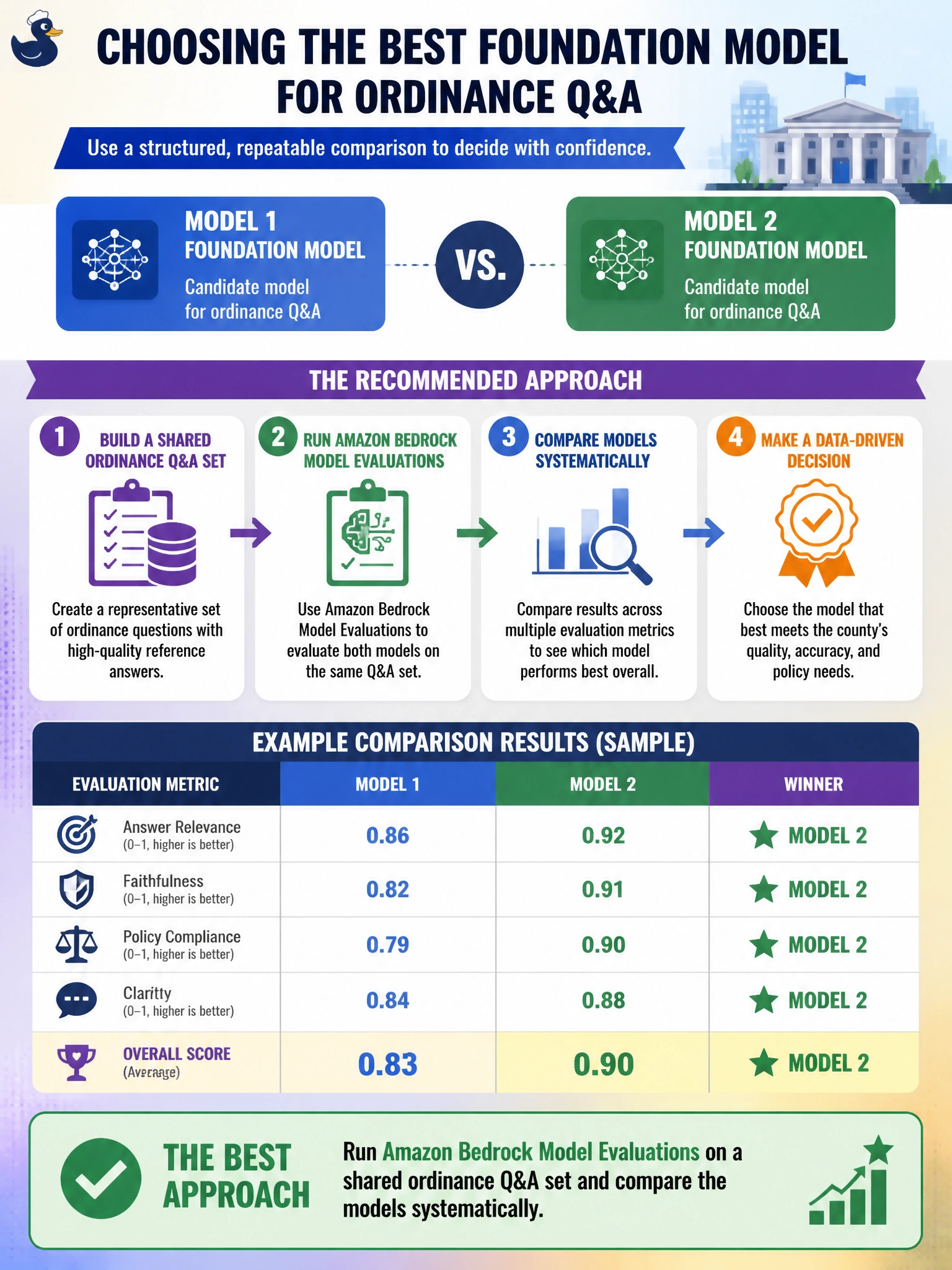
Choosing an ordinance brain is not a beauty contest. Bedrock Model Evaluations put both candidates through the same Q&A set so the county sees who actually answers better—before residents feel the experiment.
Full Explanation
Running Amazon Bedrock Model Evaluations on a shared ordinance Q&A set and comparing the models systematically is the approach that best supports a structured, repeatable foundation-model choice for county ordinance Q&A. A shared evaluation set holds content, rubrics, and scoring constant so differences reflect model behavior rather than anecdotal demos. Bedrock Model Evaluations provide a repeatable workflow the county can rerun when models or prompts change, documenting why one FM was selected for ordinance work. Picking the model whose marketing page uses the largest font size fails by concept: marketing presentation is not evidence of answer quality on local ordinances. Deploying both models to all residents with no evaluation dataset and deciding later fails by concept and risk—uncontrolled dual production exposure uses residents as the lab and delays evidence-based selection. Evaluating only classical k-means clustering accuracy instead of foundation-model answer quality fails by concept: unsupervised clustering metrics do not measure generative ordinance Q&A performance. Exam caveat: FM selection questions favor systematic evaluation on a shared task set over marketing, uncontrolled dual-deploy, or unrelated classical metrics. Operational check: freeze an ordinance Q&A evaluation set with SME labels, run Bedrock Model Evaluations for candidate models under the same prompts and retrieval context, record scores and failure modes, select with documented tradeoffs (quality, cost, latency), and re-run after major model version changes before countywide cutover.