
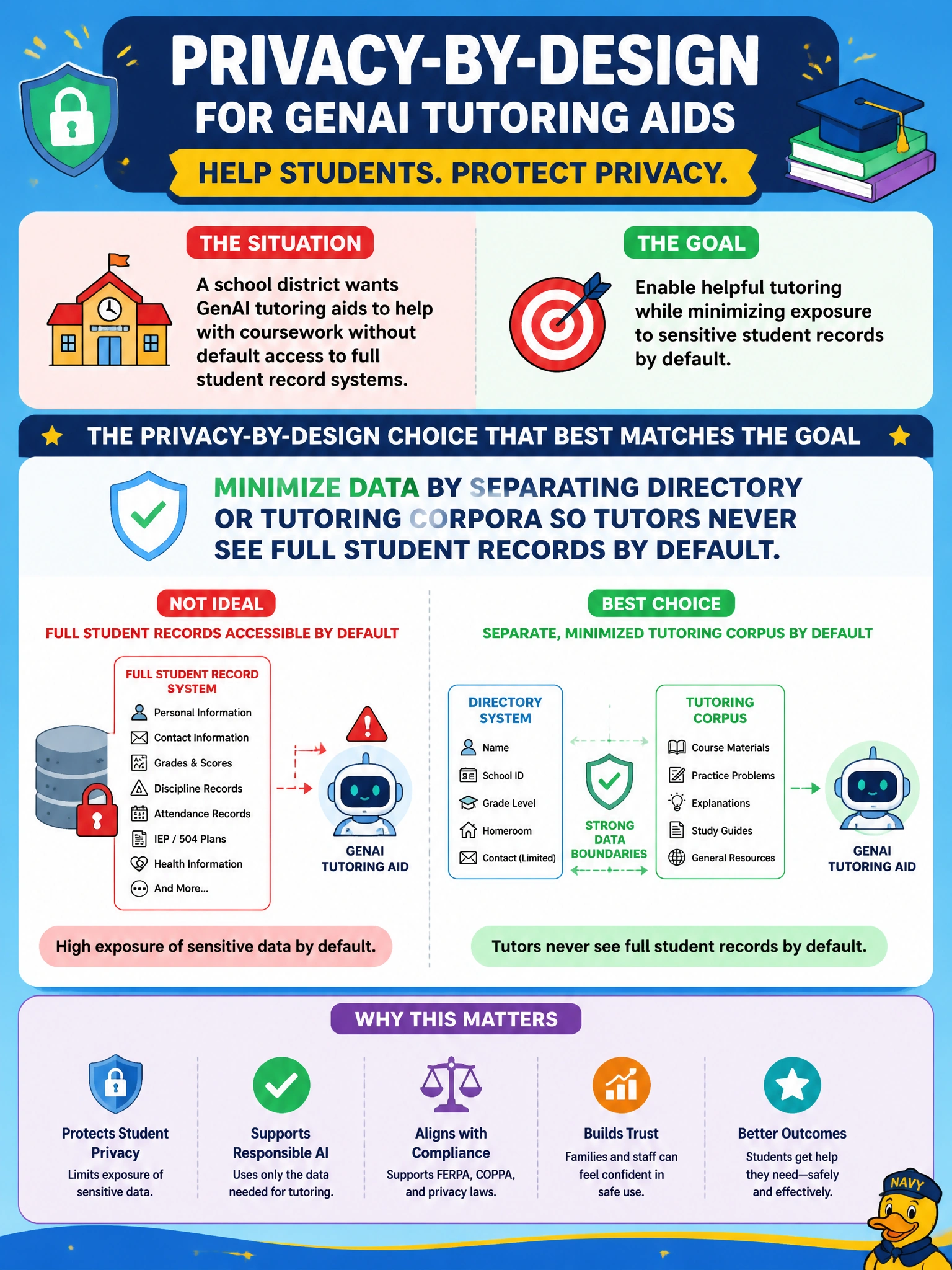
A school district wants GenAI tutoring aids to help with coursework without default access to full student record systems. Which privacy-by-design choice best matches that goal?
Select an answer to reveal the explanation.
Short Explanation
Privacy-by-design is packing only the homework folder into the backpack—not the entire cumulative file. Separate tutoring content from full SIS records so the GenAI helper stays useful without defaulting into every student field.
Full Explanation
Minimizing data by separating directory or tutoring corpora so tutors never see full student records by default is the privacy-by-design choice that matches a school district’s goal: GenAI tutoring aids help with coursework without default access to full student record systems. Build a narrow corpus (assignments, curriculum, optional limited directory fields) and keep the SIS—grades history, discipline, health, custody—off the tutor’s IAM and retrieval path unless a separate, explicitly authorized workflow requires it. Separation enforces minimization architecturally rather than hoping the model “won’t look.”
Connecting the tutor to the entire SIS with unrestricted read on every student field maximizes FERPA-sensitive exposure for a homework helper and violates least privilege. Caching complete cumulative folders in the chat session for “personalization” pulls full records into volatile context and logs. Publishing student record extracts to an open internet knowledge base for easier RAG is an unauthorized disclosure pattern dressed up as retrieval convenience.
Exam caveat: privacy by design for GenAI emphasizes data minimization and separation of corpora/systems—not bolting a chatbot onto the richest database available. Prefer purpose-limited tutoring data over full SIS connectivity.
Operational check: confirm the tutoring GenAI role cannot call SIS APIs or read full-record buckets, verify RAG indexes contain only approved coursework/directory content, sample prompts for accidental record leakage, and require a formal exception process before any SIS-linked feature ships.