
A parks web team wants a modern UI that calls GenAI without exposing Bedrock credentials in the browser. Which integration pattern accelerates that civic app?
Select an answer to reveal the explanation.
Short Explanation
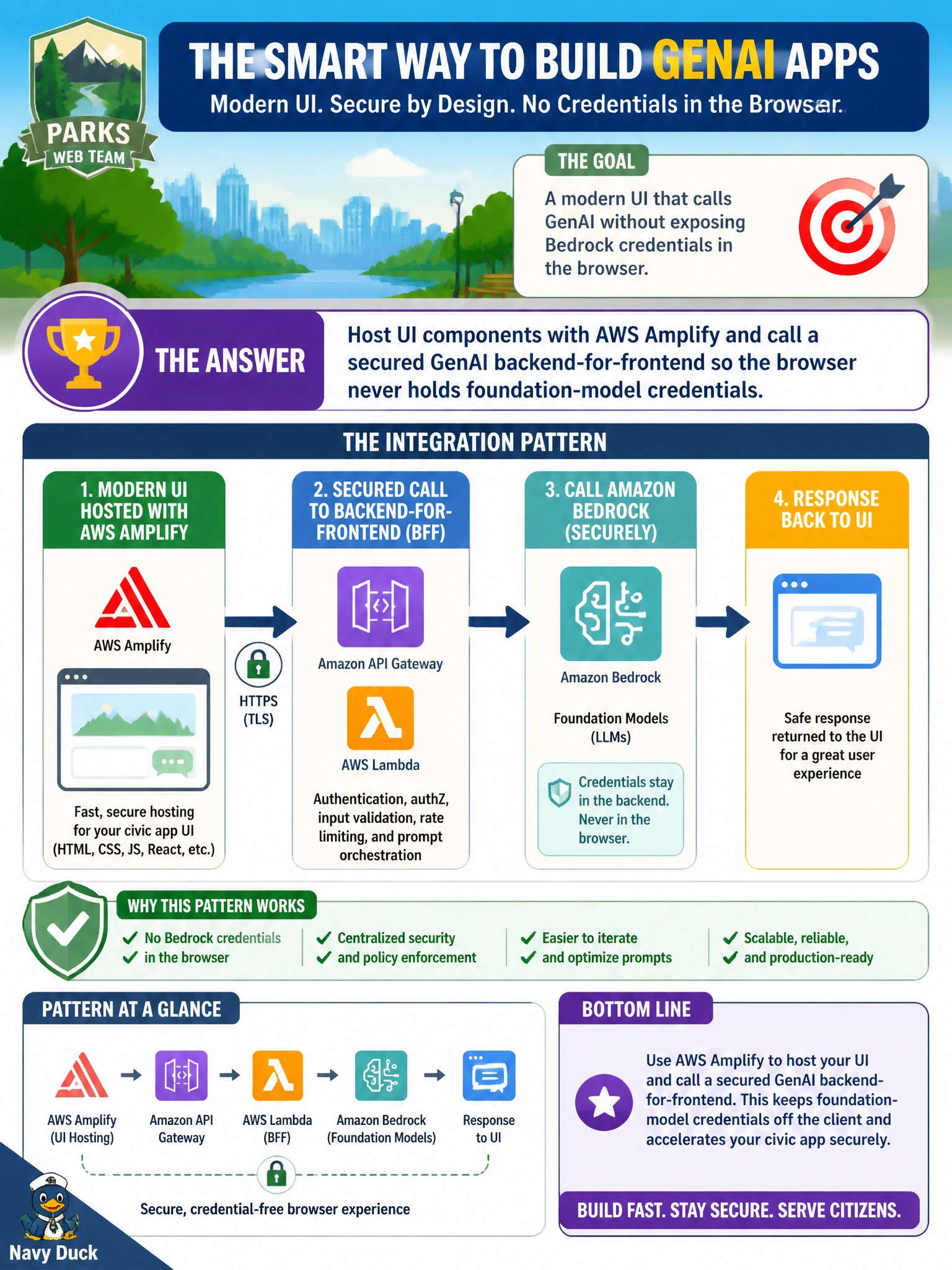
The pretty parks UI should talk to a secured back door—not carry master keys in the browser. Amplify hosts the front end; a GenAI BFF keeps Bedrock credentials server-side.
Full Explanation
A parks web team needs a modern UI that calls GenAI without exposing Bedrock credentials in the browser. Hosting UI components with AWS Amplify and calling a secured GenAI backend-for-frontend (BFF) accelerates the civic app while keeping foundation-model credentials on the server side. The browser authenticates to the BFF; the BFF invokes Bedrock with an IAM role. That pattern is standard for public-facing municipal front ends.
Embedding long-lived Bedrock access keys in client-side JavaScript bundles fails by concept: anything in the browser can be extracted, leaked, and abused at city cost. Disabling the website and requiring all park questions to be faxed fails the digital service goal entirely. Calling Bedrock directly from anonymous kiosk browsers with administrator IAM roles combines credential exposure with grossly excessive privilege.
Exam caveat: Amplify hosting plus a BFF solves credential placement; you still need authN/Z for staff vs public users, Guardrails on inputs/outputs, and rate limiting on the BFF. “Never holds FM credentials” applies to access keys and broad IAM users in JS—not to short-lived end-user tokens for your own API.
Operational check: review the shipped parks JS bundle and network calls to ensure no Bedrock keys or admin IAM credentials appear; confirm GenAI traffic goes to the secured BFF; attempt a direct Bedrock call from the browser context and verify it fails without server credentials.