
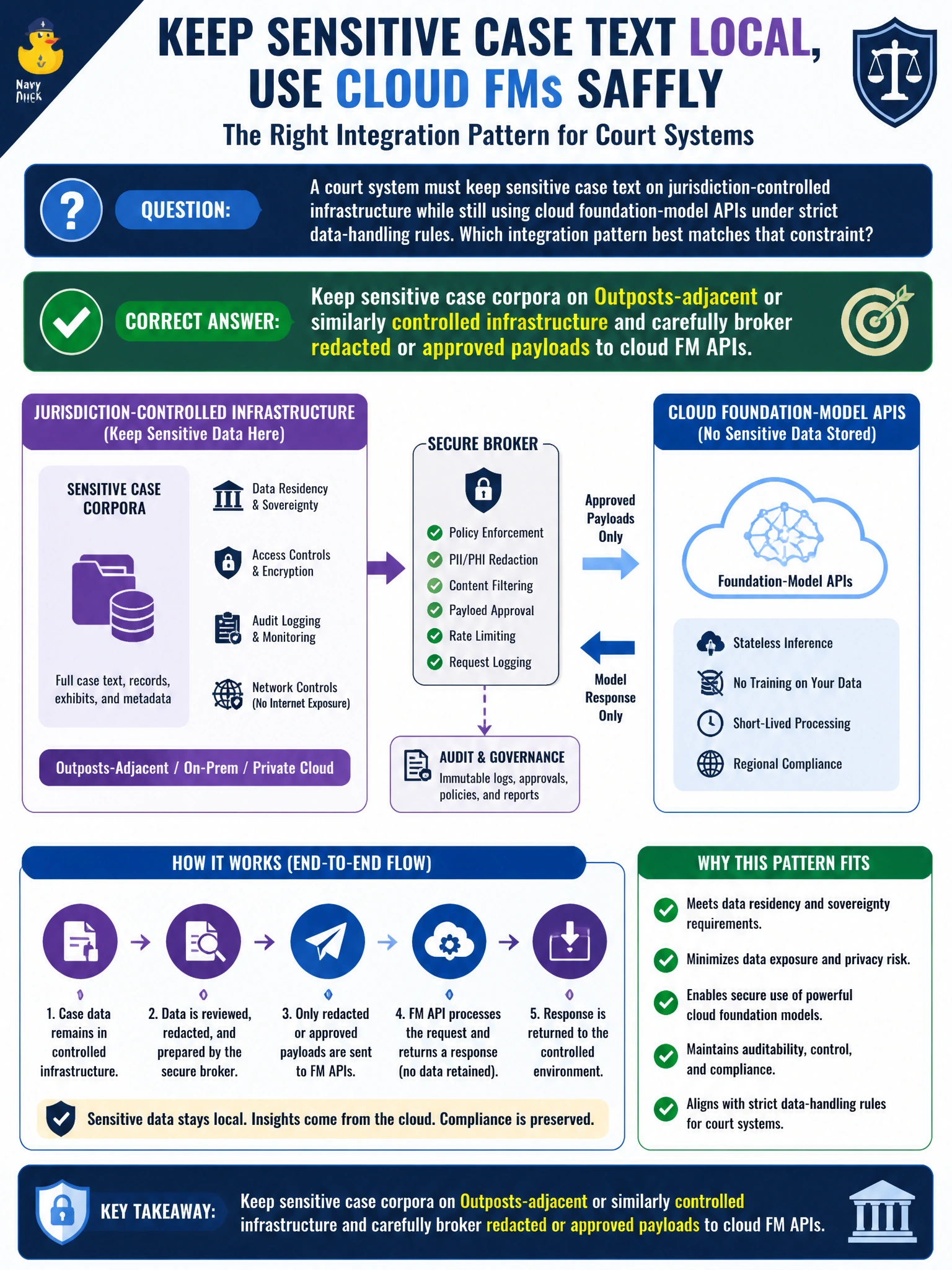
A court system must keep sensitive case text on jurisdiction-controlled infrastructure while still using cloud foundation-model APIs under strict data-handling rules. Which integration pattern best matches that constraint?
Select an answer to reveal the explanation.
Short Explanation
Think of the courthouse vault holding the originals while a tightly escorted courier carries only what the cloud model is allowed to see. Outposts-adjacent storage plus careful brokerage keeps jurisdiction rules intact without giving up cloud FM capabilities.
Full Explanation
Cross-environment GenAI for courts often retains sensitive case corpora on AWS Outposts or otherwise jurisdiction-controlled infrastructure while carefully brokering only redacted or approved payloads to cloud foundation-model APIs. That integration pattern respects judicial data-residency and confidentiality rules: raw sealed text stays on court-controlled hardware, and cloud FM calls receive minimized inputs that policy has cleared. The city or court IT team designs the broker for redaction, routing, encryption, and audit rather than treating the cloud FM as a free dump for full dockets. Uploading full sealed case files to a public model endpoint with no redaction or routing controls fails confidentiality and almost every judicial information-governance rule. Storing all case text only in a consumer chat app outside the court’s AWS accounts fails custody, e-discovery, retention, and access control—the court loses the system of record. Mirroring every sealed filing into an unencrypted cross-Region replication bucket for convenience fails encryption-in-transit/at-rest expectations and expands the blast radius of sealed material across Regions without justification. Exam caveat: Outposts-adjacent or controlled infrastructure solves residency for the corpus; it does not automatically make every cloud FM call compliant. Still enforce minimization, purpose limitation, and logging on what leaves the boundary. Also clarify which workloads must remain fully offline versus which may use approved cloud FM APIs. Operational check: Inventory which case fields may leave the controlled environment; implement redaction or summarization brokers before Bedrock invoke; verify encryption and Region constraints; audit payloads sampled from production; and confirm sealed matters never take the unredacted public-endpoint path.