
A county wants closed 311 tickets to kick off knowledge-base refresh workflows without hard-coding callers inside the ticketing UI. Which integration pattern best achieves that loose coupling?
Select an answer to reveal the explanation.
Short Explanation
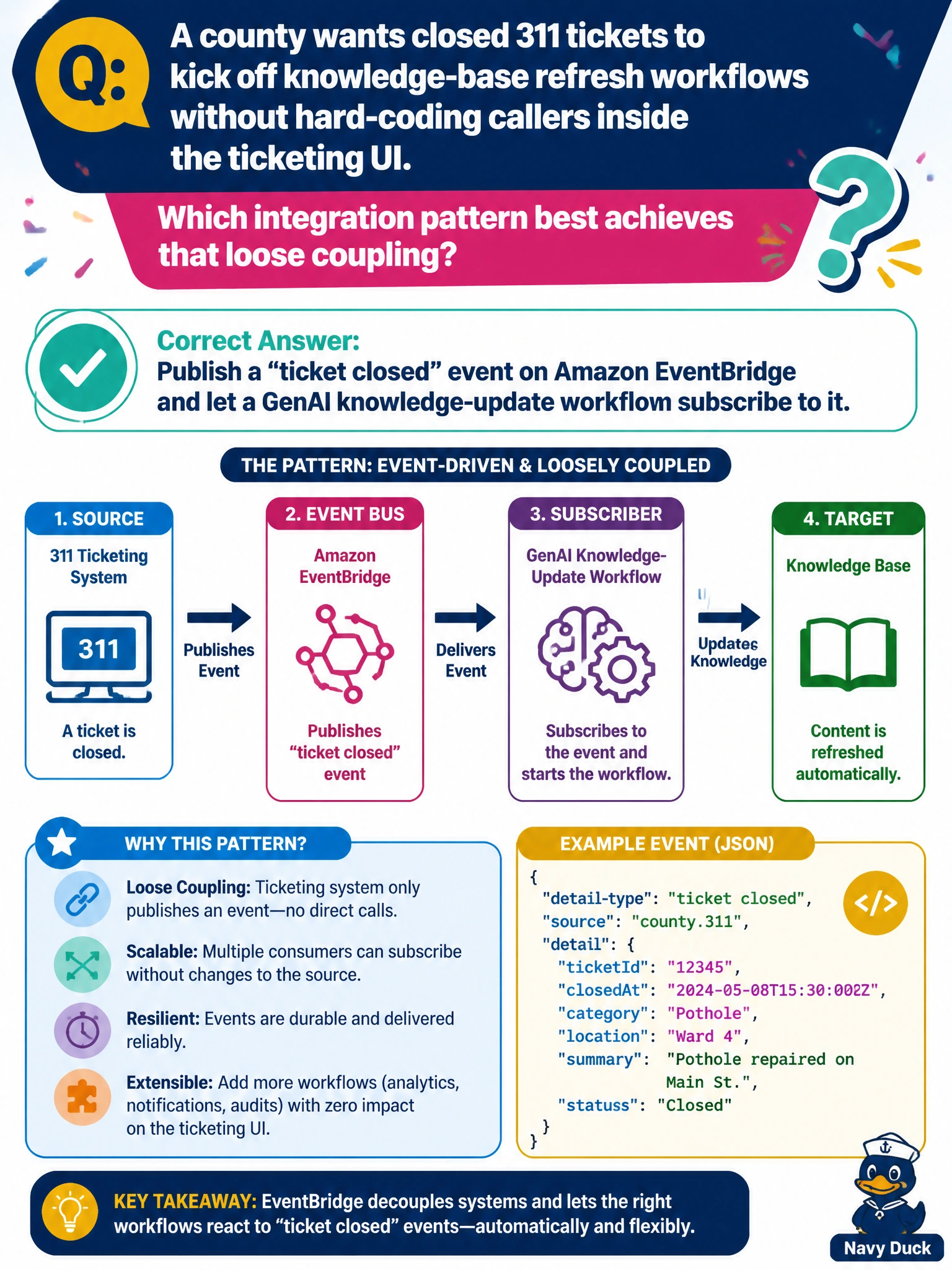
Closing a ticket should drop a note on a bulletin board that anyone interested can read—not force the front-desk app to know every downstream chore. EventBridge is that bulletin board for “ticket closed,” and the KB refresh workflow just listens.
Full Explanation
Event-driven integration with Amazon EventBridge lets a county publish a ticket-closed event from the 311 system of record and allow a GenAI knowledge-update workflow to subscribe—without hard-coding Bedrock or knowledge-base refresh callers inside the ticketing UI. That loose coupling means closing a ticket remains a domain fact; interested consumers, including GenAI maintenance pipelines, react independently. Municipal platforms stay evolvable: new GenAI subscribers can be added without rewriting the agent desktop save path. Adding a synchronous Bedrock invoke call directly in the ticketing UI save-button handler fails loose coupling and UX: UI threads should not own knowledge-base rebuild side effects, and save latency becomes tied to GenAI work. Requiring agents to paste closed-ticket text into a shared spreadsheet every Friday fails automation, auditability, and timeliness for RAG freshness. Rebuilding the entire 311 application inside Amazon Bedrock Prompt Flows so events are unnecessary fails scope and architecture—Prompt Flows are not a substitute for replacing the system of record or for event-driven enterprise integration. Exam caveat: events must carry enough identifiers for the workflow to fetch authoritative ticket content under IAM; do not stuff sensitive free text into every bus event if a pull-from-source pattern is safer. Also handle duplicate deliveries idempotently so knowledge-base updates do not thrash. Operational check: Emit a versioned TicketClosed event on closure; subscribe a knowledge-base update pipeline; verify IAM allows the workflow to read ticket details; monitor dead-letter queues for failed updates; and sample whether closed resolutions actually appear in the knowledge corpus within the county’s freshness SLO.