
An emergency-management agent must retain short-term incident context—affected zones, open tasks, and prior tool results—across multiple tool calls in one session. What capability is required?
Select an answer to reveal the explanation.
Short Explanation
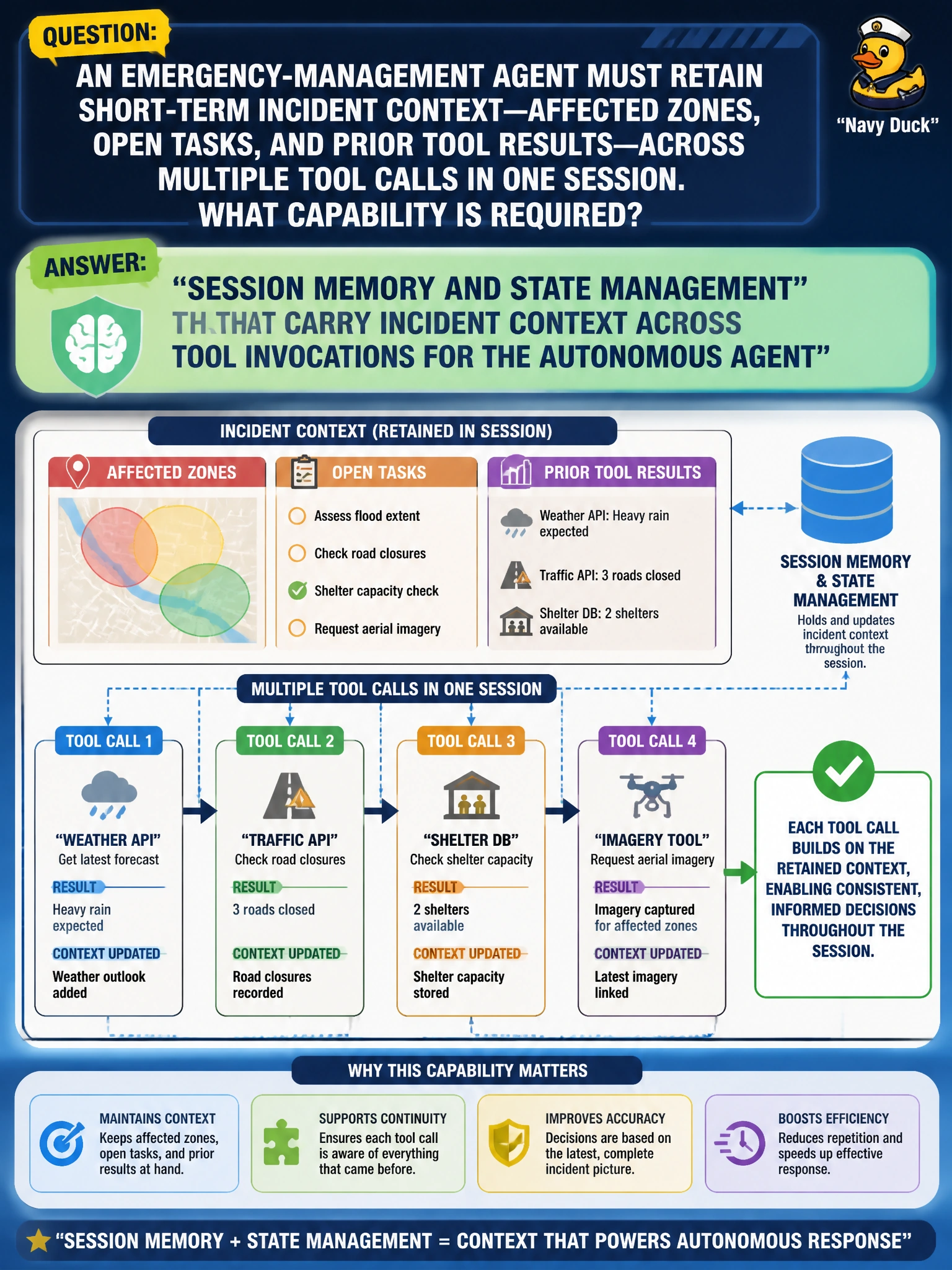
An EOC runner keeps a whiteboard of zones and open tasks between radio calls—the agent needs that whiteboard too. Short-term session memory carries incident context across tool calls. Forgetting every turn, or retraining the FM mid-incident, misses the point.
Full Explanation
Emergency-management agents that must retain affected zones, open tasks, and prior tool results across multiple tool calls in one session require session memory and state management that carry incident context across invocations. Without short-term state, each tool call is amnesiac and the agent cannot refine a coherent incident picture for EOC staff. Stateless single-shot completions that forget prior tool results every call break multi-step emergency workflows that depend on earlier lookups. Storing incident context only in public social media posts is insecure, non-authoritative, and inappropriate for operational state that may include sensitive location details. Retraining the foundation model between every tool call to memorize the incident is infeasible, costly, and confuses model weights with session memory. Exam caveat: multi-tool incident context across a session maps to agent memory and state management—not retraining or public posts. Operational check: maintain a session-scoped incident state object updated after each tool result, pass relevant slices into subsequent reasoning steps, expire sessions after the incident closes, encrypt sensitive fields, and audit what state influenced each guidance draft.