
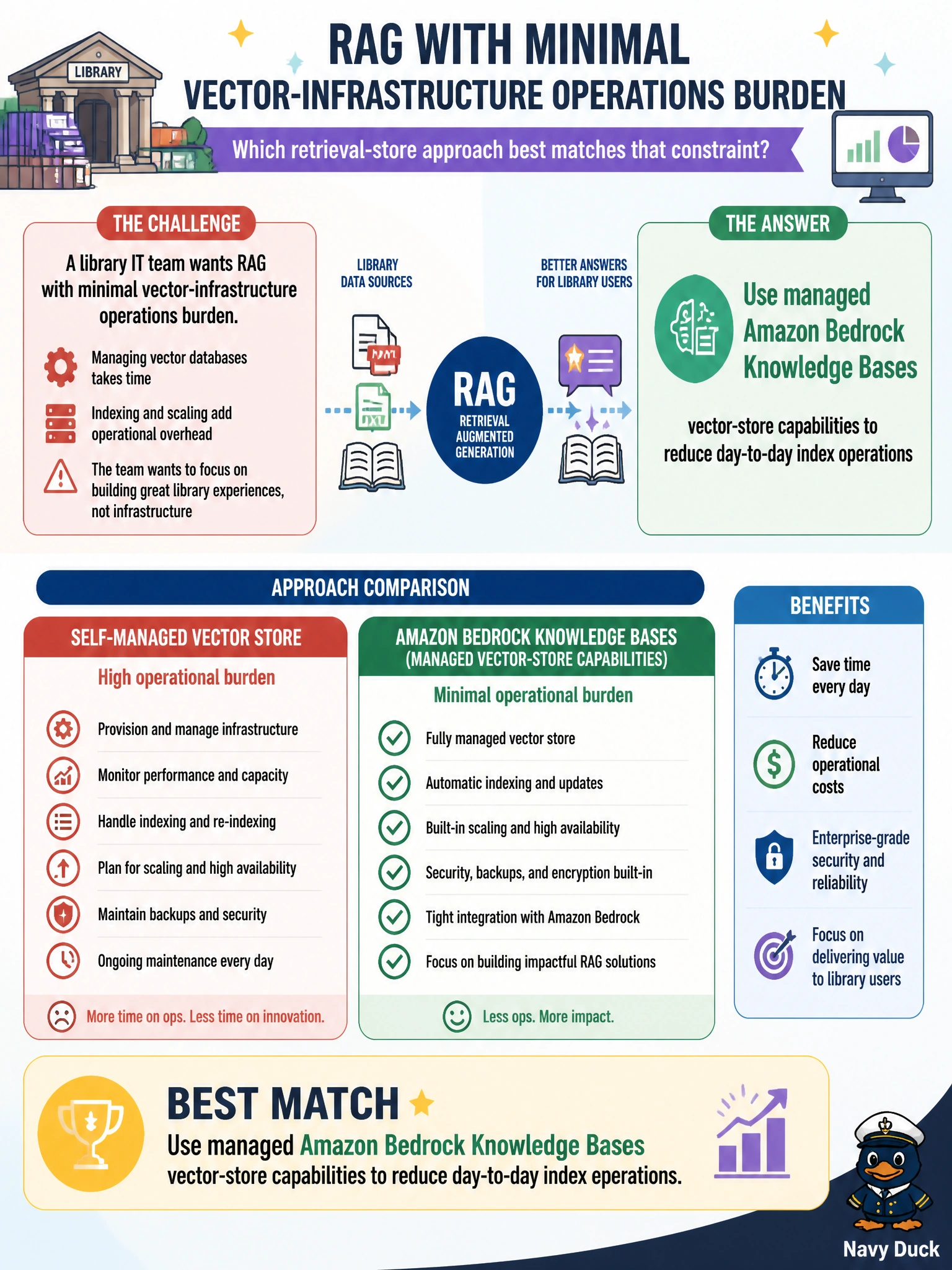
A library IT team wants RAG with minimal vector-infrastructure operations burden. Which retrieval-store approach best matches that constraint?
Select an answer to reveal the explanation.
Short Explanation
If the library crew isn’t a full-time search-platform shop, don’t gift them a pet OpenSearch zoo. Managed Bedrock Knowledge Bases handles a lot of the vector chores so staff can focus on the collection, not the cluster.
Full Explanation
A library IT team that wants RAG with minimal vector-infrastructure operations burden should prefer managed Amazon Bedrock Knowledge Bases vector-store capabilities. Managed ingestion and vector storage reduce day-to-day index clustering, patching, capacity planning, and search-platform paging that a small library staff cannot absorb, while still enabling GenAI retrieval over guides, HTML pages, and catalog-derived content. The constraint in the stem is ops burden—not maximizing every OpenSearch tuning knob.
Self-managing a complex multi-cluster OpenSearch deployment without library ops staffing fails the burden constraint and creates an unsupported platform. Building a custom GPU cluster solely to host embedding indexes for weekend hours adds infrastructure and on-call work the team explicitly cannot support. Avoiding any vector store and relying on printed card catalogs alone fails the GenAI RAG requirement and does not serve digital assistant workflows.
Exam caveat: Choose managed Knowledge Bases when the scenario emphasizes limited search-platform operations capacity; unmanaged search clusters are wrong under that constraint even if feature-rich.
Operational check: confirm Knowledge Bases sync covers the library corpus types in use, measure answer quality on catalog and guide questions, document residual ops tasks (permissions, monitoring, sync failures), set freshness alerts on the managed index, and define an escape hatch only if managed limits are actually hit—not as a default.