
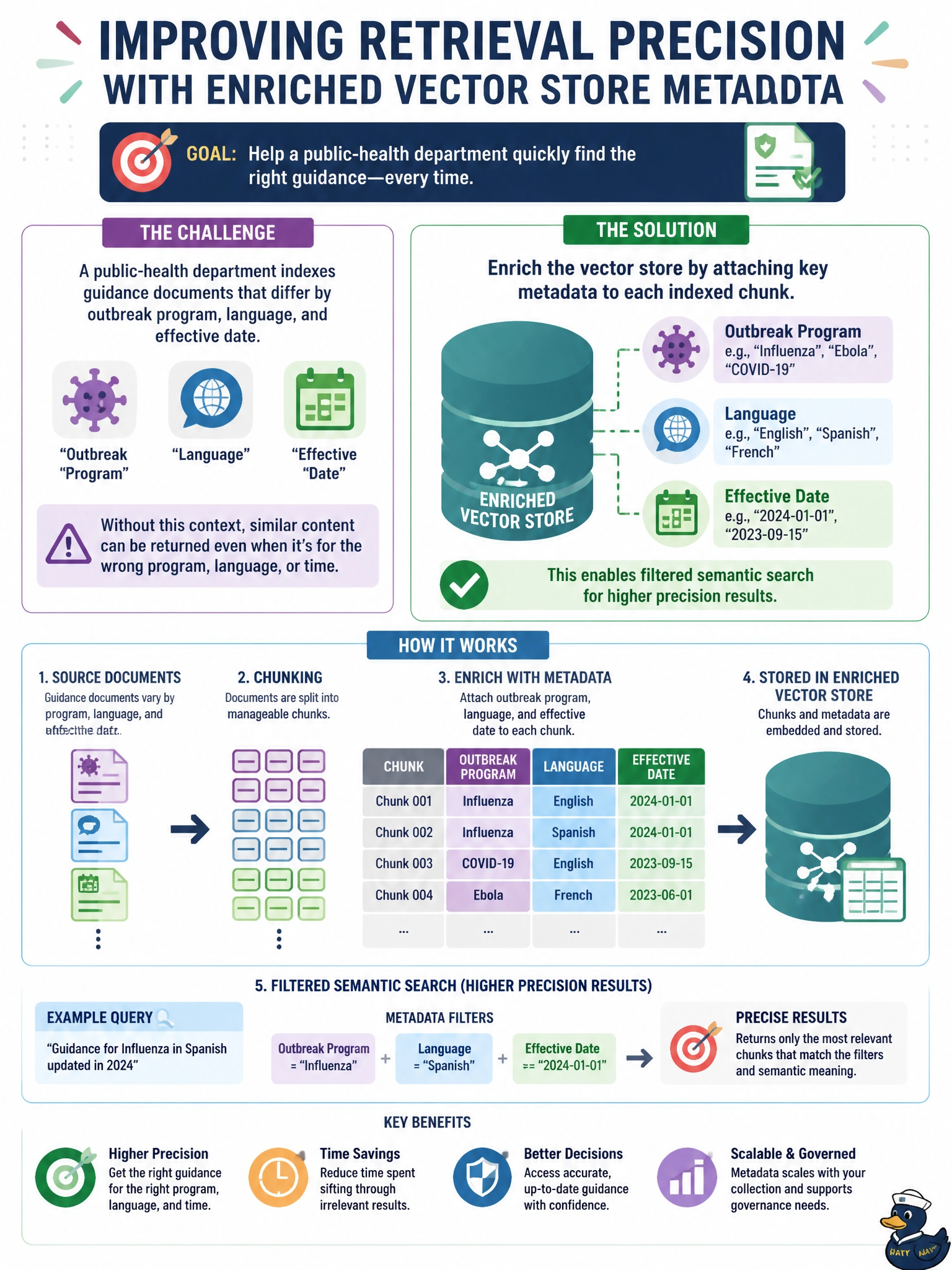
A public-health department indexes guidance documents that differ by outbreak program, language, and effective date. How should the vector store be enriched to improve retrieval precision?
Select an answer to reveal the explanation.
Short Explanation
Public-health guidance goes stale and changes by program and language — metadata is the expiration label on the jar. Tag chunks so search finds today’s measles flyer in Spanish, not last year’s English draft.
Full Explanation
Public-health guidance varies by outbreak program, language, and effective date. Retrieval precision improves when those attributes are attached as metadata on each indexed chunk and used for filtered semantic search. The vector store then can prefer today’s measles guidance in Spanish over last year’s English flu flyer even when embeddings are topically close. Enrichment with program, language, and effective-date metadata is the design that matches the department’s differentiation needs.
Removing dates and language tags so the FM invents the applicable version fails on safety and accountability—public health cannot accept invented currency. Embedding only English and translating resident questions after generation fails multilingual access at retrieval time and still lacks program/date filters. Merging all outbreak programs into one undated megadocument before embedding destroys the distinctions metadata and filters are meant to preserve.
Exam caveat: For regulated civic content, metadata filters are part of retrieval quality and safety, not optional cosmetics.
Operational check: enforce required metadata at ingest, test filtered queries per program/language/date, expire or demote superseded effective dates, and audit sample answers for correct guidance version before outbreak season peaks.