
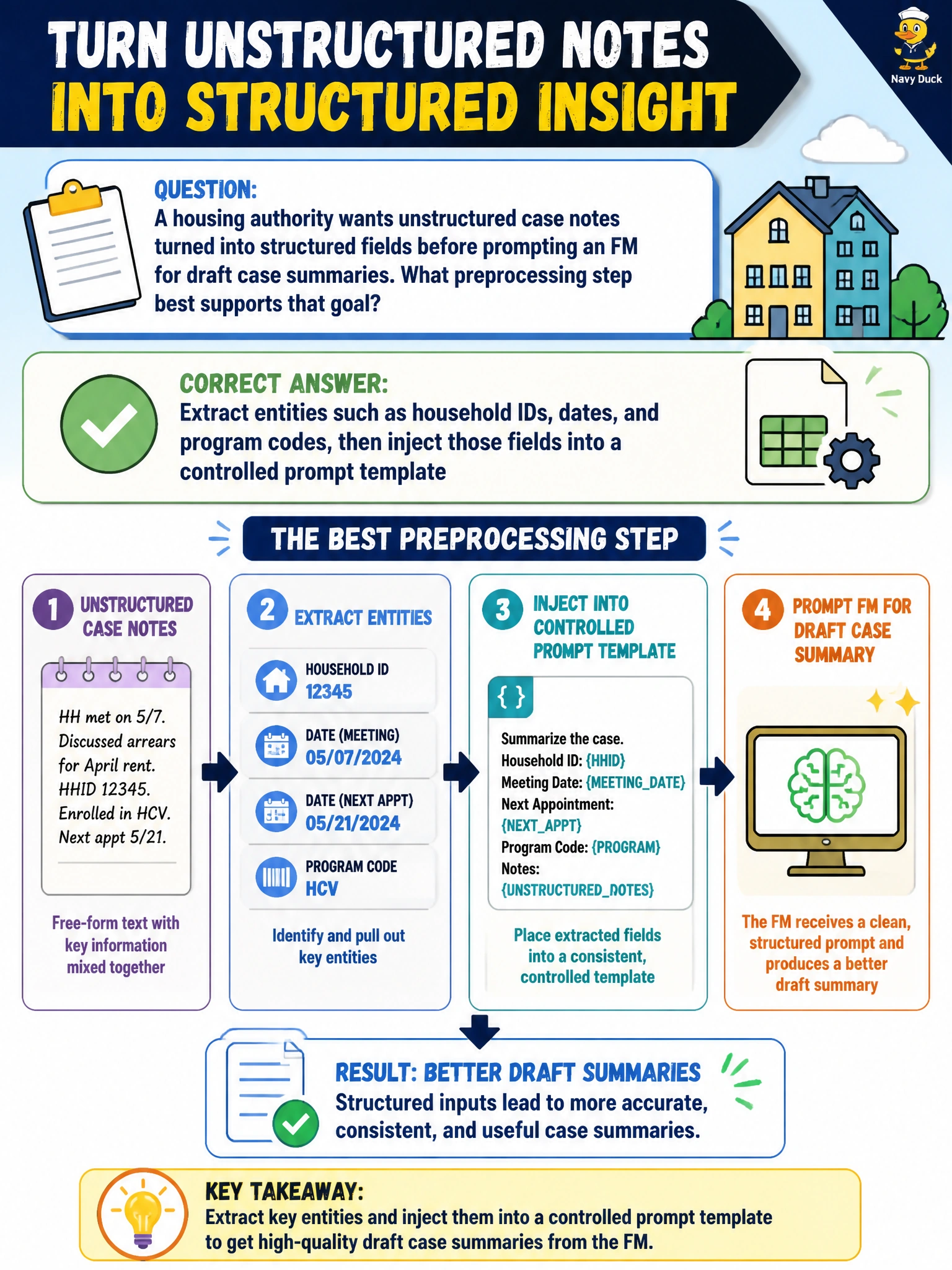
A housing authority wants unstructured case notes turned into structured fields before prompting an FM for draft case summaries. What preprocessing step best supports that goal?
Select an answer to reveal the explanation.
Short Explanation
Messy case notes are like a junk drawer — pull out the labeled bits first. Entity extraction gives the prompt clean slots for IDs, dates, and program codes so the FM summarizes facts instead of guessing.
Full Explanation
A housing authority that wants draft case summaries from unstructured notes should first turn free-form text into structured fields the prompt can reliably use. Entity extraction for household IDs, dates, program codes, and similar attributes, then injection into a controlled prompt template, gives the foundation model factual slots instead of forcing it to rediscover identifiers from messy narrative. That preprocessing improves consistency across caseworkers, supports downstream auditing, and keeps summarization grounded in extracted civic case attributes rather than invented detail.
Raising temperature to get more varied wording fails conceptually: temperature changes stylistic diversity, not the presence of structured fields, and often increases hallucinated IDs. Storing raw notes only as vector embeddings and skipping structured extraction also fails—embeddings aid semantic retrieval but do not by themselves produce typed fields for a controlled summary template. Replacing the FM with a classical regression model trained only on rent payment history fails because payment history cannot reconstruct narrative case notes or produce the multi-field summary the authority needs.
Exam caveat: GenAI preprocessing for civic casework is often extract-then-prompt, not “embed everything and hope” or “swap in a regressor.” Structured extraction is complementary to RAG, not optional fluff.
Operational check: measure extraction precision/recall on household IDs and program codes, reject prompts missing required slots, compare summary field accuracy before vs after templating, and spot-check that caseworker edits decline when structured fields are injected.