
A parks department app must fail soft to static FAQ content if the foundation-model endpoint times out. Which pattern should the team implement?
Select an answer to reveal the explanation.
Short Explanation
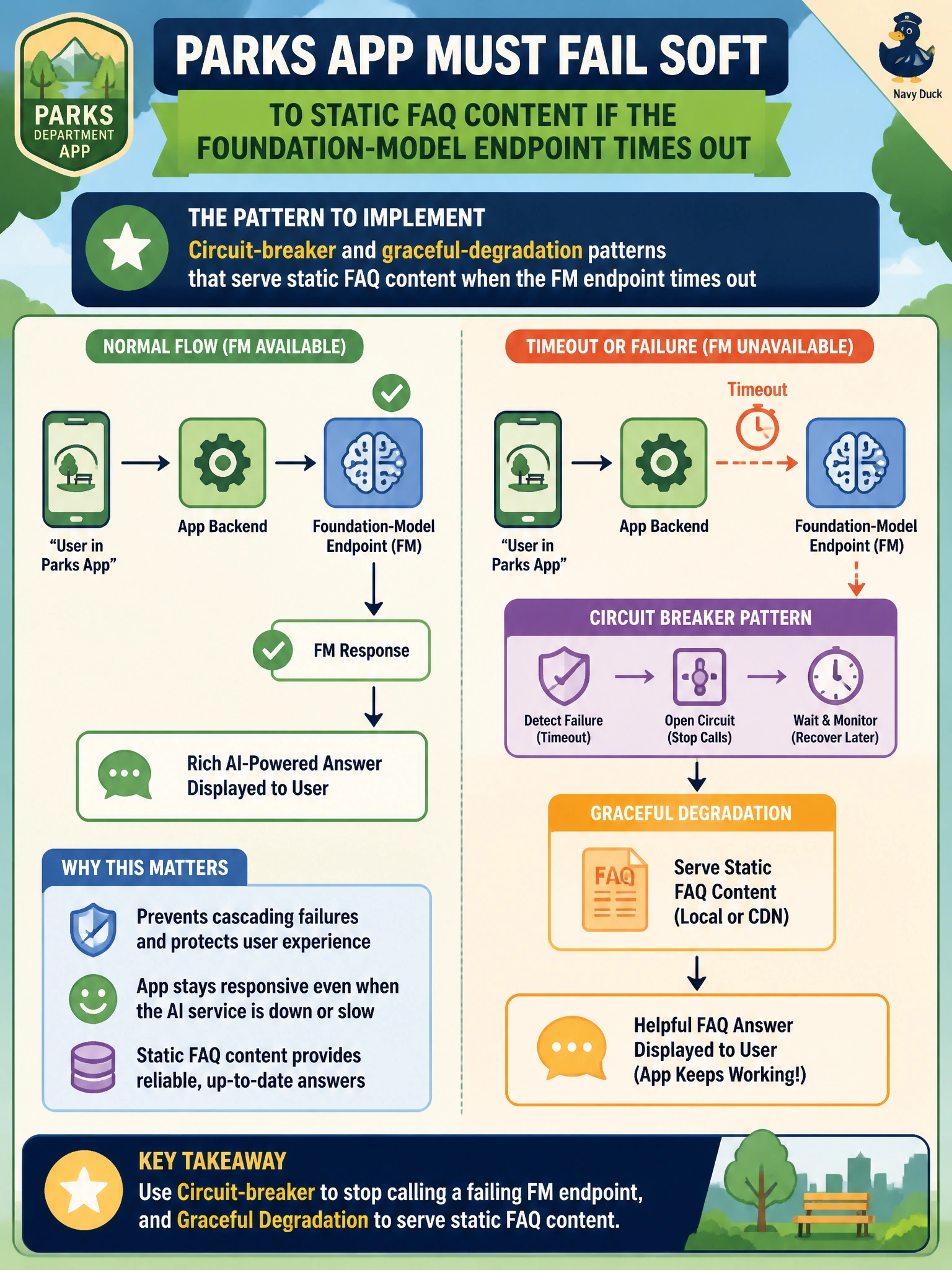
If the model hangs up, the parks app shouldn't hang with it. Trip a circuit breaker and fall back to the static FAQ so visitors still get something useful instead of a frozen kiosk or a scary stack trace.
Full Explanation
A parks department app that must fail soft to static FAQ content if the foundation-model endpoint times out should implement circuit-breaker and graceful-degradation patterns that serve that static FAQ when the FM path fails. Timeouts and consecutive errors open the breaker so the kiosk or web app stops waiting on a dead dependency and returns curated FAQ answers with a clear degraded-mode signal. Residents still get usable park information; the GenAI path resumes when health checks succeed.
Infinite retry loops with no timeout until the park kiosk freezes turn a backend outage into a client hang and destroy field usability. Showing a raw stack trace to residents whenever Bedrock is slow leaks internals and fails UX and security hygiene. Removing static FAQ content so the app can only answer through the foundation model eliminates the degradation target and makes FM availability a hard dependency for basic park questions.
Exam caveat: circuit breakers, timeouts, and fallback content are standard resilience patterns for FM-backed user experiences—especially public kiosks.
Operational check: set invoke timeouts, trip a breaker after N failures, verify static FAQ is returned without stack traces, and alert ops when degraded mode engages so the Bedrock path can be restored.