
A broadcast network's AI-generated highlight-reel captions have become increasingly inaccurate after ten months in production. Select TWO actions the steering committee should prioritize. (Select TWO.)
Select all correct answers, then click Submit.
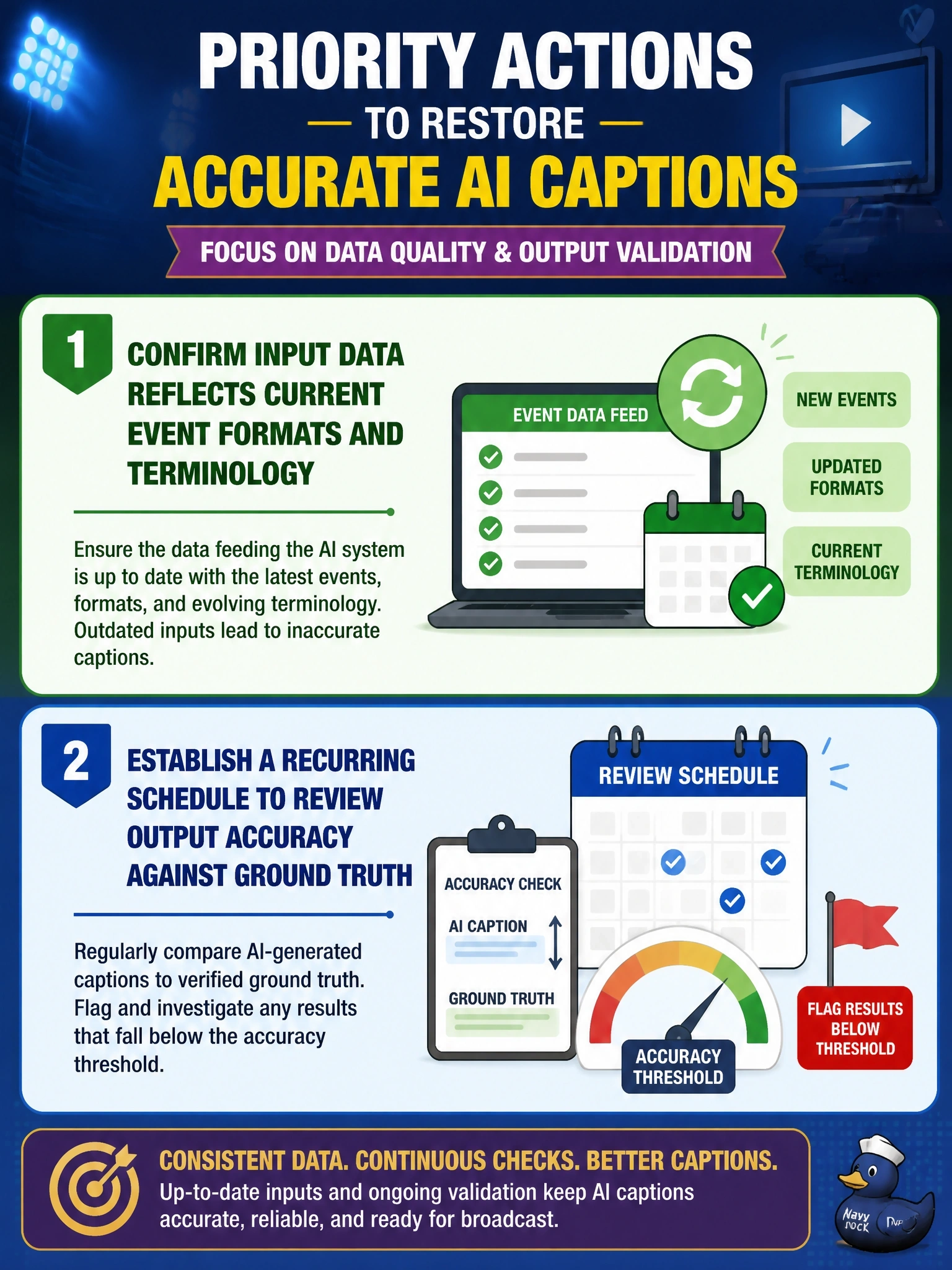
Short Explanation
Accuracy that quietly slides over ten months usually means the world moved and the data feeding the system didn't keep up. Check whether the input data's gone stale, and set up a recurring review so you catch the next drift before it's a ten-month problem again.
Full Explanation
Establishing a recurring accuracy-review schedule and checking whether input data still reflects current formats both directly address the reliability decline: recurring accuracy checks against real outcomes would have caught the drop earlier, and checking the input data targets a likely root cause of degraded accuracy over time. Concealing that captions are AI-generated addresses public perception of the tool rather than fixing the accuracy problem, and it does nothing to make the captions more accurate. Increasing caption volume increases output without addressing why accuracy has declined, and simply producing more inaccurate captions does not diagnose or fix the issue. Waiting for viewer complaints is a reactive, wait-and-see approach that lets the problem continue affecting viewers until someone complains, which is the opposite of proactive reliability management. The general principle: declining reliability over time calls for both structured, recurring accuracy monitoring and a check on whether the data feeding the system still matches current real-world conditions.