
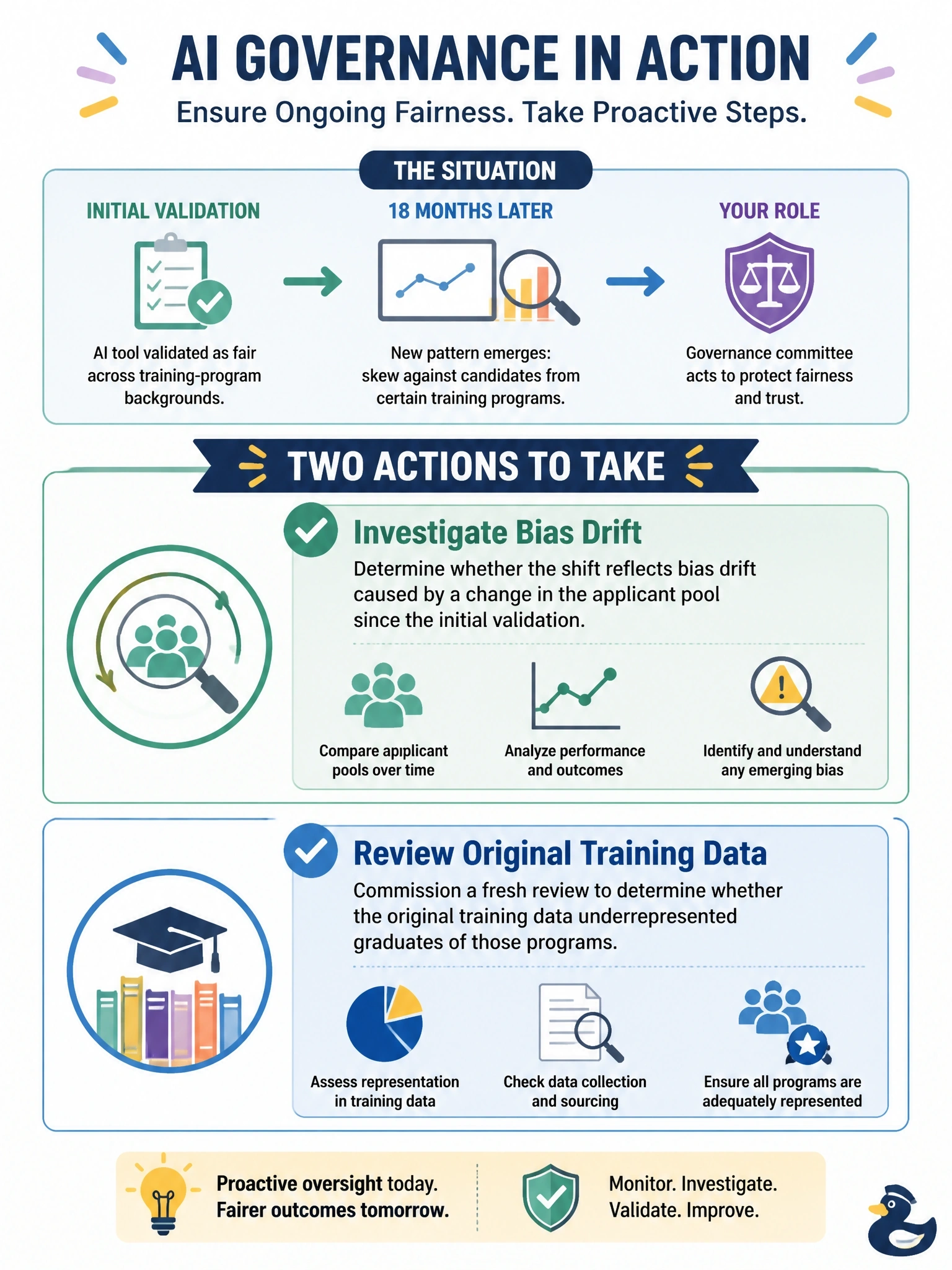
An auto manufacturer's AI tool screens technician applicants and initially validated as fair across training-program backgrounds. Eighteen months later, it shows a pattern skewing against candidates from certain training programs. Select TWO actions the governance committee should take. (Select TWO.)
Select all correct answers, then click Submit.
Short Explanation
A skew that shows up 18 months in could come from two very different places: something changed in who's applying, or something was already off in the original training data and just took time to surface. You have to check both, because the fix for each one is completely different.
Full Explanation
Investigating whether the shift reflects bias drift caused by a change in the applicant pool since initial validation, and commissioning a fresh review of whether the original training data underrepresented graduates of the affected programs, together cover the two genuinely distinct root causes behind a fairness pattern that appears after a tool was already validated as fair. Discontinuing collection of demographic and program-background data entirely would remove the very information needed to detect and measure bias going forward, making the problem invisible rather than solving it. Increasing the number of applicants processed per day adds volume, but more throughput does nothing to diagnose why the pattern is skewed, and it risks scaling the existing problem faster rather than fixing it. Instructing the vendor to retrain the model overnight without further review hands a governance decision to a third party and skips the investigation entirely, risking a retrained model that doesn't actually address whatever caused the skew in the first place. The operational check: because bias drift can originate either in a changing applicant population or in an under-examined original dataset, a thorough response investigates both stages before touching the model, rather than assuming one explanation or outsourcing the fix.