
An insurance company's governance team is applying a tiered risk classification framework across its AI portfolio. Select the TWO factors that should genuinely raise an AI use case's risk classification. (Select TWO.)
Select all correct answers, then click Submit.
Short Explanation
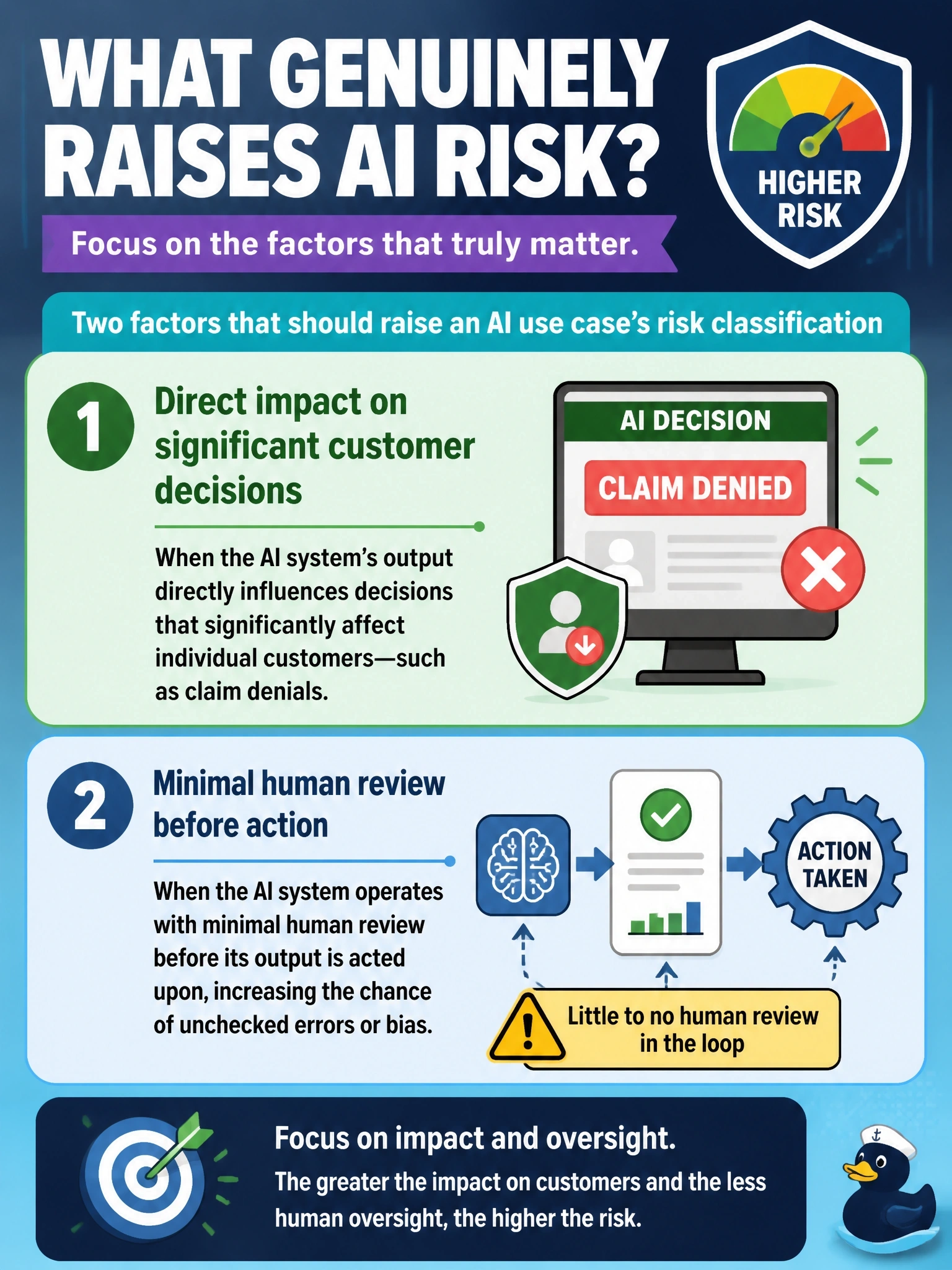
What actually raises your risk rating isn't how new or polished a system looks — it's how much its decisions can hurt an individual customer, like a claim denial, and how little chance a human gets to catch a mistake before it's acted on. Those two risk dials are the ones worth watching; budget size and interface design aren't.
Full Explanation
A system whose output significantly affects individual customers, such as claim denials, and a system with minimal human review before its output is acted on both genuinely increase risk — one reflects the severity of potential harm, the other reflects how little opportunity there is to catch an error before it causes that harm. How recently a system was developed says nothing about its actual risk; a newer system isn't inherently riskier or safer than an older one. A visually appealing user interface is a design quality unrelated to the consequences of the system's decisions. Department budget size reflects funding, not the stakes of what the AI system decides. The general principle: genuine risk drivers relate to the severity of potential harm and the degree of human oversight before action is taken — not to a system's age, appearance, or the size of the budget behind it.