
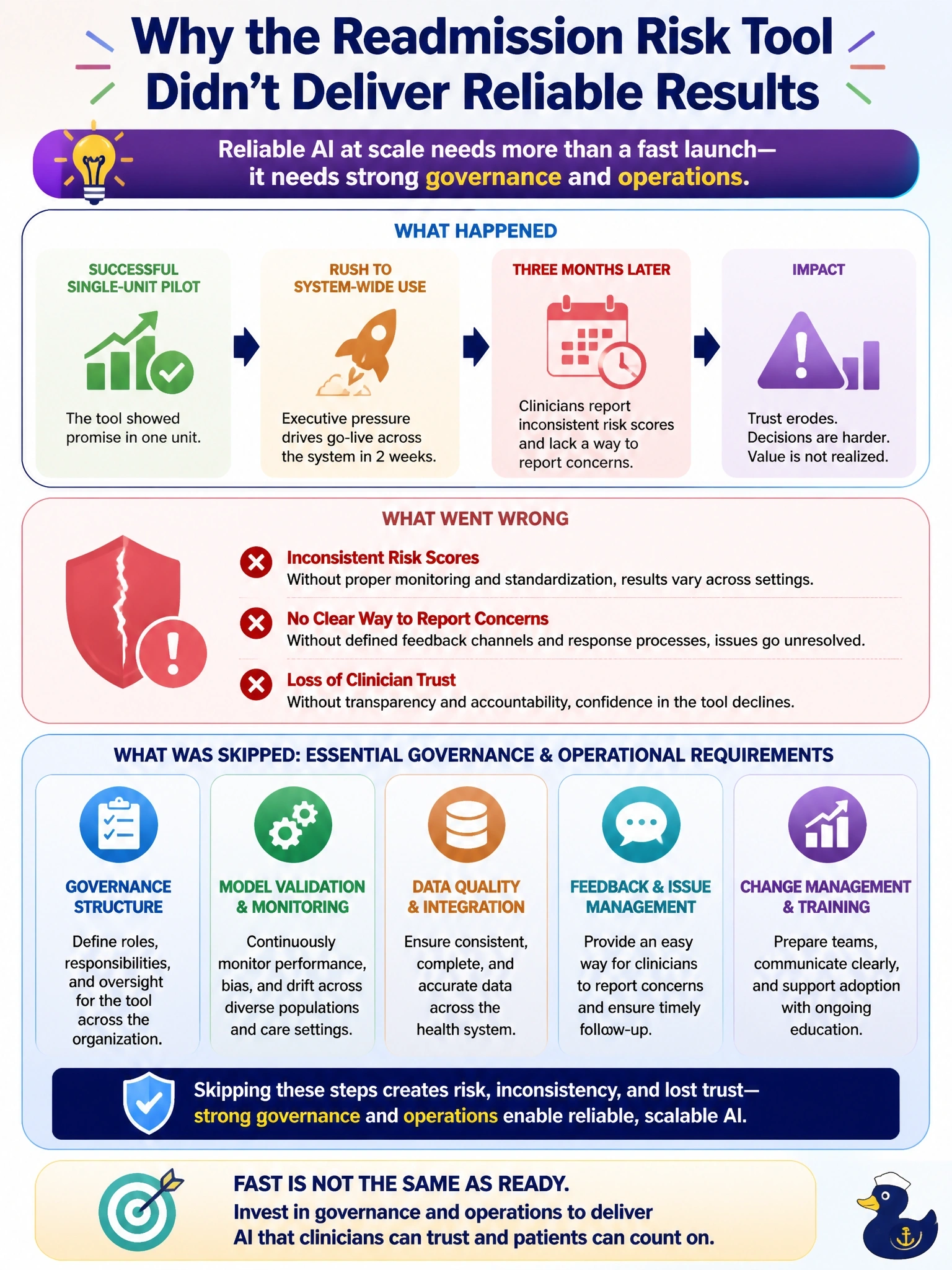
A regional health system's AI-based patient-readmission risk tool moved from a successful single-unit pilot directly to system-wide production use within two weeks, driven by executive pressure to show fast results. Three months later, clinicians report inconsistent risk scores and no clear process for reporting concerns. What most likely explains this outcome?
Select an answer to reveal the explanation.
Short Explanation
Two weeks from one unit to the whole health system, with nothing built in between, is a shortcut that always catches up with you. The governance and operational scaffolding — escalation paths, defined ownership — is exactly what a fast jump like that skips. That's why clinicians are seeing inconsistent scores with nowhere to report it, not because the model itself is broken.
Full Explanation
A two-week jump from a single-unit pilot to system-wide production, with no mention of any governance work happening in between, directly explains both symptoms reported three months later: inconsistent scores and no clear process for raising concerns are exactly what shows up when the operational and governance requirements of a production-grade transition get skipped under time pressure. Claiming the AI model is fundamentally incapable of supporting more than one clinical unit is unsupported and contradicted by the scenario itself, since the tool already succeeded in its original unit — the problem described is about how the transition was handled, not an inherent model limitation. Pointing to an understated cost-savings estimate in the original business case is unrelated to the reported problems entirely; a savings figure has no bearing on inconsistent risk scores or a missing escalation process. Blaming inadequate clinician training on how AI models are built using historical data addresses a general literacy gap that doesn't match the specific symptoms described — understanding model training wouldn't create an escalation process or resolve score inconsistency, both of which are governance and operational gaps, not knowledge gaps. The operating principle: skipping governance and operational buildout during a fast, pressured transition to production is a common and identifiable cause of exactly this kind of downstream instability. Operational check: before scaling system-wide, has a defined escalation process and governance structure been put in place, independent of how fast leadership wants results?