
A hospital's AI symptom-triage assistant performed well as an informal pilot run by a small clinical team. As it moves toward production-grade deployment, what is the most important addition compared to the pilot?
Select an answer to reveal the explanation.
Short Explanation
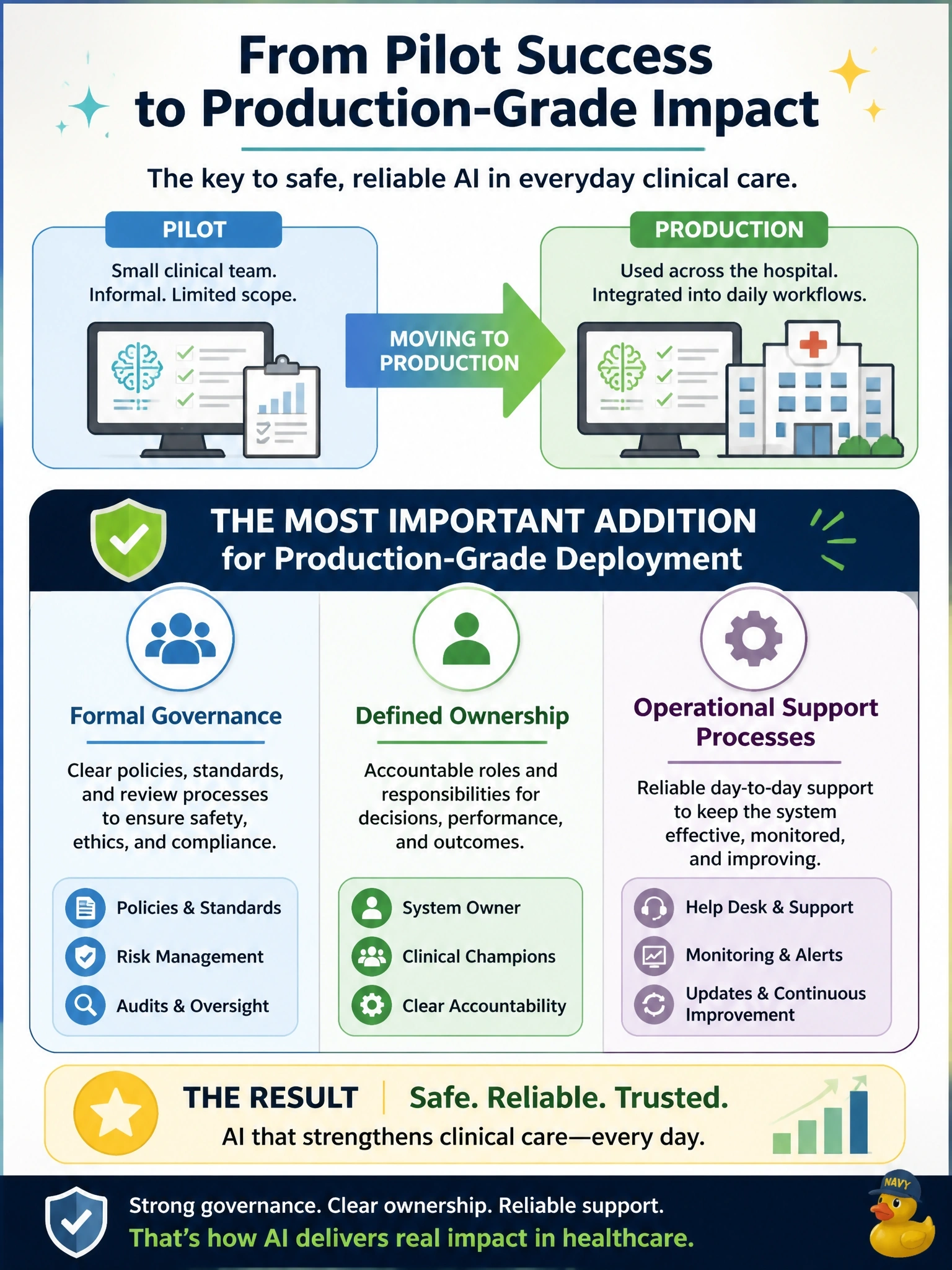
An informal pilot can run on one team's goodwill; a system you're using across the whole hospital every day can't. Moving to production means adding real governance — a named owner, defined support processes — not just telling more staff it exists, and that structure is what lets the tool survive contact with your actual clinical volume.
Full Explanation
Moving from an informal pilot to production-grade use means the tool becomes a regular part of clinical workflows, which requires formal governance, a defined owner, and operational support processes that an informal pilot simply didn't need. A larger marketing campaign announcing the tool to all hospital staff addresses visibility, not readiness; broadcasting the tool more widely doesn't establish the governance and support structures needed to run it reliably at production scale. Requiring the original pilot team to personally review every patient interaction going forward doesn't scale — a small team's personal review was feasible during a limited pilot but becomes unworkable at production volume, and it isn't a substitute for real operational processes with defined ownership. Removing the clinical team's involvement entirely now that the tool is proven strips out exactly the oversight a regulated healthcare setting needs, especially as the tool reaches more patients and more variation in cases than the pilot ever saw. The operating principle: the experimental-to-production transition is defined by adding governance and operational infrastructure, not by expanding awareness, freezing review responsibility with the original small team, or reducing human oversight. Operational check: is there a named, accountable owner for this tool's operation, distinct from the original pilot team?